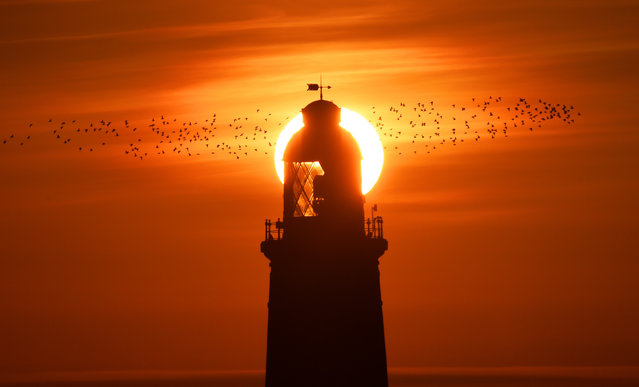
The sun rises over St Mary's Lighthouse in Whitley Bay on the Northumberland coast as a flock of Lapwing seabirds fly past on Wednesday, September 30, 2015. (Photo by Owen Humphreys/PA Wire)
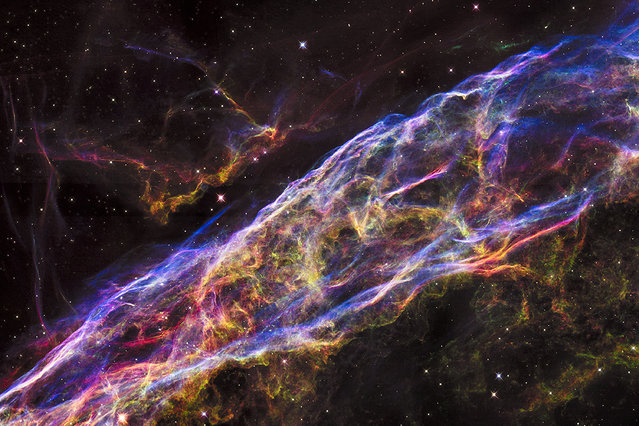
A small section of the expanding remains of the Veil Nebula, a massive star that exploded about 8,000 years ago. The entire nebula is 110 light-years across, covering six full moons on the sky as seen from Earth, and resides about 2,100 light-years away in the constellation Cygnus, the Swan. Image taken by NASA's Hubble Space Telescope. Released September 24, 2015. (Photo by Reuters/NASA/ESA/Hubble Heritage Team)
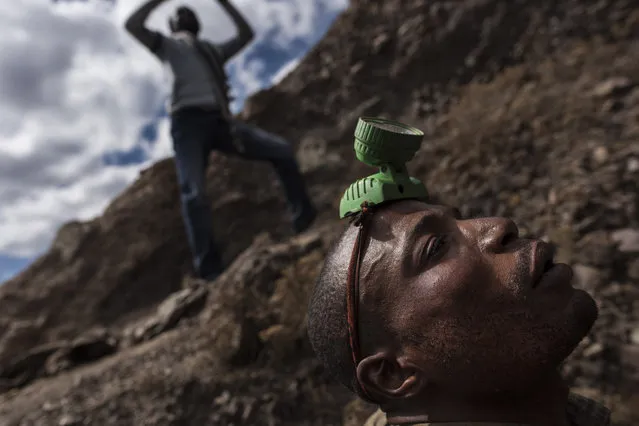
A “creuseur”, or digger, a plastic lantern on his head, readies to enter a copper and cobalt mine in Kawama, Democratic Republic of Congo on June 8, 2016. Cobalt is used in the batteries for electric cars and mobile phones. Working conditions are dangerous, often with no safety equipment or structural support for the tunnels. The diggers say they are paid on average US$2-3/day. (Photo by Michael Robinson Chavez/The Washington Post)
Zoo keepers feed crocodiles in their enclosure at the Madras Crocodile Bank, closed due to the outbreak of coronavirus disease (COVID-19), in Mahabalipuram, India, August 3, 2020. (Photo by P. Ravikumar/Reuters)
Jordan Spence and Dawson Stallworth watch waves come ashore as Hurricane Sally approaches in Orange Beach, Alabama, U.S., September 15, 2020. (Photo by Jonathan Bachman/Reuters)
Activists from the climate action group Ocean Rebellion perform a stunt outside the Science Museum, in London, United Kingdom on May 19, 2021. (Photo by Hannah McKay/Reuters)
People wearing face masks to protect against the spread of the coronavirus walk on a crossing in Tokyo Tuesday, August 17, 2021. Japan’s coronavirus state of emergency will continue through Sept. 12 rather than finishing at the end of this month as initially planned, the government decided Monday. (Photo by Koji Sasahara/AP Photo)
Staff members work on sorting and assembling the skeleton of a fossilized Triceratops dinosaur, in Paris, France, 31 August 2021. The skeleton of a Triceratops, an over 66 million years old dinosaur, knicknamed “Big John”, will be auctioned at the Drouot Auction House on 21 October 2021 and is estimated to fetch a total of 1.5 million euros. (Photo by Christophe Petit Tesson/EPA/EFE)