Loading...
Done
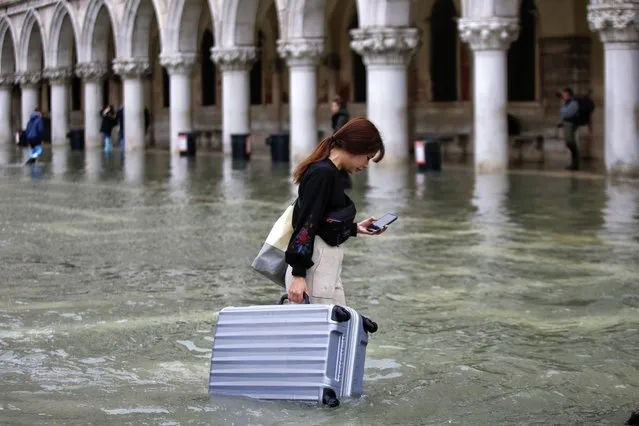
A tourist carries her luggage in a flooded St. Mark's Square, in Venice, Wednesday, November 13, 2019. The high-water mark hit 187 centimeters (74 inches) late Tuesday, Nov. 12, 2019, meaning more than 85% of the city was flooded. The highest level ever recorded was 194 centimeters (76 inches) during infamous flooding in 1966. (Photo by Luca Bruno/AP Photo)

A tourist carries her luggage in a flooded St. Mark's Square, in Venice, Wednesday, November 13, 2019. The high-water mark hit 187 centimeters (74 inches) late Tuesday, Nov. 12, 2019, meaning more than 85% of the city was flooded. The highest level ever recorded was 194 centimeters (76 inches) during infamous flooding in 1966. (Photo by Luca Bruno/AP Photo)
Details
05 Feb 2020 00:01:00
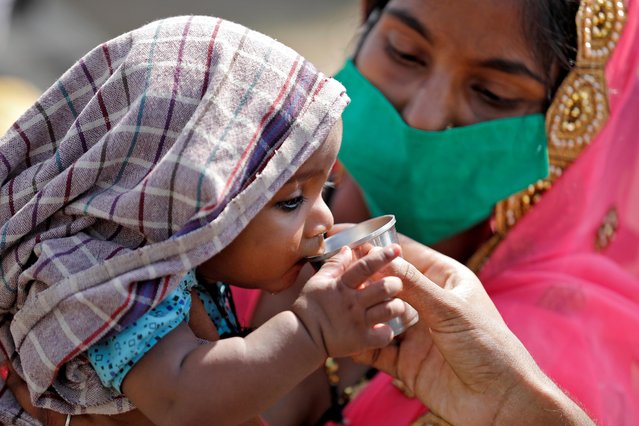
A child of a migrant worker drinks water as his mother holds him while waiting in a queue for transport to reach to a railway station to board a train to their home state of northern Uttar Pradesh, after a limited reopening of India's giant rail network following a nearly seven-week lockdown to slow the spreading of the coronavirus disease (COVID-19), in Ahmedabad, India, May 15, 2020. (Photo by Amit Dave/Reuters)

A child of a migrant worker drinks water as his mother holds him while waiting in a queue for transport to reach to a railway station to board a train to their home state of northern Uttar Pradesh, after a limited reopening of India's giant rail network following a nearly seven-week lockdown to slow the spreading of the coronavirus disease (COVID-19), in Ahmedabad, India, May 15, 2020. (Photo by Amit Dave/Reuters)
Details
23 May 2020 00:01:00
A 10-year-old boy living on the streets of New Delhi lies down on cascading water of a fountain in the gardens of the India Gate monument on May 20, 2016. The Indian Meteorological Department issued warnings of “severe heat wave” conditions across large parts of India's north and west, including the capital Delhi, where temperatures hit 47 degrees Celsius. (Photo by Roberto Schmidt/AFP Photo)

A 10-year-old boy living on the streets of New Delhi lies down on cascading water of a fountain in the gardens of the India Gate monument on May 20, 2016. The Indian Meteorological Department issued warnings of “severe heat wave” conditions across large parts of India's north and west, including the capital Delhi, where temperatures hit 47 degrees Celsius. (Photo by Roberto Schmidt/AFP Photo)
Details
28 May 2016 12:06:00
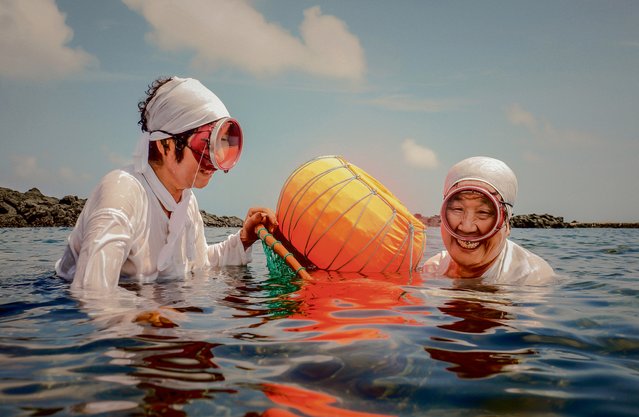
Ja Kang Song, 71, and Ja Hyun Su, 72, dive for shellfish and are the main breadwinners for their families. In South Korea, 45% of the diving women of Jeju are over the age of 70. Routinely diving to depths of 20m and staying under for an average of two to three minutes, the pressure on the body takes its toll and, like many others, burst eardrums have left Ja Hyun Su deaf. Each season, between seven and 10 women die diving the waters around Jeju Island. (Photo by Andy W. Langton/Age International)

Ja Kang Song, 71, and Ja Hyun Su, 72, dive for shellfish and are the main breadwinners for their families. In South Korea, 45% of the diving women of Jeju are over the age of 70. Routinely diving to depths of 20m and staying under for an average of two to three minutes, the pressure on the body takes its toll and, like many others, burst eardrums have left Ja Hyun Su deaf. Each season, between seven and 10 women die diving the waters around Jeju Island. (Photo by Andy W. Langton/Age International)
Details
12 Sep 2016 10:35:00
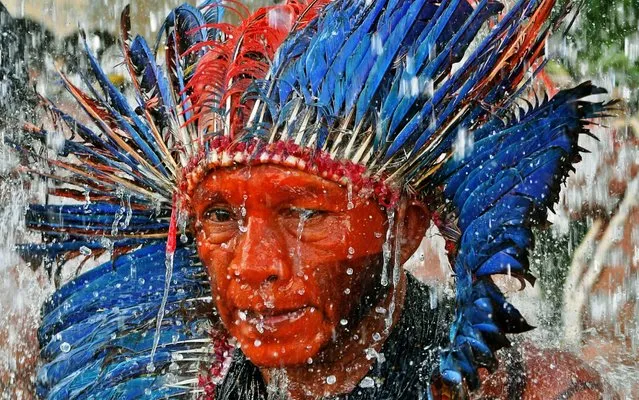
An Indigenous man stands under a water fountain outside a government building in Brasilia, on April 26, 2019, during the last day of a protest camp. Approximately 4,000 indigenous people from different tribes are taking part in protests during the Indigenous National Mobilization (MNI) week, a mobilization which seeks to tackle territorial rights' negotiations with the government. (Photo by Carl De Souza/AFP Photo)

An Indigenous man stands under a water fountain outside a government building in Brasilia, on April 26, 2019, during the last day of a protest camp. Approximately 4,000 indigenous people from different tribes are taking part in protests during the Indigenous National Mobilization (MNI) week, a mobilization which seeks to tackle territorial rights' negotiations with the government. (Photo by Carl De Souza/AFP Photo)
Details
29 Apr 2019 00:07:00
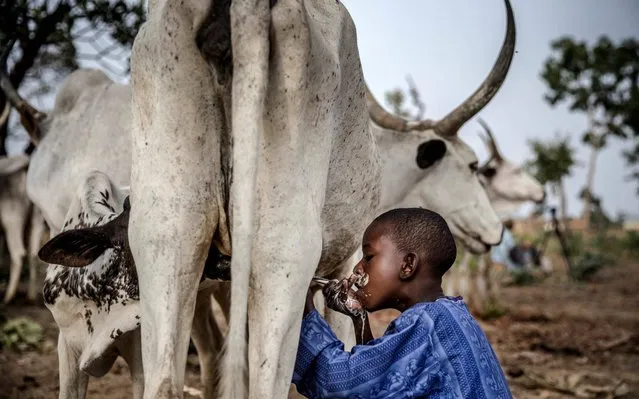
8-year-old Fulani boy Suleiman Yusuf drinks milk from a cow belonging to his father cattle near his family's house at Kachia Grazing Reserve, Kaduna State, Nigeria, on April 16, 2019. Kachia Grazing Reserve is an area set aside for the use of Fulani pastoralist and it is intended to be the foci of livestock development. The purpose for the grazing reserves is the settlement of nomadic pastoralists and inducement to sedentarisation through the provision of land for grazing and permanent water as way to avoid conflict. (Photo by Luis Tato/AFP Photo)

8-year-old Fulani boy Suleiman Yusuf drinks milk from a cow belonging to his father cattle near his family's house at Kachia Grazing Reserve, Kaduna State, Nigeria, on April 16, 2019. Kachia Grazing Reserve is an area set aside for the use of Fulani pastoralist and it is intended to be the foci of livestock development. The purpose for the grazing reserves is the settlement of nomadic pastoralists and inducement to sedentarisation through the provision of land for grazing and permanent water as way to avoid conflict. (Photo by Luis Tato/AFP Photo)
Details
10 Jul 2019 00:01:00
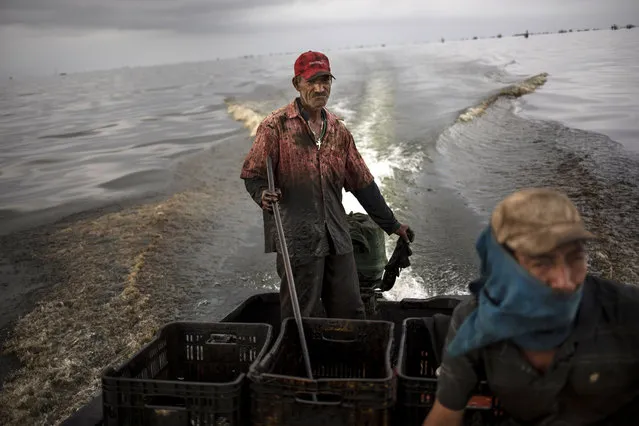
Fisherman Jose Miguel Perez, whose nickname is “Taliban”, navigates the oil infested waters of Lake Maracaibo, near Cabimas, Venezuela, May 21, 2019. Nobody lives as closely with the environmental fallout of Venezuela's collapsing oil industry as the fishermen who scratch out an existence on the blackened, sticky shores of Lake Maracaibo. (Photo by Rodrigo Abd/AP Photo)

Fisherman Jose Miguel Perez, whose nickname is “Taliban”, navigates the oil infested waters of Lake Maracaibo, near Cabimas, Venezuela, May 21, 2019. Nobody lives as closely with the environmental fallout of Venezuela's collapsing oil industry as the fishermen who scratch out an existence on the blackened, sticky shores of Lake Maracaibo. (Photo by Rodrigo Abd/AP Photo)
Details
26 Nov 2019 00:03:00
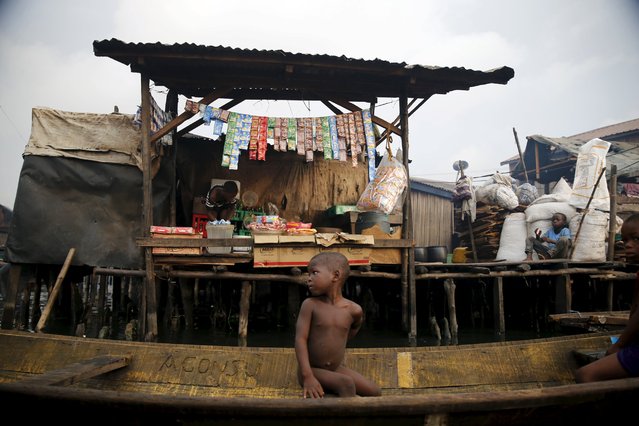
A boy sits in a canoe in front of a shed built on a raft in the Makoko fishing community on the Lagos Lagoon, Nigeria February 29, 2016. Makoko, a vast slum of houses on stilts in a Lagos lagoon, now boasts a new school – pyramid-shaped, floating and capable of withstanding the waterways' extreme weather, it is a beacon of hope for the nearly 100,000 Nigerians who live there.  (Photo by Akintunde Akinleye/Reuters)

A boy sits in a canoe in front of a shed built on a raft in the Makoko fishing community on the Lagos Lagoon, Nigeria February 29, 2016. In Makoko, a sprawling slum of Nigeria's megacity Lagos, a floating school capable of holding up to a hundred pupils has since November brought free education to the waterways known as the Venice of Lagos. It offers the chance of social mobility for youngsters who, like most of the city's 21 million inhabitants, lack a reliable electricity and water supply and whose water-based way of life is threatened by climate change as well as rapid urbanisation. (Photo by Akintunde Akinleye/Reuters)
Details
05 Mar 2016 12:01:00