Loading...
Done
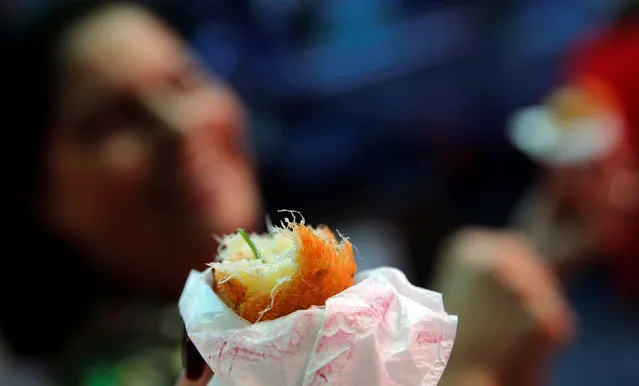
A view of traditional bolinhos de bacalhau (fried codfish balls) in Rio de Janeiro, Brazil, May 7, 2016. (Photo by Sergio Moraes/Reuters)

If the most popular foods of Rio de Janeiro have one thing in common, it is their informality. You can find fine restaurants in the city, but they do not set Rio apart from other places. What does set it apart, and what invariably brings its residents, known as "Cariocas," together is the unpretentious food they eat in bright, loud, crowded bars and restaurants, on busy street corners, or after a day at the beach. Here: A view of traditional bolinhos de bacalhau (fried codfish balls) in Rio de Janeiro, Brazil, May 7, 2016. (Photo by Sergio Moraes/Reuters)
Details
05 Aug 2016 13:20:00
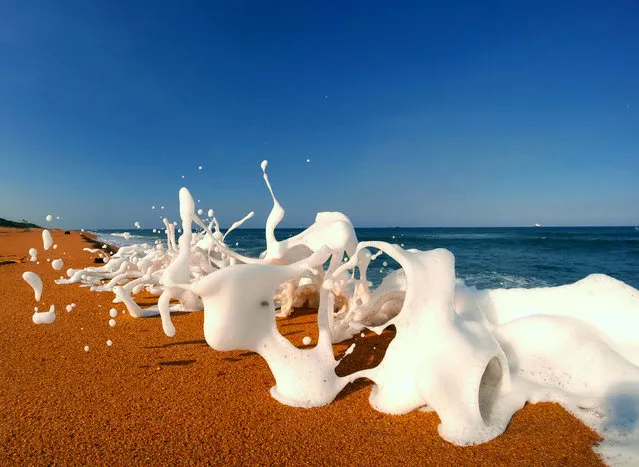
Foam party: Marck captured this moment in time from the shore on July, 30, 2015, in Durban, South Africa. (Photo by Marck Botha/Barcroft Media)

Beautiful seascapes capture the “raw power” of waves rising and crashing in the Indian Ocean. The stunning photos were taken off the coast of Durban in South Africa, and show formations from above and below the surface. Surfer and photographer Marck Botha took the images between April and July, and has always had a passion for the ocean. Here: Marck captured this moment in time from the shore on July, 30, 2015, in Durban, South Africa. (Photo by Marck Botha/Barcroft Media)
Details
30 Jan 2016 13:46:00
An Orthodox priest conducts a blessing in front of the Soyuz TMA-20M for the next International Space Station (ISS) crew, comprised of Jeff Williams of the U.S. and Oleg Skriprochka and Alexey Ovchinin of Russia, at the launchpad at the Baikonur cosmodrome, Kazakhstan, March 17, 2016, ahead of its launch scheduled on March 19. (Photo by Shamil Zhumatov/Reuters)

An Orthodox priest conducts a blessing in front of the Soyuz TMA-20M for the next International Space Station (ISS) crew, comprised of Jeff Williams of the U.S. and Oleg Skriprochka and Alexey Ovchinin of Russia, at the launchpad at the Baikonur cosmodrome, Kazakhstan, March 17, 2016, ahead of its launch scheduled on March 19. (Photo by Shamil Zhumatov/Reuters)
Details
18 Mar 2016 12:13:00
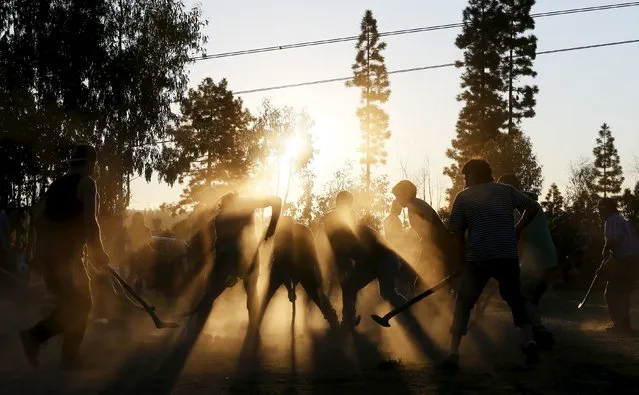
People play "Palin", a traditional ritual and ancestral Mapuche game played with curved sticks called "Chuecas" and a wooden ball, during a meet on Dia de la Raza (Day of the Races), also known as Columbus Day in Vina del Mar, Chile October 11, 2015. (Photo by Rodrigo Garrido/Reuters)

People play "Palin", a traditional ritual and ancestral Mapuche game played with curved sticks called "Chuecas" and a wooden ball, during a meet on Dia de la Raza (Day of the Races), also known as Columbus Day in Vina del Mar, Chile October 11, 2015. (Photo by Rodrigo Garrido/Reuters)
Details
15 Oct 2015 08:01:00
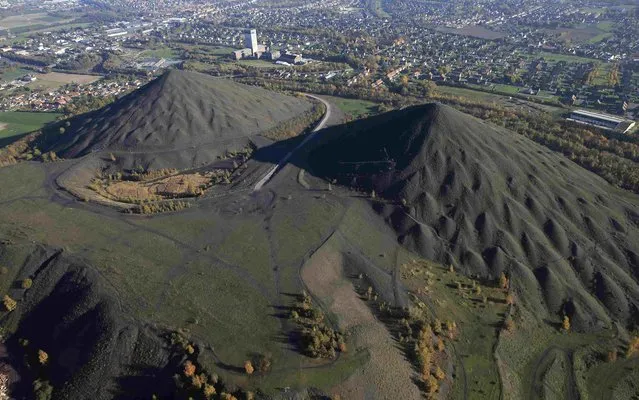
An aerial view shows the 11/19 pit and twin slag heaps at the former coal mine site in Loos-en-Gohelle, northern France, November 1, 2015. Loos-en-Gohelle, a town of 7000 inhabitants in the North of France, marked by the closure of coal mines in 1970, has demonstrated a successful transition from coal to a green economy. (Photo by Pascal Rossignol/Reuters)

An aerial view shows the 11/19 pit and twin slag heaps at the former coal mine site in Loos-en-Gohelle, northern France, November 1, 2015. Loos-en-Gohelle, a town of 7000 inhabitants in the North of France, marked by the closure of coal mines in 1970, has demonstrated a successful transition from coal to a green economy. (Photo by Pascal Rossignol/Reuters)
Details
07 Nov 2015 08:01:00
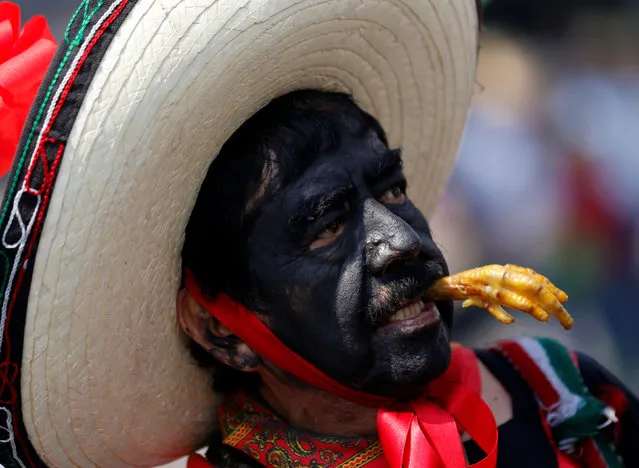
A Mexican wearing a period costume re-enacts the battle of Puebla, in the Penon de los Banos neighbourhood of Mexico City, Mexico May 5, 2016. (Photo by Henry Romero/Reuters)

A Mexican wearing a period costume re-enacts the battle of Puebla, in the Penon de los Banos neighbourhood of Mexico City, Mexico May 5, 2016. The battle marked the defeat of French forces by Mexican troops and local Indians in the central state of Puebla in 1862. During the re-enactment, participants fired homemade shotguns loaded with gunpowder and hundreds of men dressed as Indian peasants fought mock battles against others dressed as French invaders. (Photo by Henry Romero/Reuters)
Details
07 May 2016 12:38:00
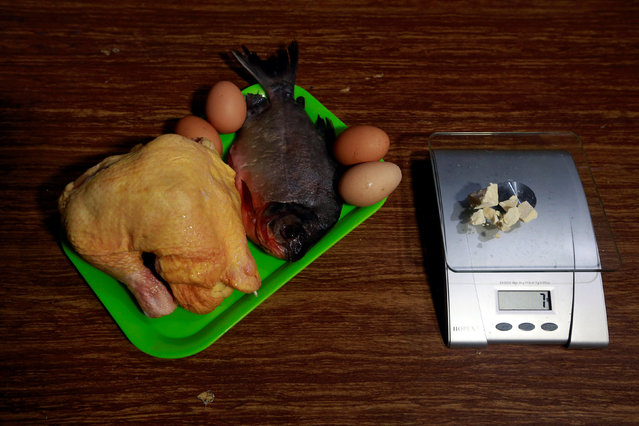
Chicken, fish and eggs lie next to coca paste worth $14,000 Colombian pesos at a local store in Guyabero Region, Guaviare, Colombia, May 24, 2016. (Photo by John Vizcaino/Reuters)

Chicken, fish and eggs lie next to coca paste worth $14,000 Colombian pesos at a local store in Guyabero Region, Guaviare, Colombia, May 24, 2016. As the government nears a historic peace deal with the rebels of the Revolutionary Armed Forces of Colombia (FARC), the nation's authorities are struggling to tame an increase in farming of coca, the raw material used to make cocaine. In the Guyabero Region, where many people work on coca plantations, locals barter coca paste to buy groceries at the local shop. (Photo by John Vizcaino/Reuters)
Details
03 Jun 2016 12:46:00
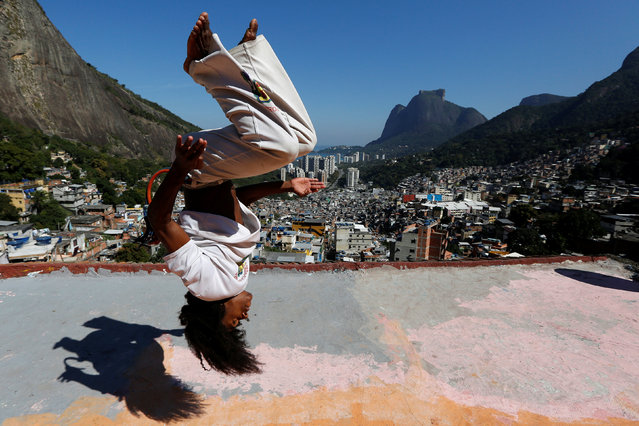
A member of the Acorda Capoeira (Awaken Capoeira) group performs on a rooftop in the Rocinha favela in Rio de Janeiro, Brazil, July 24, 2016. (Photo by Bruno Kelly/Reuters)

A member of the Acorda Capoeira (Awaken Capoeira) group performs on a rooftop in the Rocinha favela in Rio de Janeiro, Brazil, July 24, 2016. In a favela with a history of violence between police and drug gangs, or armed battles between traffickers themselves, capoeira is an outlet that gives kids a sense of community – its practice a collective exercise blending characteristics of drum circles, sparring and tag-team gymnastics. (Photo by Bruno Kelly/Reuters)
Details
30 Jul 2016 11:11:00