Loading...
Done
Mikhail Kalashnikov, the father of the world's most popular assault rifle, is handed  an AK-74 November 23, 2002 in Izhevsk,1000 East km. from Moscow. November 23 marked the 55th anniversary of the release of the first Kalashnikov gun. According to the Moscow-based Center for Analysis of Strategic and Technologies some 70 million to 100 million Kalashnikovs have been built worldwide since 1947, compared about 7 million to Kalashnikov's Western rival the M-16 assault rifles. (Photo by Oleg Nikishin/Getty Images)

Mikhail Kalashnikov, the father of the world's most popular assault rifle, is handed an AK-74 November 23, 2002 in Izhevsk,1000 East km. from Moscow. November 23 marked the 55th anniversary of the release of the first Kalashnikov gun. According to the Moscow-based Center for Analysis of Strategic and Technologies some 70 million to 100 million Kalashnikovs have been built worldwide since 1947, compared about 7 million to Kalashnikov's Western rival the M-16 assault rifles. (Photo by Oleg Nikishin/Getty Images)
Details
24 Dec 2013 09:12:00


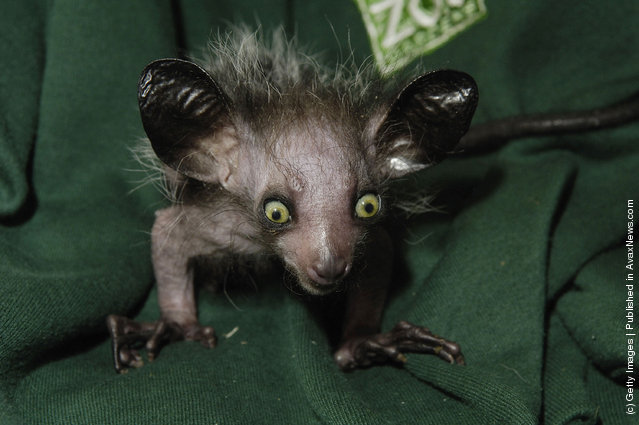
“The aye-aye (Daubentonia madagascariensis) is a lemur, a strepsirrhine primate native to Madagascar that combines rodent-like teeth and a special thin middle finger to fill the same ecological niche as a woodpecker. It is the world's largest nocturnal primate, and is characterized by its unusual method of finding food; it taps on trees to find grubs, then gnaws holes in the wood and inserts its narrow middle finger to pull the grubs out. The only other animal species known to find food in this way is the striped possum. From an ecological point of view the aye-aye fills the niche of a woodpecker as it is capable of penetrating wood to extract the invertebrates within”. – Wikipedia

Photo: In this handout image from Bristol Zoo is seen the first captive bred aye-aye in the UK named “Kintana” (meaning star in Malagasy) April 15, 2005 at Bristol Zoo Gardens, England. The zoo announced today only the second baby aye-aye to be hand-reared in the world (the first was in Jersey Zoo) and has now made his first public appearance since his birth on 11 February 2005. (Photo by Rob Cousins/Bristol Zoo via Getty Images)
Details
13 Apr 2011 13:33:00
A small section of the expanding remains of the Veil Nebula, a massive star that exploded about 8,000 years ago. The entire nebula is 110 light-years across, covering six full moons on the sky as seen from Earth, and resides about 2,100 light-years away in the constellation Cygnus, the Swan. Image taken by NASA's Hubble Space Telescope. Released September 24, 2015. (Photo by Reuters/NASA/ESA/Hubble Heritage Team)

A small section of the expanding remains of the Veil Nebula, a massive star that exploded about 8,000 years ago. The entire nebula is 110 light-years across, covering six full moons on the sky as seen from Earth, and resides about 2,100 light-years away in the constellation Cygnus, the Swan. Image taken by NASA's Hubble Space Telescope. Released September 24, 2015. (Photo by Reuters/NASA/ESA/Hubble Heritage Team)
Details
10 Dec 2015 08:01:00
Indian artist Sudarsan Pattnaik works on a sand sculpture depicting drowned Syrian boy Aylan Kurdi at Puri beach, some 65 kilometers away from Bhubaneswar, on September 4, 2015. Charities helping refugees saw a surge in donations on September 4 across Europe as people shocked by the heart-rending images of a drowned Syrian boy on a Turkish beach dug deep to help out. (Photo by Asit Kumar/AFP Photo)

Indian artist Sudarsan Pattnaik works on a sand sculpture depicting drowned Syrian boy Aylan Kurdi at Puri beach, some 65 kilometers away from Bhubaneswar, on September 4, 2015. Charities helping refugees saw a surge in donations on September 4 across Europe as people shocked by the heart-rending images of a drowned Syrian boy on a Turkish beach dug deep to help out. The photos of the lifeless body of three-year-old Aylan Kurdi, lying on a beach in Bodrum, Turkey, have triggered a wave of emotion across the continent, despite deep divisions among European governments on how to deal with the crisis. (Photo by Asit Kumar/AFP Photo)
Details
05 Sep 2015 12:59:00
The following “Utopian Tours” drawings are conceptual images of what tourism in North Korea might one day look like, created by North Korean architects. The images, curated by Nick Bonner, are on view as part of the exhibition at the Venice Architecture Biennale in the Korean Pavilion. Bonner runs the Beijing-based Koryo Tours – a company that organizes tours of outsiders into North Korea. (Photo by Nick Bonner/Kyle Vanhemert/Venice Architecture Biennale)

At this year’s Venice Bienniale in Italy, the Korean pavilion has a curious exhibit called “Commissions for Utopia”. It includes renderings from North Korea’s top architects and artists (all anonymous), many of whom studied at the Paekho Institute of Architecture, North Korea’s state-run architectural college, and none of whom have ever left the country. They were asked to create a vision of North Korea’s future sustainable architecture for its expanding tourism industry. Their final products are a glimpse into what it would be like to envision the future after being entirely cut off from the present for almost 70 years. (Photo by Nick Bonner/Kyle Vanhemert/Venice Architecture Biennale)
Details
08 Aug 2014 11:03:00
A man from the Dani tribe cuts the head of a pig after cooked by traditional way which is use burned hot stones at Obia Village on August 9, 2014 in Wamena, Papua, Indonesia. The stone-age Dani tribe live a traditional existence in the Baliem Valley, which is situated 1600 metres above sea level in the heart of the Cyclops Mountains. (Photo by Agung Parameswara/Getty Images)

A man from the Dani tribe cuts the head of a pig after cooked by traditional way which is use burned hot stones at Obia Village on August 9, 2014 in Wamena, Papua, Indonesia. The stone-age Dani tribe live a traditional existence in the Baliem Valley, which is situated 1600 metres above sea level in the heart of the Cyclops Mountains. (Photo by Agung Parameswara/Getty Images)
Details
14 Aug 2014 10:30:00
Sue Bunclark, 40, from Rotherham poses for a photograph besides her 1964 first generation or T1, split-screen Volkswagen Transporter Samba van in Newquay on August 6, 2014 in Cornwall, England. The van, which she and her family have owned for five years is nicknamed Sammy. (Photo by Matt Cardy/Getty Images)

Sue Bunclark, 40, from Rotherham poses for a photograph besides her 1964 first generation or T1, split-screen Volkswagen Transporter Samba van in Newquay on August 6, 2014 in Cornwall, England. The van, which she and her family have owned for five years is nicknamed Sammy. The Volkswagen Transporter was first produced in 1950 and has sold over ten million units worldwide evolving through five generations of functional and practical body styles, each representing the ultimate multi-purpose vehicle of its time. To commemorate the model's 60th anniversary in the UK Volkswagen has launched a special edition of the Transporter dubbed the Sportline 60. (Photo by Matt Cardy/Getty Images)
Details
15 Aug 2014 08:58:00
NASA's rover Opportunity visits Victoria Crater, viewed from orbit by the High Resolution Imaging Science Experiment on NASA's Mars Reconnaissance Orbiter in october of 2006. Opportunity is a small dot on the crater's lip, at top right. Opportunity first reached the crater's rim on September 27, 2006. (Photo by NASA/JPL-Caltech/University of Arizona/The Atlantic)

“NASA's Mars rover Opportunity just celebrated its ninth anniversary on Mars – a mission that was originally meant to last just 90 days...” – The Atlantic. Photo: NASA's rover Opportunity visits Victoria Crater, viewed from orbit by the High Resolution Imaging Science Experiment on NASA's Mars Reconnaissance Orbiter in october of 2006. Opportunity is a small dot on the crater's lip, at top right. Opportunity first reached the crater's rim on September 27, 2006. (Photo by NASA/JPL-Caltech/University of Arizona via The Atlantic)


Details
14 Feb 2013 10:58:00