Loading...
Done
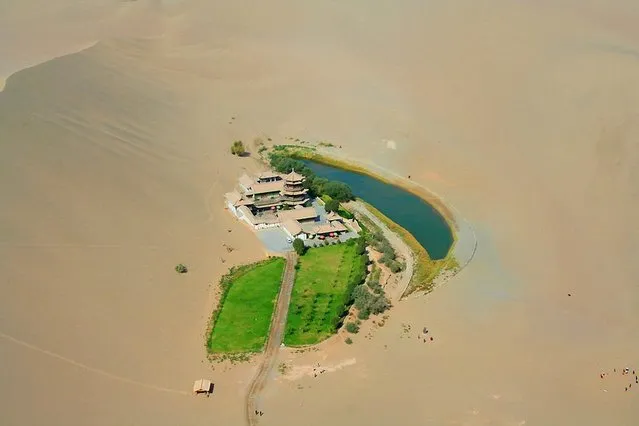
Crescent Lake In China

Yueyaquan is a crescent-shaped lake in an oasis, 6 km south of the city of Dunhuang in Gansu Province, China. It was named Yueyaquan in the Qing Dynasty. According to measurements made in 1960, the average depth of the lake was 4 to 5 meters, with a maximum depth of 7.5 metres In the following 40 years, the depth of the lake continually declined. In the early 1990s, its area had shrunk to only 5,500 m2 with an average depth of 0.9 meter (maximum 1.3 meter). In 2006, the local government with help of the central government started to fill the lake and restore its depth; its depth and size have been growing yearly since then. The lake and the surrounding deserts are very popular with tourists, who are offered camel and 4x4 rides.
Details
25 Jun 2013 10:29:00
Women sing and dance as children gather in the background during the so-called parade of children's troops in Rostov-on-Don, southern Russia, May 14, 2015. (Photo by Eduard Korniyenko/Reuters)

Women sing and dance as children gather in the background during the so-called parade of children's troops in Rostov-on-Don, southern Russia, May 14, 2015. About 500 children aged from 4 to 10, members of youth military patriotic clubs, honor guards and paratroopers took part in the event, which was organized under the guidance of Commander of Southern Military District Colonel-General Alexander Galkin and was held to honor World War Two veterans and mark the 70th anniversary of the victory over Nazi Germany, according to local media. (Photo by Eduard Korniyenko/Reuters)
Details
15 May 2015 10:39:00
Students of the "Escola de Papai Noel do Brasil" (Brazil's school of Santa Claus)  travel on a ferry through Guanabara bay, during their graduation ceremony in Rio de Janeiro, Brazil, November 10, 2015. (Photo by Pilar Olivares/Reuters)

Students of the "Escola de Papai Noel do Brasil" (Brazil's school of Santa Claus) travel on a ferry through Guanabara bay, during their graduation ceremony in Rio de Janeiro, Brazil, November 10, 2015. The school holds 4 days' lessons in Santa-training, teaching Christmas carols, how to interact with children, and also how to wear the heavy red suit in Rio's typical 104-degree (40 degrees celsius) summer weather that is common around the holidays. (Photo by Pilar Olivares/Reuters)
Details
13 Nov 2015 08:01:00
A glass building mirrors the sky in Singapore as the sun goes down over the city. (Photo by Fong Qi Wei/Thoughtful Photography)

Intrigued by photographing time, Singapore-based photographer Fong Qi Wei created single, composite pictures from a sequence of images spanning 2-4 hours. He concentrated on capturing sunrises and sunsets as they evolved over different landscapes, seascapes, and cityscapes. He then digitally stitched the images together to get a snapshot of time passing over the scene for his series “Time is a Dimension”. “Most paintings and photographs are an instance of time”, Wei explained in his artist’s statement. “That’s not the way the world works. We experience a sequence of time, and that’s why a video is somehow more compelling than a freeze frame”. (Photo by Fong Qi Wei/Thoughtful Photography)
Details
19 Aug 2014 10:28:00
Mimi Pineda, 15, whose parents are from El Salvador, rides to church in a limousine with her friend Christian Flores, 17, during her quinceanera in Santa Clarita, California August 23, 2014. Quinceanera is a rite of passage celebrated on the fifteenth birthday of many female Latino teenagers. (Photo by Lucy Nicholson/Reuters)

Reuters photographer Lucy Nicholson documented some of the migrant communities that live in Los Angeles. Los Angeles is a culturally thriving city and one of the most ethnically diverse in the United States, with a population that is 48.5 percent Latino and 11.3 percent Asian, according to a 2010 census. Immigration has become a hot button issue ahead of U.S. midterm elections on November 4, and despite arguments from the White House that legal migration benefits businesses, a recent opinion poll found most Americans believe migrants place a burden on the economy. (Photo by Lucy Nicholson/Reuters)
Details
02 Nov 2014 11:03:00


“Echus Chasma is a chasma in the Lunae Planum high plateau north of the Valles Marineris canyon system of Mars. Clay has been found in Echus Chasma that means that water once sat there for a time. Echus Chasma is approximately 100 km long and 10 km wide, with valleys ranging in depth from around 1 km to 4 km”. – Wikipedia

Photo: In this handout image supplied by the European Space Agency (ESA) on July 16, 2008, The Echus Chasma, one of the largest water source regions on Mars, is pictured from ESA's Mars Express. The data was acquired on September 25, 2005. The dark material shows a network of light-coloured, incised valleys that look similar to drainage networks known on Earth. It is still debated whether the valleys originate from precipitation, groundwater springs or liquid or magma flows on the surface. (Photo by ESA via Getty Images)
Details
18 Jul 2011 11:47:00


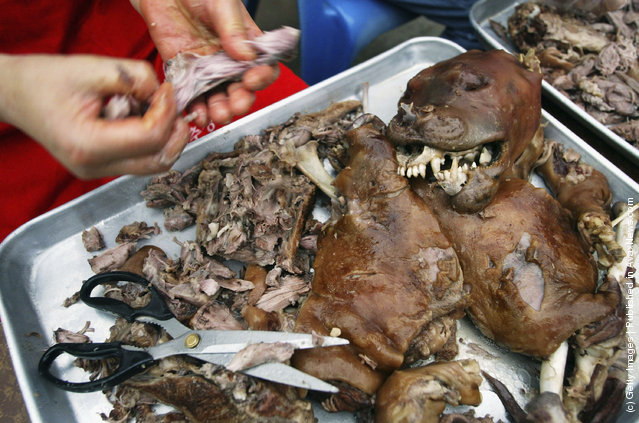
“Dog meat refers to edible parts and the flesh derived from (predominantly domestic) dogs. Human consumption of dog meat has been recorded in many parts of the world, including ancient China, ancient Mexico, and ancient Rome. According to contemporary reports, dog meat is consumed in a variety of countries such as Switzerland, China, Vietnam, the Philippines, and Korea. In addition, dog meat has also been used as survival food in times of war and/or other hardships”. – Wikipedia

Photo: A chef prepares dog meat at a restaurant on July 4, 2005 in Gwacheon, South Korea. Dog meat is a traditional dish in Korea dating back to the Samkuk period (period of the three kingdoms BC 57 – AD 668). Although many recipes existed historically for dog meat, now chefs only make soups, or dishes using boiled or roasted meat. Koreans traditionally eat dog meat on the hottest day of the summer, for it's reputed benefits of virility, invigoration and health. (Photo by Chung Sung-Jun/Getty Images)
Details
24 Jul 2011 13:21:00
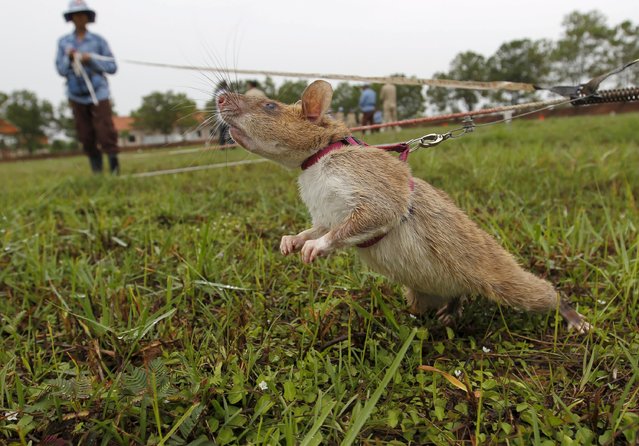
A rat being trained by the Cambodian Mine Action Centre (CMAC) is pictured on an inactive landmine field in Siem Reap province July 9, 2015. Gambian pouched rats were deployed to Cambodia from Tanzania in April by a Belgian non-profit organization, APOPO, to help clear mines. (Photo by Samrang Pring/Reuters)

A rat being trained by the Cambodian Mine Action Centre (CMAC) is pictured on an inactive landmine field in Siem Reap province July 9, 2015. Gambian pouched rats were deployed to Cambodia from Tanzania in April by a Belgian non-profit organization, APOPO, to help clear mines. They've been trained since they were 4 weeks old. Cambodia is still littered with landmines after emerging from decades of civil war, including the 1970s Khmer Rough “Killing Fields” genocide, leaving it with one of the world's highest disability rates. APOPO has used the rodents for mine-clearing projects in several countries, including Angola, Mozambique, Thailand, Laos, and Vietnam. (Photo by Samrang Pring/Reuters)
Details
14 Jul 2015 13:35:00