Loading...
Done
Indigenous Q'eqchi girls practice taekwondo with their teacher, Danny Coy, on a dirt court in the middle of the village in Tipulcan village, San Pedro Carcha, Guatemala, on 25 November 2019 (issued 27 November 2019). Tipulcan village girls learn taekwondo to combat sexist violence and harassment they have suffered in their community in northern Guatemala. (Photo by Esteban Biba/EPA/EFE)

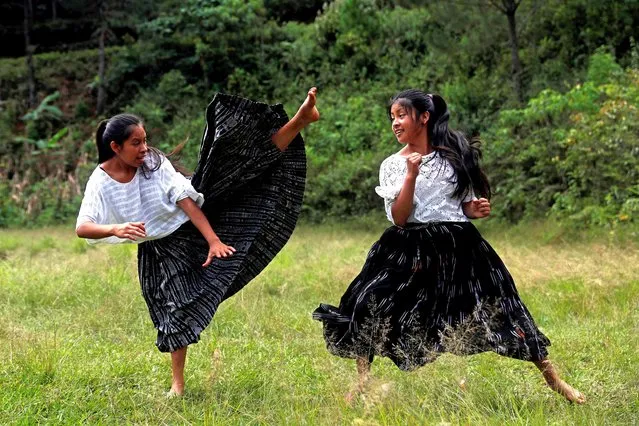
Indigenous Q'eqchi girls practice taekwondo with their teacher, Danny Coy, on a dirt court in the middle of the village in Tipulcan village, San Pedro Carcha, Guatemala, on 25 November 2019 (issued 27 November 2019). Tipulcan village girls learn taekwondo to combat sexist violence and harassment they have suffered in their community in northern Guatemala. (Photo by Esteban Biba/EPA/EFE)
Details
01 Dec 2019 00:07:00
Cave Diver, Anhumas Abyss, Bonito, Brazil: The Anhumas Abyss is an underground cavern with a crystal-clear lake below, more than 260 feet (79 m) deep. A visitor must enter through a narrow opening at the top of the chamber and rappel into the cave. Snorkeling and scuba diving in the lake reveal amazing scenery. Distinctive, conical limestone stalagmites and stalactites occupy the lake and the surrounding area, some reaching 65 feet (20 m) high. “One must rappel about 235 feet (72 m) to get down into this deep lake. The photo was taken at a depth of 50 feet (15 m). It was a challenge to create the image because of the high contrast, plus the diver could not see into the darkness, making communication impossible”. (Photo by Marcio Cabral/Nature’s Best Photography Awards 2017)

Cave Diver, Anhumas Abyss, Bonito, Brazil: The Anhumas Abyss is an underground cavern with a crystal-clear lake below, more than 260 feet (79 m) deep. A visitor must enter through a narrow opening at the top of the chamber and rappel into the cave. Snorkeling and scuba diving in the lake reveal amazing scenery. Distinctive, conical limestone stalagmites and stalactites occupy the lake and the surrounding area, some reaching 65 feet (20 m) high. (Photo by Marcio Cabral/Nature’s Best Photography Awards 2017)
Details
26 Oct 2017 08:10:00
A man walks into the The Life Tabernacle megachurch as local residents attend Sunday service challenging state orders against assembling in large groups to prevent the spread of coronavirus disease (COVID-19) in Baton Rouge, Louisiana U.S., April 5, 2020. (Photo by Carlos Barria/Reuters)

A man walks into the The Life Tabernacle megachurch as local residents attend Sunday service challenging state orders against assembling in large groups to prevent the spread of coronavirus disease (COVID-19) in Baton Rouge, Louisiana U.S., April 5, 2020. (Photo by Carlos Barria/Reuters)
Details
10 Apr 2020 00:01:00
Animal rights activists perform, demanding the abolition of bullfights, during a demonstration in Medellin, Colombia February 11, 2018. The Colombian Constitutional Court overruled on February 7, 2018, a judgment that allowed to hold a referendum regarding bullfights. (Photo by Fredy Builes/Reuters)

Animal rights activists perform, demanding the abolition of bullfights, during a demonstration in Medellin, Colombia February 11, 2018. The Colombian Constitutional Court overruled on February 7, 2018, a judgment that allowed to hold a referendum regarding bullfights. (Photo by Fredy Builes/Reuters)
Details
13 Feb 2018 08:58:00
Sculputure by Anish Kapoor

“Anish Kapoor CBE RA (born 12 March 1954) is a British sculptor of Indian birth. Born in Mumbai (Bombay), Kapoor has lived and worked in London since the early 1970s when he moved to study art, first at the Hornsey College of Art and later at the Chelsea School of Art and Design”. – Wikipedia

Photo: Workmen install a large-scale sculputure by Anish Kapoor at the Lisson Gallery on October 10, 2006 in London, England. (Photo by Gareth Cattermole/Getty Images)
Details
07 Aug 2011 11:15:00
Tibetan Mastiff

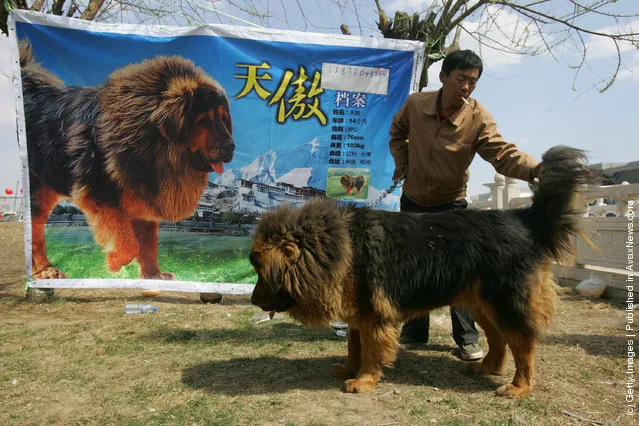
“The Tibetan Mastiff also known as Do-khyi (variously translated as “home guard”, “door guard”, “dog which may be tied”, “dog which may be kept”), reflects its use as a guardian of herds, flocks, tents, villages, monasteries, and palaces, much as the old English ban-dog (also meaning tied dog) was a dog tied outside the home as a guardian. However, in nomad camps and in villages, the Do-khyi is traditionally allowed to run loose at night and woe be unto the stranger who walks abroad after dark”. – Wikipedia

Photo: A man displays a Tibetan Mastiff he raised during the Tibetan Mastiff exposition on April 7, 2007 in Langfang of Hebei Province, China. (Photo by China Photos/Getty Images)
Details
05 Oct 2011 14:27:00
A mine detection rat is given banana as a reward after successfully identifying an inactive mine on July 2, 2015 in Siem Reap, Cambodia. (Photo by Taylor Weidman/Getty Images)

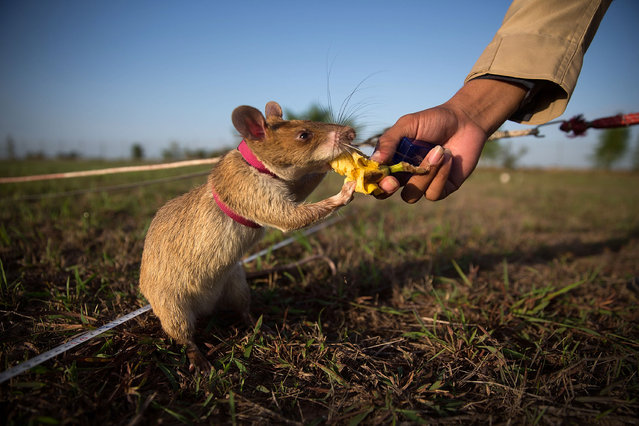
A mine detection rat is given banana as a reward after successfully identifying an inactive mine on July 2, 2015 in Siem Reap, Cambodia. The Cambodian Mine Action Center (CMAC) working with the Belgian NGO APOPO has recently begun testing the feasability of using large mine detection rats from Tanzania to help clear fields of mines and unexploded ordnance in one of the most bombed and mined countries in the world. (Photo by Taylor Weidman/Getty Images)
Details
03 Jul 2015 13:31:00
Macaque monkeys crowd together in their cage at a monkey farm on February 3, 2016 in Xinye county, Henan province, China. The area boasts a centuries-long and lucrative history of raising and training monkeys for performance. In Xinye, villagers are seeing an increase in business with the lunar calendar's “Year of the Monkey”. Farmers say most of the monkeys are bred and raised for domestic zoos, circuses, and performing groups, but add that some are also sold for medical research in China and the United States. Despite the popularity of the tradition, critics contend the training methods and conditions constitute animal cruelty. (Photo by Kevin Frayer/Getty Images)

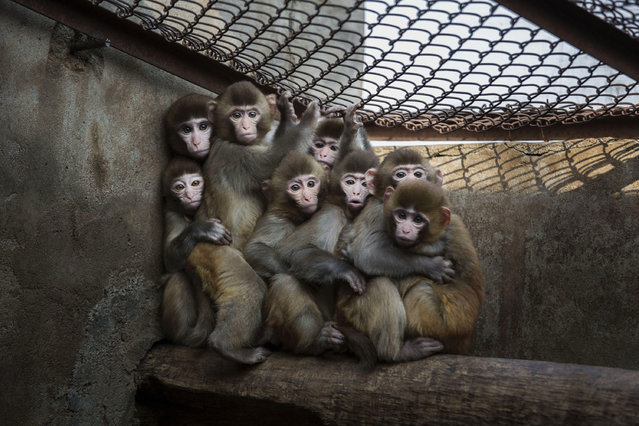
Macaque monkeys crowd together in their cage at a monkey farm on February 3, 2016 in Xinye county, Henan province, China. The area boasts a centuries-long and lucrative history of raising and training monkeys for performance. In Xinye, villagers are seeing an increase in business with the lunar calendar's “Year of the Monkey”. Farmers say most of the monkeys are bred and raised for domestic zoos, circuses, and performing groups, but add that some are also sold for medical research in China and the United States. Despite the popularity of the tradition, critics contend the training methods and conditions constitute animal cruelty. (Photo by Kevin Frayer/Getty Images)
Details
31 Dec 2016 09:56:00