Loading...
Done
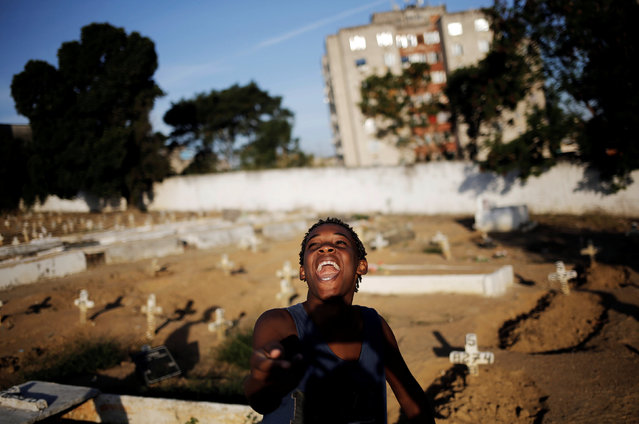
A boy flies his kite in a cemetery in the Vila Operaria Favela of Rio de Janeiro, Brazil, July 9, 2016. (Photo by Nacho Doce/Reuters)

A boy flies his kite in a cemetery in the Vila Operaria Favela of Rio de Janeiro, Brazil, July 9, 2016. (Photo by Nacho Doce/Reuters)
Details
21 Jul 2016 13:56:00
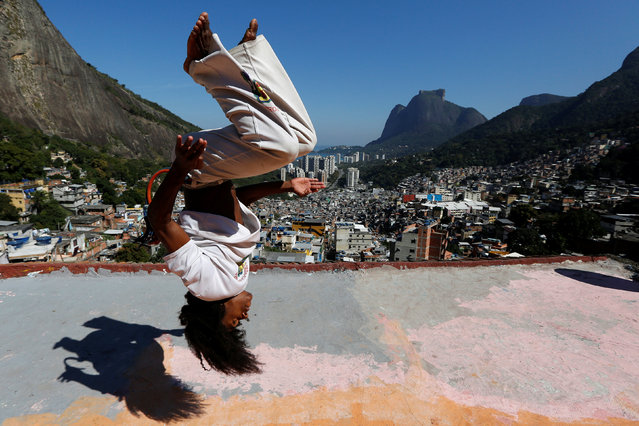
A member of the Acorda Capoeira (Awaken Capoeira) group performs on a rooftop in the Rocinha favela in Rio de Janeiro, Brazil, July 24, 2016. (Photo by Bruno Kelly/Reuters)

A member of the Acorda Capoeira (Awaken Capoeira) group performs on a rooftop in the Rocinha favela in Rio de Janeiro, Brazil, July 24, 2016. In a favela with a history of violence between police and drug gangs, or armed battles between traffickers themselves, capoeira is an outlet that gives kids a sense of community – its practice a collective exercise blending characteristics of drum circles, sparring and tag-team gymnastics. (Photo by Bruno Kelly/Reuters)
Details
30 Jul 2016 11:11:00
A brown bear waits for food at the zoo in Madrid, Spain on July 30, 2016. (Photo by Jorge Sanz/Pacific Press/SIPA Press/Rex Features/Shutterstock)

A brown bear waits for food at the zoo in Madrid, Spain on July 30, 2016. (Photo by Jorge Sanz/Pacific Press/SIPA Press/Rex Features/Shutterstock)
Details
31 Jul 2016 10:57:00
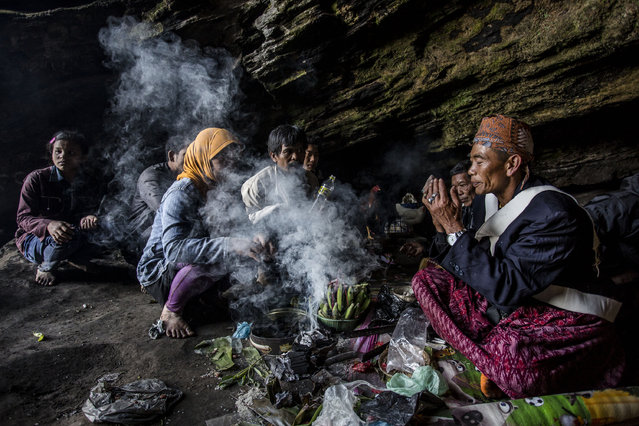
A Tenggerese shaman praying for worshippers at Widodaren cave during the Tenggerese Hindu Yadnya Kasada festival on July 31, 2015 in Probolinggo, East Java, Indonesia. The festival is the main festival of the Tenggerese people and lasts about a month. On the fourteenth day, the Tenggerese make the journey to Mount Bromo to make offerings of rice, fruits, vegetables, flowers and livestock to the mountain gods by throwing them into the volcano's caldera. (Photo by Ulet Ifansasti/Getty Images)

A Tenggerese shaman praying for worshippers at Widodaren cave during the Tenggerese Hindu Yadnya Kasada festival on July 31, 2015 in Probolinggo, East Java, Indonesia. The festival is the main festival of the Tenggerese people and lasts about a month. On the fourteenth day, the Tenggerese make the journey to Mount Bromo to make offerings of rice, fruits, vegetables, flowers and livestock to the mountain gods by throwing them into the volcano's caldera. The origin of the festival lies in the 15th century when a princess named Roro Anteng started the principality of Tengger with her husband Joko Seger, and the childless couple asked the mountain Gods for help in bearing children. The legend says the Gods granted them 24 children but on the provision that the 25th must be tossed into the volcano in sacrifice. The 25th child, Kesuma, was finally sacrificed in this way after initial refusal, and the tradition of throwing sacrifices into the caldera to appease the mountain Gods continues today. (Photo by Ulet Ifansasti/Getty Images)
Details
01 Aug 2015 12:07:00
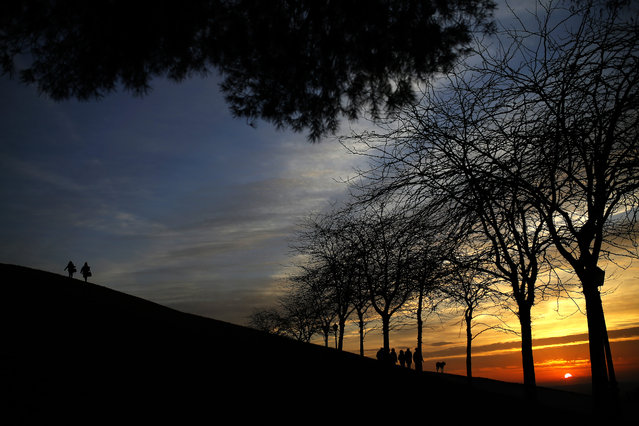
People stroll alongside one of the hills of the Tio Pio park in Madrid, Monday, January 25, 2016. The park is a high viewpoint frequented mostly by locals due to its view of the  Spanish capital skyline. (Photo by Francisco Seco/AP Photo)

People stroll alongside one of the hills of the Tio Pio park in Madrid, Monday, January 25, 2016. The park is a high viewpoint frequented mostly by locals due to its view of the Spanish capital skyline. (Photo by Francisco Seco/AP Photo)
Details
26 Jan 2016 12:33:00
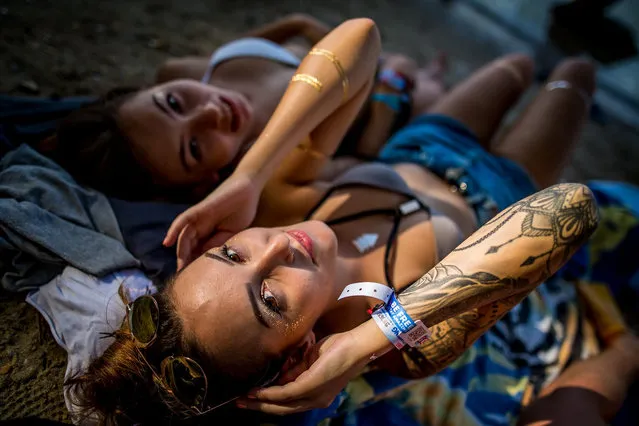
Revellers attend the 25th edition of the Sziget Festival on August 9, 2017 in Budapest, Hungary. (Photo by Laszlo Mudra/Rockstar Photographers)

Revellers attend the 25th edition of the Sziget Festival on August 9, 2017 in Budapest, Hungary. The Sziget Festival, one of the largest music and cultural festivals in Europe, celebrates its 25th anniversary in 2017, taking place from August 9-16 on the Hajogyari Sziget in Budapest. (Photo by Laszlo Mudra/Rockstar Photographers)
Details
11 Aug 2017 07:41:00
An injured young woman is led away after an incident at Parsons Green underground tube station in west London on September 15, 2017. Police and ambulance services said they were responding to an “incident” at Parsons Green underground station in west London on Friday, following media reports of an explosion. A Metro. co. uk reporter at the scene was quoted by the paper as saying that a white container exploded on the train and passengers had suffered facial burns. (Photo by Luke MacGregor/Reuters)

An injured young woman is led away after an incident at Parsons Green underground tube station in west London on September 15, 2017. Police and ambulance services said they were responding to an “incident” at Parsons Green underground station in west London on Friday, following media reports of an explosion. A Metro. co. uk reporter at the scene was quoted by the paper as saying that a white container exploded on the train and passengers had suffered facial burns. (Photo by Luke MacGregor/Reuters)
Details
16 Sep 2017 07:30:00
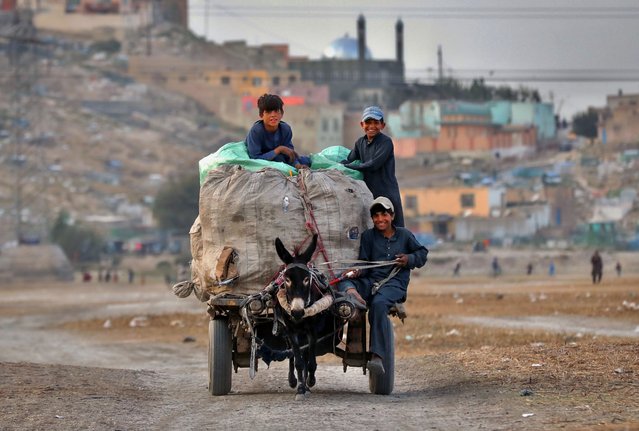
Afghan boys ride on donkey cart transporting plastic bottles for recycling, on the outskirts of Kabul, Afghanistan, on 16 September 2020. Nearly 19 years after the fall of the Taliban regime and the United States invasion, the Afghan government and insurgents on 12 September, began peace negotiations in Doha. Unlike the Taliban team, the 21-member negotiating group sent by Kabul includes four women, who – among other things – will look to safeguard the progress on women's rights since the fall of the Taliban regime that had prevented girls from going to schools and confined women to their homes. (Photo by Hedayatullah Amid/EPA/EFE)

Afghan boys ride on donkey cart transporting plastic bottles for recycling, on the outskirts of Kabul, Afghanistan, on 16 September 2020. Nearly 19 years after the fall of the Taliban regime and the United States invasion, the Afghan government and insurgents on 12 September, began peace negotiations in Doha. (Photo by Hedayatullah Amid/EPA/EFE)
Details
14 Oct 2020 00:01:00