A young Thai man jumps in the air and cheers as his rocket takes off at the Bun Bang Fai Rocket Festival on May 10, 2015 in Yasothon, Thailand. (Photo by Taylor Weidman/Getty Images)
Hotel staff practice self-defence skills after a training session given by team member of Special Weapons and Tactics (SWAT) team, in Hangzhou, Zhejiang province, April 7, 2016. (Photo by Reuters/Stringer)
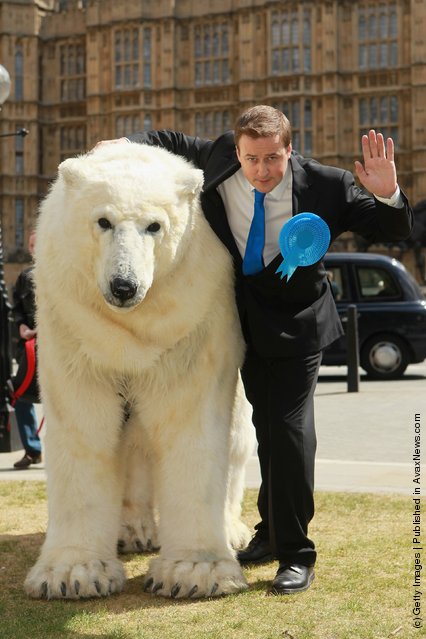
A David Cameron look-alike poses with a polar bear model outside the Houses of Parliament as part of a Greenpeace protest on May 13, 2011 in London, England. The environmental charity Greenpeace arranged the protest to highlight the first anniversary of David Cameron’s speech when he pledged to make his new government the greenest ever. In April 2006 Mr Cameron traveled by huskie-drawn sledge when he visited the island of Svalbard in Norway to witness the effects of climate change. (Photo by Oli Scarff/Getty Images)
An employee feeds a one-week-old coati cub with a bottle of milk at the Royev Ruchey zoo in the suburbs of Krasnoyarsk, Siberia, October 10, 2014. The mother of three cubs refused to nurse them, according to zoo employees. (Photo by Ilya Naymushin/Reuters)
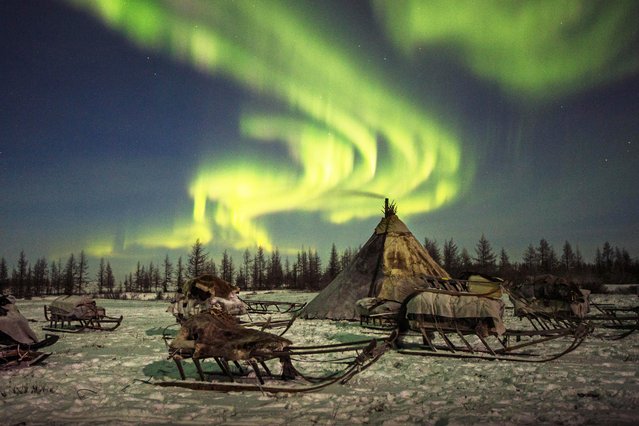
A British photographer has captured life at the “edge of the world”. Timothy Allen, best known for his work on BBC's Human Planet, trekked through the freezing Siberian wilderness for 16 days as he joined part of an 800km migration of reindeer in the Yamal-Nenets region – a name that roughly translates to “edge of the world”. The stunning pictures feature the nomadic Nenets tribe, who drink blood to survive in -45°C temperatures. Timothy's epic journey, which will be revealed in an eight-minute documentary on Animal Planet USA, saw him travel across the bleak terrain of the frozen Ob River with the Nenets people in December last year. Here: An empty camp is shown beneath a colourful sky in Siberia, December 2016. (Photo by Timothy Allen/Barcroft Productions)
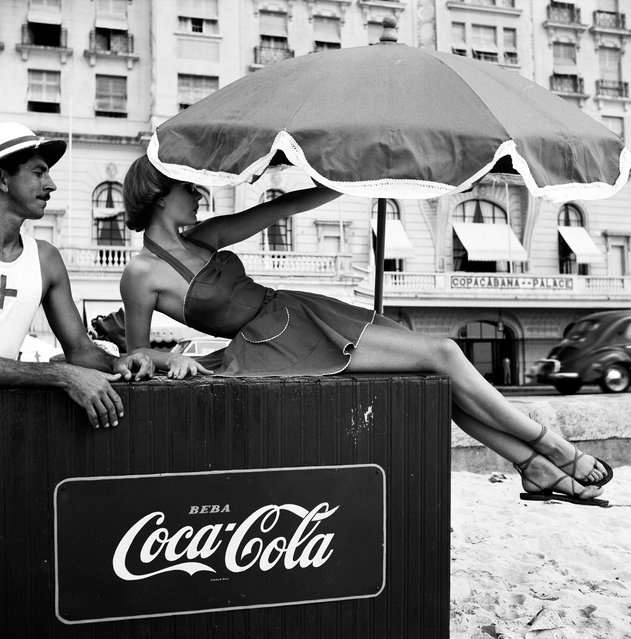
“Grit and Glamour”, a retrospective of the late British photographer Elsbeth Juda, who fled Nazi occupation and came to England in 1933, is at the Jewish Museum, in London, until July 1, 2018. Here: Shelagh Wilson, Copacabana beach, Rio de Janeiro, 1951. (Photo by Elsbeth Juda Archive/Victoria and Albert Museum)