Loading...
Done
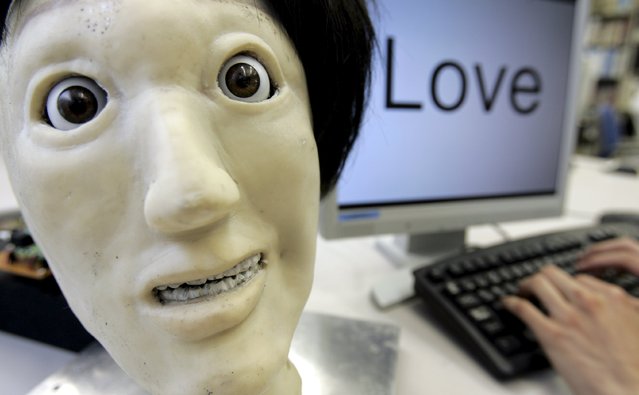
A humanoid robot named Kansei, meaning “sensibility” in Japanese, makes a facial expression depicting “happiness”, next to the word “Love” during a demonstration at a laboratory of Meiji University's Robot and Science Institute in Kawasaki, south of Tokyo in this June 4, 2007 file photo. (Photo by Yuriko Nakao/Reuters)

A humanoid robot named Kansei, meaning “sensibility” in Japanese, makes a facial expression depicting “happiness”, next to the word “Love” during a demonstration at a laboratory of Meiji University's Robot and Science Institute in Kawasaki, south of Tokyo in this June 4, 2007 file photo. Three-fourths of robot installations over the next decade are expected to be concentrated in four areas: transportation equipment, including the automotive sector; computer and electronic products; electrical equipment and machinery. Labor costs have climbed in countries such as China that have been popular for outsourcing production, while technological advances for robots allow them to be more flexible and perform more tasks. (Photo by Yuriko Nakao/Reuters)
Details
17 Apr 2015 09:39:00
Figure skating couple Madison Chock and Evan Bates, of the USA, practice their dance routine during a training session at the 2022 Winter Olympics, Thursday, February 3, 2022, in Beijing. At the Beijing Winter Games, opening Friday, it’s a homecoming of sorts for one of the world’s most sprawling diasporas – often sweet and sometimes complicated, but always a reflection of where they are, where they come from and the Olympic spirit itself. “Every time I’m on the bus, I’m just looking out and studying the city and just imagining my roots are here, my ancestors are here”, says Chock, whose father is Chinese-Hawaiian, with family ties to rural China. (Photo by Natacha Pisarenko/AP Photo)

Figure skating couple Madison Chock and Evan Bates, of the USA, practice their dance routine during a training session at the 2022 Winter Olympics, Thursday, February 3, 2022, in Beijing. (Photo by Natacha Pisarenko/AP Photo)
Details
06 Feb 2022 06:25:00
The Prince Albert Cairn, built in 1862 by Queen Victoria, is surrounded by snow and ice, near Balmoral, Aberdeenshire, Scotland, Friday November 22, 2024. (Photo by Jane Barlow/PA Wire via AP Photo)

The Prince Albert Cairn, built in 1862 by Queen Victoria, is surrounded by snow and ice, near Balmoral, Aberdeenshire, Scotland, Friday November 22, 2024. (Photo by Jane Barlow/PA Wire via AP Photo)
Details
17 Dec 2024 04:08:00
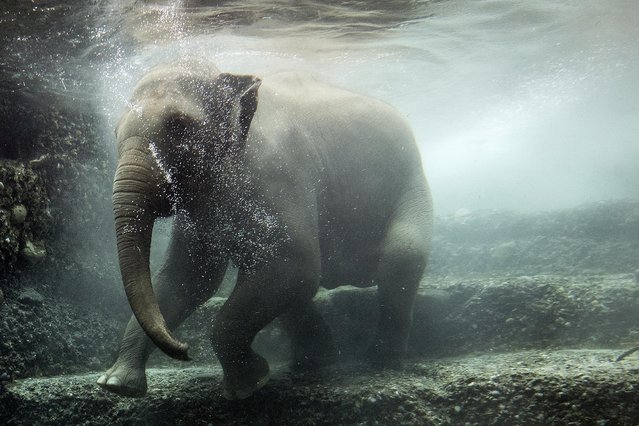
The elephant cow Omysha dives under water in its enclosure at the Zoo in Zurich, Switzerland, Wednesday, February 3, 2021. (Photo by Alexandra Wey/Keystone via AP Photo)

The elephant cow Omysha dives under water in its enclosure at the Zoo in Zurich, Switzerland, Wednesday, February 3, 2021. (Photo by Alexandra Wey/Keystone via AP Photo)
Details
14 Feb 2021 09:33:00
A guest proposes to his companion as they arrive for the screening of “Mektoub, My Love: Intermezzo” during the 72nd annual Cannes Film Festival, in Cannes, France, 23 May 2019. The movie is presented in the Official Competition of the festival which runs from 14 to 25 May. (Photo by Julien Warnand/EPA/EFE)

A guest proposes to his companion as they arrive for the screening of “Mektoub, My Love: Intermezzo” during the 72nd annual Cannes Film Festival, in Cannes, France, 23 May 2019. The movie is presented in the Official Competition of the festival which runs from 14 to 25 May. (Photo by Julien Warnand/EPA/EFE)
Details
25 May 2019 00:07:00
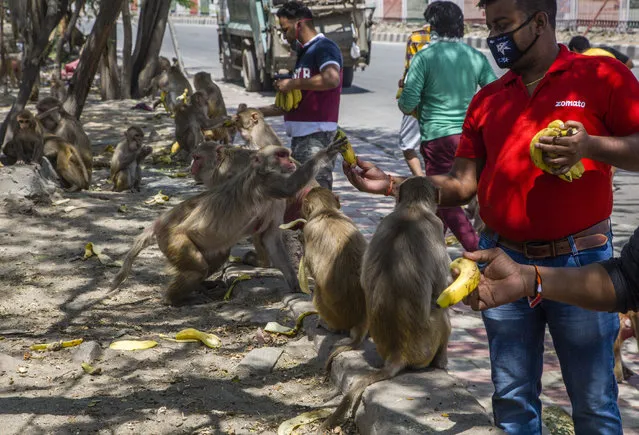
Men give bananas to monkeys gathered on the side of the road as India remains under an unprecedented lockdown over the highly contagious coronavirus (COVID-19) on April 08, 2020 in New Delhi, India. Wild animals, including monkeys, are roaming human settlements in India as people are staying indoors due to the 21-day lockdown. With India's 1.3 billion population and tens of millions of cars off the roads, wildlife is moving towards areas inhabited by humans. Wild animals in many countries have been seen roaming streets. A study says some 60 percent of the new diseases found around the globe every year are zoonotic, meaning they originate in animals and are passed on to humans. COVID-19 is a zoonotic disease that is suspected to have come from the wet markets of Wuhan, China. (Photo by Yawar Nazir/Getty Images)

Men give bananas to monkeys gathered on the side of the road as India remains under an unprecedented lockdown over the highly contagious coronavirus (COVID-19) on April 08, 2020 in New Delhi, India. Wild animals, including monkeys, are roaming human settlements in India as people are staying indoors due to the 21-day lockdown. (Photo by Yawar Nazir/Getty Images)
Details
12 Apr 2020 00:05:00
A group of riders splash down a water slide in Bromont, Que on Monday, June 29, 2020 as water parks reopen in the province of Quebec, Canada. (Photo by Canadian Press/Rex Features/Shutterstock)

A group of riders splash down a water slide in Bromont, Que on Monday, June 29, 2020 as water parks reopen in the province of Quebec, Canada. (Photo by Canadian Press/Rex Features/Shutterstock)
Details
01 Jul 2020 00:07:00
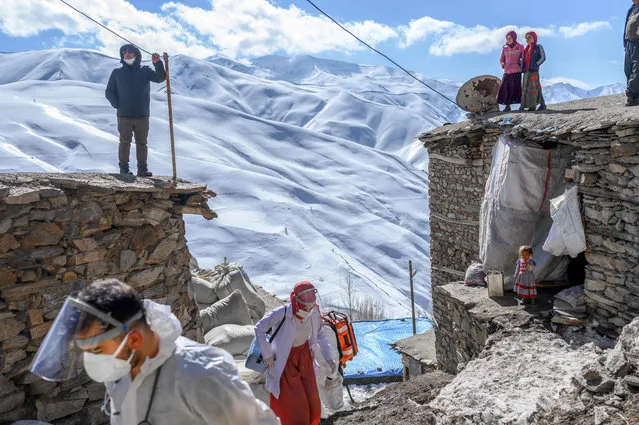
In this photograph taken on February 15, 2021, doctor Sergen Saracoglu (L) and nurse Yilzdiz Ayten (C) from the Bahcesaray public hospital vaccination team, arrive at the village of Guneyyamac in eastern Turkey, as part of an expedition to vaccinate residents of 65 years old or above with Sinovac's CoronaVac Covid-19 vaccine. Turkey's population of more than 83 million is spread out across Europe and Asia and covers some seemingly impregnable terrain. The vaccination effort with China's CoronaVac jab kicked off with a bang in mid-January when Turkey inoculated more than half a million people in the first few days. But it slowed down considerably when doctors left the big cities and tried to reach remote places such as Imamli and Ozbeyli – two ethnically Kurdish hamlets of a few hundred herders and farmers each. (Photo by Bulent Kilic/AFP Photo)

In this photograph taken on February 15, 2021, doctor Sergen Saracoglu (L) and nurse Yilzdiz Ayten (C) from the Bahcesaray public hospital vaccination team, arrive at the village of Guneyyamac in eastern Turkey, as part of an expedition to vaccinate residents of 65 years old or above with Sinovac's CoronaVac Covid-19 vaccine. (Photo by Bulent Kilic/AFP Photo)
Details
18 Mar 2021 09:32:00