Loading...
Done
Seven-year-old Ruby Macis explores the stunning sunflower field at Balgone Estate, East Lothian, UK on August 6 2024, which prepares to open to the public for the second year this week with quarter of a million sunflowers over seven acres. (Photo by South West News Service)

Seven-year-old Ruby Macis explores the stunning sunflower field at Balgone Estate, East Lothian, UK on August 6 2024, which prepares to open to the public for the second year this week with quarter of a million sunflowers over seven acres. (Photo by South West News Service)
Details
22 Apr 2025 03:08:00
Matilda Thurston 10, enjoys a warm day at Hathersage Swimming Pool in Hathersage on April 27, 2025. A mini heatwave is set to hit parts of the UK with temperatures reaching 27 degrees next week. (Photo by Ioannis Alexopoulos/London News Pictures)

Matilda Thurston 10, enjoys a warm day at Hathersage Swimming Pool in Hathersage on April 27, 2025. A mini heatwave is set to hit parts of the UK with temperatures reaching 27 degrees next week. (Photo by Ioannis Alexopoulos/London News Pictures)
Details
30 May 2025 03:04:00
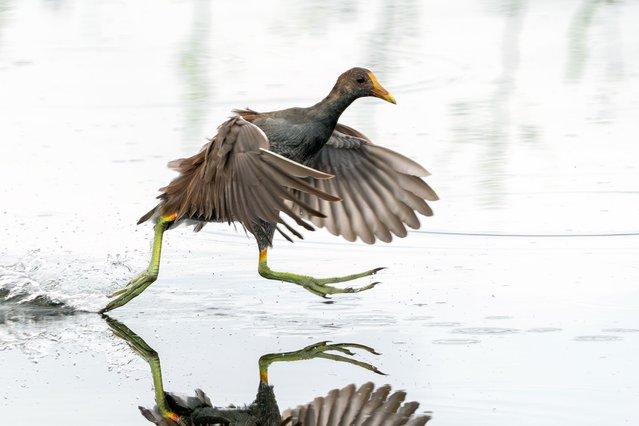
A common gallinule runs across the water to escape a nearby alligator at Green Cay Nature Center in Boynton Beach, Florida on September 4, 2025. Unlike most waterbirds, gallinules have long toes that allow them to walk on floating vegetation. The species is known for its loud, cackling calls that often echo through wetlands. (Photo by Ronen Tivony/NurPhoto/Rex Features/Shutterstock)

A common gallinule runs across the water to escape a nearby alligator at Green Cay Nature Center in Boynton Beach, Florida on September 4, 2025. Unlike most waterbirds, gallinules have long toes that allow them to walk on floating vegetation. The species is known for its loud, cackling calls that often echo through wetlands. (Photo by Ronen Tivony/NurPhoto/Rex Features/Shutterstock)
Details
21 Sep 2025 03:35:00
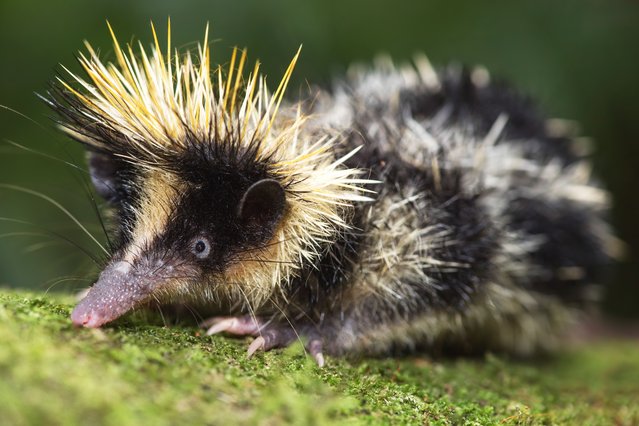
This spiky tenrec was spotted in Madagascar’s Mantadia National Park in the last decade of September 2025. Mostly nocturnal and rarely seen, it puffs out its spines when threatened. Spiky tenrecs are excellent swimmers — unlike most spiny mammals, some species of tenrec can forage in streams and rivers, using their spines for protection while hunting aquatic insects and small prey. (Photo by Dale Morris/Solent News & Photo Agency)

This spiky tenrec was spotted in Madagascar’s Mantadia National Park in the last decade of September 2025. Mostly nocturnal and rarely seen, it puffs out its spines when threatened. Spiky tenrecs are excellent swimmers — unlike most spiny mammals, some species of tenrec can forage in streams and rivers, using their spines for protection while hunting aquatic insects and small prey. (Photo by Dale Morris/Solent News & Photo Agency)
Details
05 Oct 2025 04:02:00
A child sits in a walkway at a shelter for families displaced by gang violence, in Port-au-Prince, Haiti, Thursday, May 22, 2025. (Photo by Odelyn Joseph/AP Photo)

A child sits in a walkway at a shelter for families displaced by gang violence, in Port-au-Prince, Haiti, Thursday, May 22, 2025. (Photo by Odelyn Joseph/AP Photo)
Details
20 Oct 2025 03:39:00
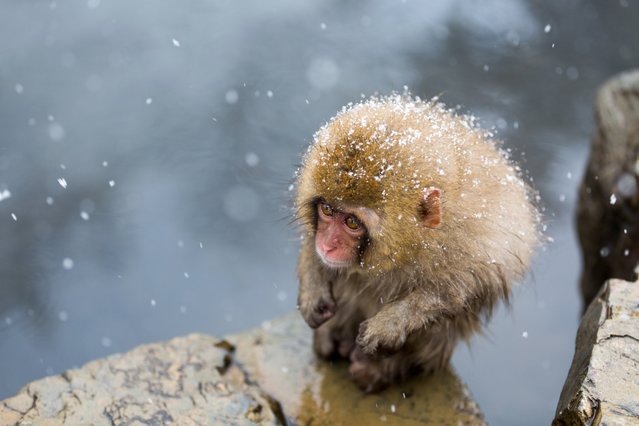
“A Little Monkey on the Cliff”. “A cold front hit the Nagano prefecture. I saw a little monkey enduring the cold in Jigokudani Monkey Park. This little monkey is really cute”. (Photo by Hidetoshi Ogata/Smithsonian Photo Contest)

“A Little Monkey on the Cliff”. “A cold front hit the Nagano prefecture. I saw a little monkey enduring the cold in Jigokudani Monkey Park. This little monkey is really cute”. (Photo by Hidetoshi Ogata/Smithsonian Photo Contest)
Details
10 Mar 2016 12:01:00
The six-months-old female koala cub holds on to the back of zoo keeper Lena at the zoo in Duisburg, Germany, 23 October 2015. The yet unnamed baby weighs 580 grams. (Photo by Roland Weihrauch/EPA)

The six-months-old female koala cub holds on to the back of zoo keeper Lena at the zoo in Duisburg, Germany, 23 October 2015. The yet unnamed baby weighs 580 grams. (Photo by Roland Weihrauch/EPA)
Details
26 Oct 2015 08:03:00
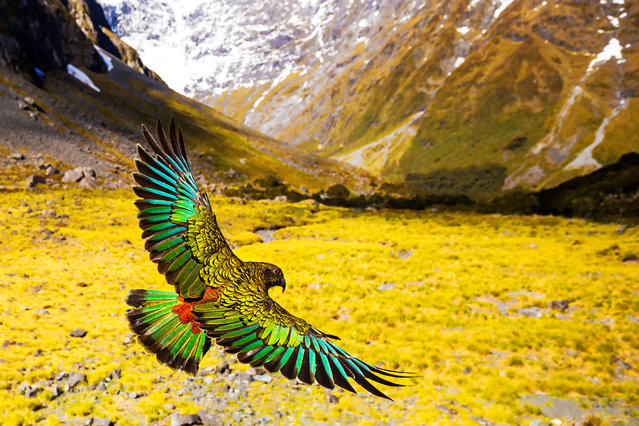
Kea are the only true alpine parrots in the world and thrive as cunning opportunists in the freezing conditions of the Southern Alps. Kea are thought to have developed their wide array of food-finding strategies during the last great ice age, where they learned to adapt using their unusual powers of curiosity. (Photo by Tom Walker/BBC Pictures/The Guardian)

Kea are the only true alpine parrots in the world and thrive as cunning opportunists in the freezing conditions of the Southern Alps. Kea are thought to have developed their wide array of food-finding strategies during the last great ice age, where they learned to adapt using their unusual powers of curiosity. (Photo by Tom Walker/BBC Pictures/The Guardian)
Details
19 Jul 2016 13:03:00