Loading...
Done
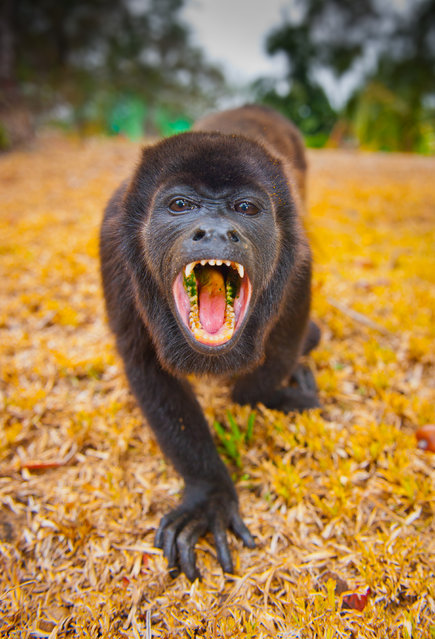
“Attacking Howler Monkey”. Due to a major tropical rainstorm my wife and I were forced to stay overnight in a Howler Monkey Rescue center in Panama. I used the time to explore the area and to take photos of the monkeys. Just after the rain finally stopped, I ran into this monkey that tried to mock attack me. I quickly took a couple of photos before retreating to a (more) safe distance. (Photo and caption by Christian Mueller-Planitz/National Geographic Traveler Photo Contest)

“Attacking Howler Monkey”. Due to a major tropical rainstorm my wife and I were forced to stay overnight in a Howler Monkey Rescue center in Panama. I used the time to explore the area and to take photos of the monkeys. Just after the rain finally stopped, I ran into this monkey that tried to mock attack me. I quickly took a couple of photos before retreating to a (more) safe distance. (Photo and caption by Christian Mueller-Planitz/National Geographic Traveler Photo Contest)

ATTENTION! All pictures are presented in high resolution. To see Hi-Res images – just TWICE click on any picture. In other words, click small picture – opens the BIG picture. Click BIG picture – opens VERY BIG picture.
Details
30 Jun 2013 12:25:00
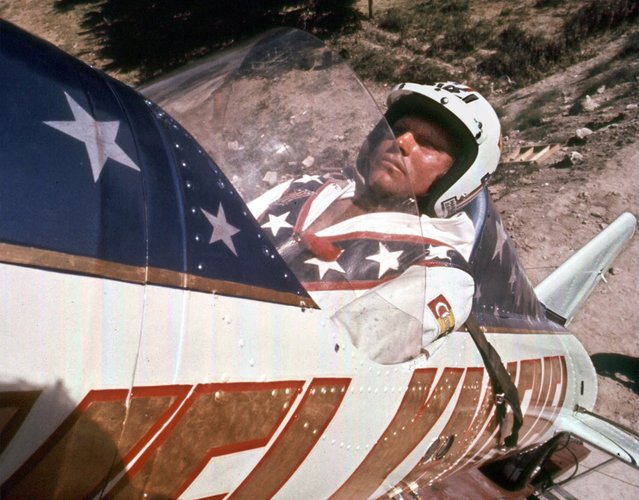
Evel Knievel is shown in his rocket before his failed attempt at a highly promoted 3/4-mile leap across Snake River Canyon in Twin Falls, Idaho, on September 8, 1974. The jump failed when the parachute on his rocket malfunctioned, opening prematurely. Knievel was uninjured. (Photo by AP Photo)

Evel Knievel is shown in his rocket before his failed attempt at a highly promoted 3/4-mile leap across Snake River Canyon in Twin Falls, Idaho, on September 8, 1974. The jump failed when the parachute on his rocket malfunctioned, opening prematurely. Knievel was uninjured. (Photo by AP Photo)
Details
09 Sep 2015 12:49:00
Harry Potter fan Emil Valkov, 7, from Bulgaria, who travelled to Britain with his family to attend the event for his older sister's birthday, poses for a photo at “Platform 9 3/4” during Back to Hogwarts Day at Kings Cross Station in London, Britain on September 1, 2023. (Photo by Hollie Adams/Reuters)

Harry Potter fan Emil Valkov, 7, from Bulgaria, who travelled to Britain with his family to attend the event for his older sister's birthday, poses for a photo at “Platform 9 3/4” during Back to Hogwarts Day at Kings Cross Station in London, Britain on September 1, 2023. (Photo by Hollie Adams/Reuters)
Details
17 Dec 2024 04:21:00
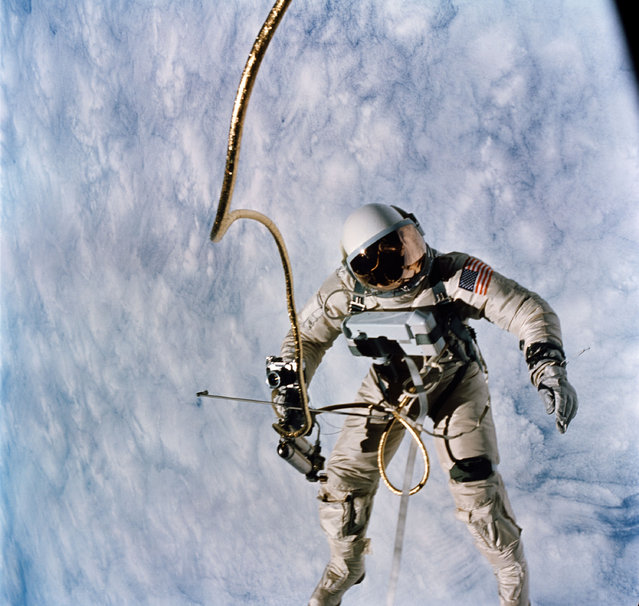
Astronaut Edward H. White II, pilot for the Gemini-Titan 4 (GT-4) spaceflight, floats in the zero-gravity of space during the third revolution of the GT-4 spacecraft on June 3, 1965. White wears a specially designed spacesuit. His face is shaded by a gold-plated visor to protect him from unfiltered rays of the sun. (Photo by NASA)

Astronaut Edward H. White II, pilot for the Gemini-Titan 4 (GT-4) spaceflight, floats in the zero-gravity of space during the third revolution of the GT-4 spacecraft on June 3, 1965. White wears a specially designed spacesuit. His face is shaded by a gold-plated visor to protect him from unfiltered rays of the sun. In his right hand he carries a Hand-Held Self-Maneuvering Unit (HHSMU) that gives him control over his movements in space. White also wears an emergency oxygen chest pack; and he carries a camera mounted on the HHSMU for taking pictures of the sky, Earth and the GT-4 spacecraft. He is secured to the spacecraft by a 25-feet umbilical line and a 23-feet tether line. Both lines are wrapped together in gold tape to form one cord. Astronaut James A. McDivitt, command pilot, remained inside the spacecraft during the extravehicular activity (EVA). Astronaut White died in the Apollo/Saturn 204 fire at Cape Kennedy on January 27, 1967. (Photo by NASA)
Details
22 Jul 2014 12:05:00
21st International Tattoo Convention

A customer grimaces in pain as she gets a tattoo on her arm at the 21st International Tattoo Convention Berlin on December 3, 2011 in Berlin, Germany. The annual tattoo trade fair runs from December 2–4, 2011. (Photo by Adam Berry/Getty Images)
Details
04 Dec 2011 12:32:00


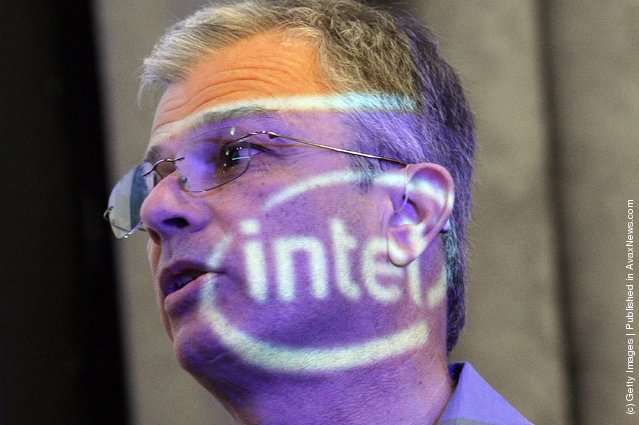
The Intel logo is projected on the face of Intel Executive Vice President Dadi Perlmutter as he speaks during a news conference about the 3-D Tri-Gate transistors called “Ivy Bridge” on May 4, 2011 in San Francisco, California. Intel announced a technical breakthrough in the microprocessors with the world's first Tri-Gate transistors, that will increase speed and consume less energy. (Photo by Justin Sullivan/Getty Images)
Details
05 May 2011 07:25:00
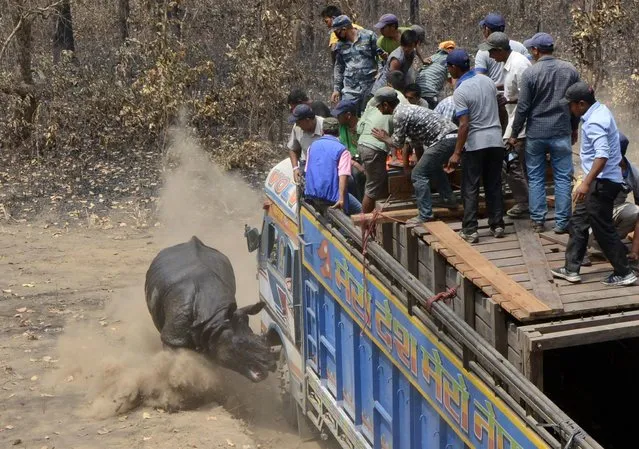
A Nepalese vetinary and technical team release a rhino after it is relocated in Chitwan National Park some of 250 Kilometer South of Kathmandu on April 4, 2017. Conservationists on April 3 captured a rare one-horned rhinoceros in Nepal as part of an attempt to increase the number of the vulnerable animals, which are prized by wildlife poachers. Five rhinos – one male and four female – will be released into a national park in Nepal's far west over the coming week in the hope of establishing a new breeding group. (Photo by Prakash Mathema/AFP Photo)

A Nepalese vetinary and technical team release a rhino after it is relocated in Chitwan National Park some of 250 Kilometer South of Kathmandu on April 4, 2017. Conservationists on April 3 captured a rare one-horned rhinoceros in Nepal as part of an attempt to increase the number of the vulnerable animals, which are prized by wildlife poachers. Five rhinos – one male and four female – will be released into a national park in Nepal's far west over the coming week in the hope of establishing a new breeding group. (Photo by Prakash Mathema/AFP Photo)
Details
05 Apr 2017 09:19:00
On August 31, 2012, a long filament of solar material that had been hovering in the sun's atmosphere, the corona, erupted out into space at 4:36 p.m. EDT. The coronal mass ejection, or CME, traveled at over 900 miles per second. The CME did not travel directly toward Earth, but did connect with Earth's magnetic environment, or magnetosphere, causing aurora to appear on the night of Monday, September 3. (Photo by NASA/GSFC/SDO)

On August 31, 2012, a long filament of solar material that had been hovering in the sun's atmosphere, the corona, erupted out into space at 4:36 p.m. EDT. The coronal mass ejection, or CME, traveled at over 900 miles per second. The CME did not travel directly toward Earth, but did connect with Earth's magnetic environment, or magnetosphere, causing aurora to appear on the night of Monday, September 3. (Photo by NASA/GSFC/SDO via The Atlantic)
Details
14 Sep 2012 09:01:00