Employees cover bacon on fried dranik, a potato pancake that is the national dish of Belarus, in the Sula History Park near the village of Sula, Belarus March 7, 2016. According to the park's representatives, the two-metre-wide pancake was an attempt to enter the Guinness World Records as the world's largest dranik. (Photo by Vasily Fedosenko/Reuters)
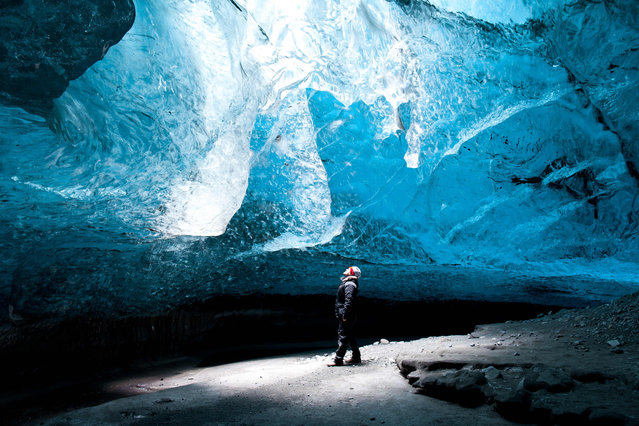
Shimmering clearest blue and stretching as far as the eye can see, this is one of Iceland's famed crystal ice caves. The giant solid waves look frozen in time but they are slowly moving along as part of the Vatnajokull Glacier – which stretches across eight per cent of the island. The images were captured in February 2014 by British photographer Rob Lott, 49. Photo: A wide view of Rob Lott in the crystal ice cave in the Vatnajokull Glacier, Iceland. (Photo by Rob Lott/Barcroft Media)
“These are the stunning images of some of Americas most breathtaking churches – all of which are abandoned. Matthew Christopher travels around the United States taking shots of its most beautiful decaying wonders. He shot those in his churches series in Philadelphia, Pennsylvania, where he works as a photographer and lecturer. Matthew’s fascination with such abandoned spaces started when he was a child when he enjoyed looking at artwork set in buildings that have since decayed”. – Caters News. Photo: St. Boniface Church, Philadelphia Pa. (Photo by Matthew Christopher/Caters News)
Live octopus is a delicacy in South Korea but is a known choking hazard, since the still-moving suction cups can cause tentacle pieces to stick in a person's throat. A baby octopus is often consumed whole, while larger varieties are cut up and the still-wriggling tentacles eaten with a splash of sesame oil. Photo: A South Korean man and a woman eat a live octopus during an event to promote a local food festival in Seoul on September 12, 2013. (Photo by Jung Yeon-Je/AFP Photo)
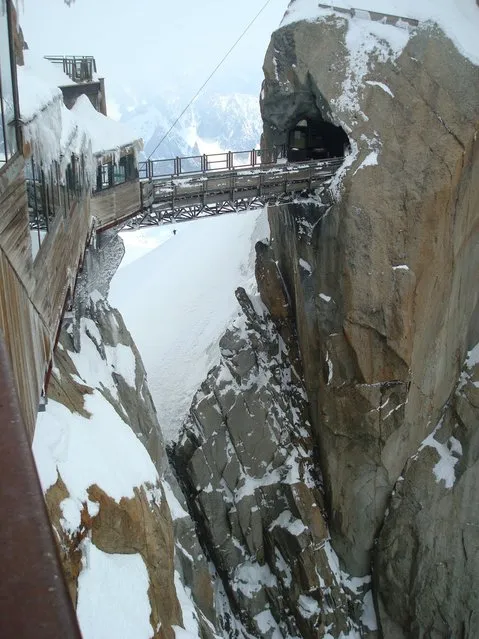
The name “Aiguille du Midi” translates literally as “Needle of the Noon” or “Needle of the South”. It gets its name from its tapered form and from its position when viewed from Chamonix: it approximately indicates noon when the sun passes over its summit.
A herdsman stands on the back of a grey bull during a ceremony of driving sheep from their winter habitat to their summer pasture in the puszta or Hungarian steppe of Hortobagy, 183 kms east of Budapest, Hungary, 23 April 2016. Sheep are traditionally driven to their summer pasture at around St. George's Day in the Hortobagy region, because livestock breeding people traditionally consider St. George's Day the beginning of spring. (Photo by Zsolt Czegledi/EPA)