Loading...
Done
People of pro-government groups, with Russian flags, dance marching through downtown Moscow to mark People s Unity Day, a public holiday, in Russia, on Tuesday, November 4, 2014. (Photo by Ivan Sekretarev/AP Photo)

People of pro-government groups, with Russian flags, dance marching through downtown Moscow to mark People's Unity Day, a public holiday, in Russia, on Tuesday, November 4, 2014. Russia marks National Unity Day on November 4 to celebrate the defeat of Polish invaders in 1612. (Photo by Ivan Sekretarev/AP Photo)
Details
05 Nov 2014 12:19:00
Hucul horses play in the wild meadows and forests near Odrzychowa in southeastern Poland on October 18, 2014. Huculs, a primitive breed of horse, escaped total extinction due to the efforts of scientists and Polish farmers. (Photo by Janek Skarzynski/AFP Photo)

Hucul horses play in the wild meadows and forests near Odrzychowa in southeastern Poland on October 18, 2014. Huculs, a primitive breed of horse, escaped total extinction due to the efforts of scientists and Polish farmers. (Photo by Janek Skarzynski/AFP Photo)
Details
25 Oct 2014 14:08:00
Dressed up as Punxsutawney Phil, Marty Nagy, of Hallandale Beach, Fla., gives thumbs up to passers by before the start of the 12th annual Groundhog Day on Hollywood Beach, Tuesday, February 2, 2016, in Hollywood, Fla. The event, which featured breakfast and an ocean plunge, benefited the Hollywood Beach Lifeguard Competition Team. (Photo by Wilfredo Lee/AP Photo)

Dressed up as Punxsutawney Phil, Marty Nagy, of Hallandale Beach, Fla., gives thumbs up to passers by before the start of the 12th annual Groundhog Day on Hollywood Beach, Tuesday, February 2, 2016, in Hollywood, Fla. The event, which featured breakfast and an ocean plunge, benefited the Hollywood Beach Lifeguard Competition Team. (Photo by Wilfredo Lee/AP Photo)
Details
03 Feb 2016 13:18:00
A vendor sells chili peppers at his stall at a market in Bangkok, Thailand March 31, 2016. (Photo by Jorge Silva/Reuters)

A vendor sells chili peppers at his stall at a market in Bangkok, Thailand March 31, 2016. (Photo by Jorge Silva/Reuters)
Details
01 Apr 2016 12:09:00
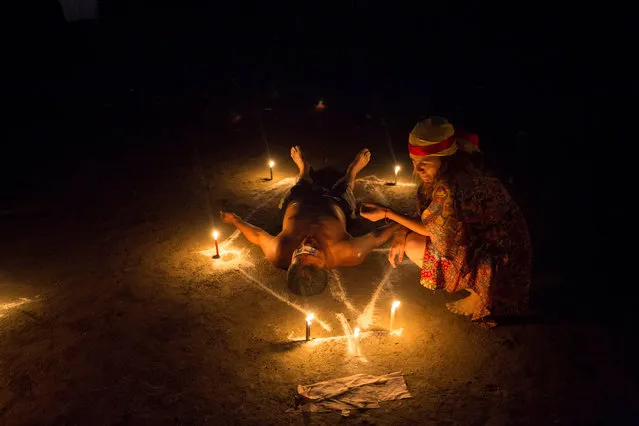
A man lies on the floor during a ritual at the Sorte Mountain on the outskirts of Chivacoa, in the state of Yaracuy, Venezuela October 10, 2015. (Photo by Marco Bello/Reuters)

A man lies on the floor during a ritual at the Sorte Mountain on the outskirts of Chivacoa, in the state of Yaracuy, Venezuela October 10, 2015. One long night every year in a mountainous rainforest in Venezuela, hundreds gather to dance on red-hot embers, enter trance-like states, and worship an ancient goddess known as Maria Lionza. Those who travel to the mountain known as Sorte in central Venezuela are practitioners of a cult that is built on local indigenous traditions. (Photo by Marco Bello/Reuters)
Details
08 Jul 2016 12:19:00
A woman talks to a man as two children play inside a wrecked car at a camp for displaced people in Port-au-Prince, Haiti, March 6, 2016. (Photo by Andres Martinez Casares/Reuters)

A woman talks to a man as two children play inside a wrecked car at a camp for displaced people in Port-au-Prince, Haiti, March 6, 2016. (Photo by Andres Martinez Casares/Reuters)
Details
18 Aug 2016 11:16:00
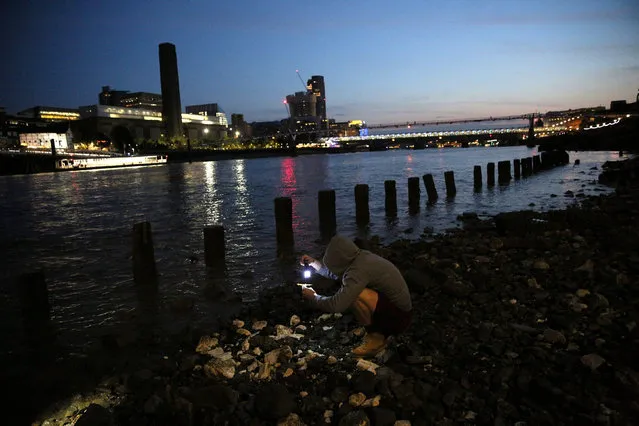
A mudlark uses a torch to look for items on the bank of the River Thames in London, Britain June 06, 2016. Mudlarking is believed to trace its origins to the 18th and 19th century, when scavengers searched the Thames' shores for items to sell. These days, history and archaeology fans are the ones hoping to find old relics such as coins, ceramics, artifacts or everyday items from across centuries. They wait for the low tide and then scour specific areas of exposed shores. "If you're in a field you could be out all day long, with the river you're restricted to about two or three hours," mudlark Nick Stevens said. While many just use the naked eye for their searches, others rely on metal detectors for which a permit from the Port of London Authority is needed. Digging also requires consent. (Photo by Neil Hall/Reuters)

A mudlark uses a torch to look for items on the bank of the River Thames in London, Britain June 06, 2016. Mudlarking is believed to trace its origins to the 18th and 19th century, when scavengers searched the Thames' shores for items to sell. These days, history and archaeology fans are the ones hoping to find old relics such as coins, ceramics, artifacts or everyday items from across centuries. their finds with the Portable Antiquities Scheme. Any item over 300 years old must be recorded. (Photo by Neil Hall/Reuters)
Details
27 Aug 2016 10:43:00
A man poses in front of a portrait of late Chinese Chairman Mao Zedong during the opening of an exhibition of Mao related art in Beijing, China, September 8, 2016. (Photo by Thomas Peter/Reuters)

A man poses in front of a portrait of late Chinese Chairman Mao Zedong during the opening of an exhibition of Mao related art in Beijing, China, September 8, 2016. (Photo by Thomas Peter/Reuters)
Details
09 Sep 2016 09:17:00