Loading...
Done
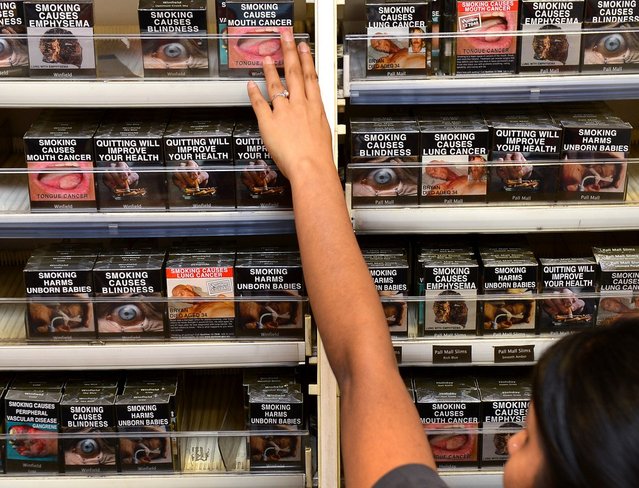
An employee in a bookshop adjusts packaged cigarettes which have to be sold in identical olive-brown packets bearing the same typeface and largely covered with graphic health warnings, with the same style of writing so the only identifier of a brand will be the name on the packet, in Sydney on December 1, 2012.  A new world-first law forcing tobacco companies to sell cigarettes in identical packets came into effect Saturday in Australia in an effort to strip any glamour from smoking and prevent young people from taking up the habit

An employee in a bookshop adjusts packaged cigarettes which have to be sold in identical olive-brown packets bearing the same typeface and largely covered with graphic health warnings, with the same style of writing so the only identifier of a brand will be the name on the packet, in Sydney on December 1, 2012. A new world-first law forcing tobacco companies to sell cigarettes in identical packets came into effect Saturday in Australia in an effort to strip any glamour from smoking and prevent young people from taking up the habit. (Photo by William West/AFP Photo)
Details
02 Dec 2012 09:18:00
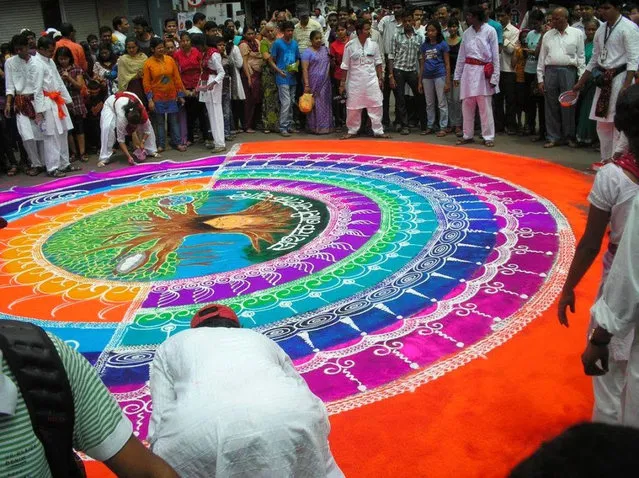
Rangoli Folk Art From India

Rangoli, also known as kolam or Muggu, is a folk art from India in which patterns are created on the floor in living rooms or courtyards using materials such as colored rice, dry flour, colored sand or flower petals. It is usually made during Diwali, Onam, Pongal and other Indian festivals. They are meant to be sacred welcoming areas for the Hindu deities. The ancient symbols have been passed down through the ages, from each generation to the next, keeping both the art form and the tradition alive. Similar practices are followed in different Indian states: in Tamil Nadu, there is Kolam in Tamil Nadu; Mandana in Rajasthan; Chaookpurna in Chhattisgarh; Alpana in West Bengal; Aripana in Bihar; Chowk pujan in Uttar Pradesh; Muggu in Andhra Pradesh and others.
Details
16 Jun 2014 10:37:00
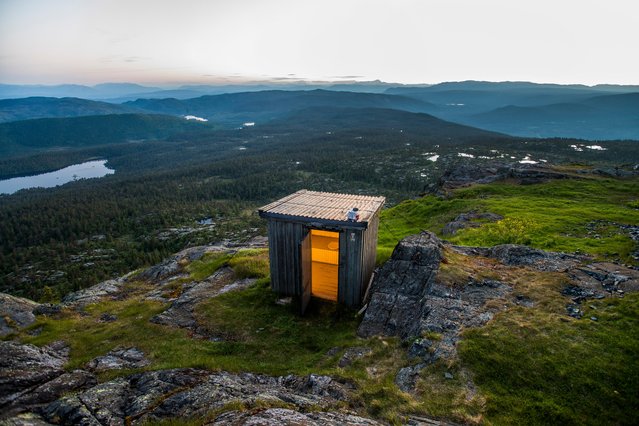
This restroom on the rubbly flanks of Jonsknuten in Norway looks up at the peak of the 904m mountain. Yu have to leave the door open to enjoy the view but the chances of being disturbed are minimal. (Photo by Olaf Menz/Lonely Planet)

This restroom on the rubbly flanks of Jonsknuten in Norway looks up at the peak of the 904m mountain. Yu have to leave the door open to enjoy the view but the chances of being disturbed are minimal. (Photo by Olaf Menz/Lonely Planet)
Details
13 Apr 2016 09:00:00
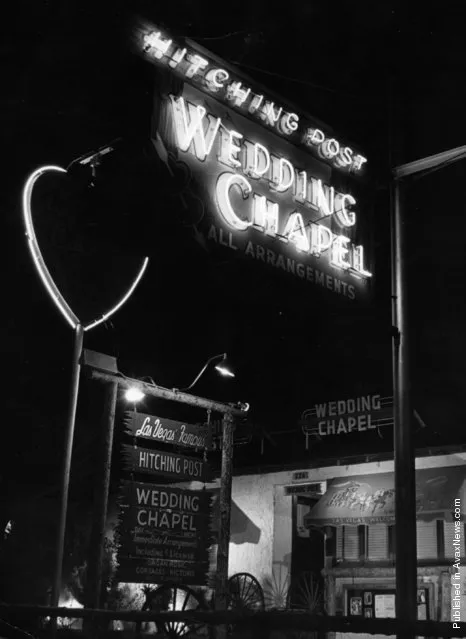
Las Vegas

circa 1930: The neon illuminations of a wedding Chapel in Las Vegas.
Details
19 Mar 2011 09:41:00
Mount Whaleback iron ore mine 23°21’32.3”S, 119°40’40.1”E. The Mount Whaleback Iron Ore Mine in the Pilbara region of Western Australia. Roughly 98% of the world’s mined iron ore is used to make steel and is thus a significant component in the construction of buildings, automobiles, and appliances such as refrigerators. (Photo by Daily Overview/DigitalGlobe, a Maxar Company)

Mount Whaleback iron ore mine 23°21’32.3”S, 119°40’40.1”E. The Mount Whaleback Iron Ore Mine in the Pilbara region of Western Australia. Roughly 98% of the world’s mined iron ore is used to make steel and is thus a significant component in the construction of buildings, automobiles, and appliances such as refrigerators. (Photo by Daily Overview/DigitalGlobe, a Maxar Company)
Details
16 Nov 2018 00:03:00
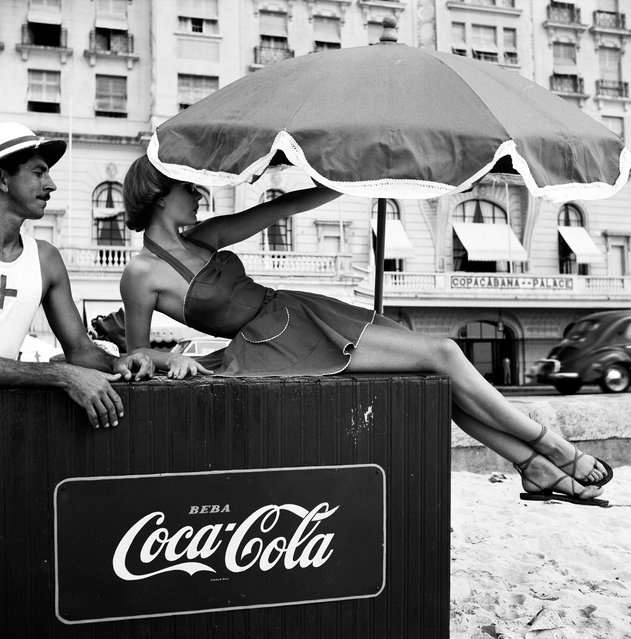
Writing about the Ambassador, the art critic Robert Melville said it was “the most daring and enterprising trade journal ever conceived … No other magazine … has so consistently and brilliantly demonstrated the relevance of works of art to the problems of industrial design”. Here: Shelagh Wilson, Copacabana beach, Rio de Janeiro, 1951. (Photo by Elsbeth Juda Archive/Victoria and Albert Museum)

“Grit and Glamour”, a retrospective of the late British photographer Elsbeth Juda, who fled Nazi occupation and came to England in 1933, is at the Jewish Museum, in London, until July 1, 2018. Here: Shelagh Wilson, Copacabana beach, Rio de Janeiro, 1951. (Photo by Elsbeth Juda Archive/Victoria and Albert Museum)
Details
31 Mar 2018 00:05:00
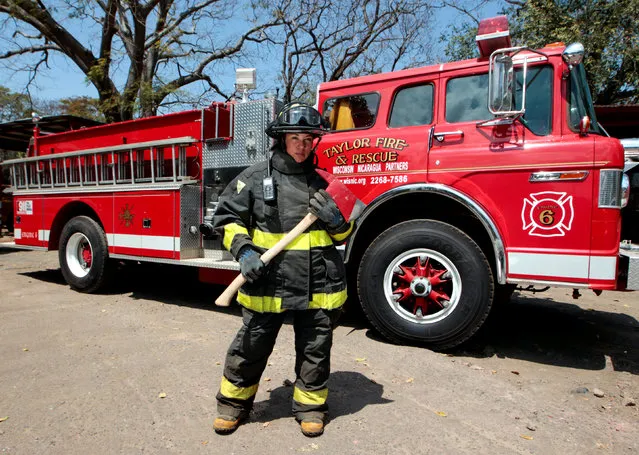
Yolaina Chavez Talavera, 31, a firefighter, poses for a photograph in front of a truck at a fire station in Managua, Nicaragua, February 22, 2017. “In my early days as a female firefighter, men, my team mates, thought that I would not last long in the organisation due to the hard training. However, in practice I showed them that I am able to take on tasks at the same level as men. I think women must fight to break through in all areas, in the midst of the machismo that still persists in Nicaragua and in Hispanic countries”, Talavera said. (Photo by Oswaldo Rivas/Reuters)

Wednesday March 8 marks International Women's Day, with festivals, concerts and exhibitions among the numerous events planned around the world to celebrate the achievements of women in society. The annual event has been held since the early 1900s and traditionally promotes a different theme each year, with this year's edition calling on people to #BeBoldForChange and push for a more gender-inclusive working world. Reuters photographers have been speaking with women in a range of professions around the world about their experiences of gender inequality. Here: Yolaina Chavez Talavera, 31, a firefighter, poses for a photograph in front of a truck at a fire station in Managua, Nicaragua, February 22, 2017. (Photo by Oswaldo Rivas/Reuters)
Details
04 Mar 2017 00:06:00
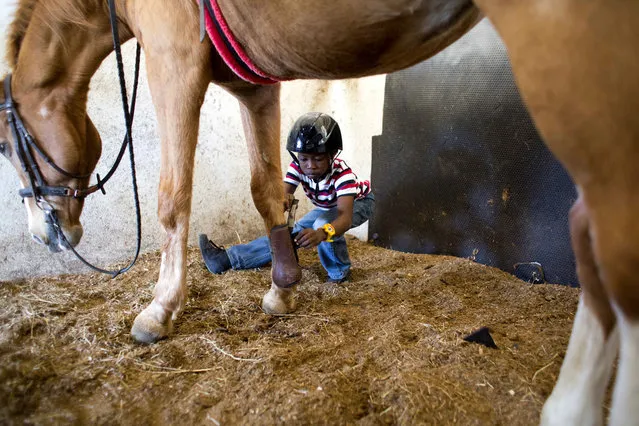
In this January 7, 2017 photo, Judeley Hans Debel squats down to remove a boot from Tic Tac, holding out his prosthetic leg after his therapeutic riding lesson at the Chateaublond Equestrian Center in Petion-Ville, Haiti. Anne-Rose Schoen, who founded the equestrian center, said perhaps the most important thing about therapeutic riding is it makes youngsters happy in a country where disabled people face enormous challenges. (Photo by Dieu Nalio Chery/AP Photo)

In this January 7, 2017 photo, Judeley Hans Debel squats down to remove a boot from Tic Tac, holding out his prosthetic leg after his therapeutic riding lesson at the Chateaublond Equestrian Center in Petion-Ville, Haiti. Anne-Rose Schoen, who founded the equestrian center, said perhaps the most important thing about therapeutic riding is it makes youngsters happy in a country where disabled people face enormous challenges. (Photo by Dieu Nalio Chery/AP Photo)
Details
13 Jan 2017 08:10:00