Children feed a giraffe at Pairi Daiza wildlife park, a zoo and botanical garden in Brugelette, Belgium, May 25, 2015. (Photo by Francois Lenoir/Reuters)
A woman cries as she stands next to house destroyed by the earthquake in the Pacific coastal town of Pedernales, Ecuador, Sunday, April 17, 2016. A magnitude-7.8 quake, the strongest since 1979, hit Ecuador flattening buildings, buckling highways along its Pacific coast and killing hundreds. (Photo by Dolores Ochoa/AP Photo)
A participant in the 5th Lady on Bicycle annual festival opens her bag in the back basket of her tricycle in the Sokolniki park in Moscow on August 6, 2017. The festival's aim is to capture the city's fashionable women on vintage style bicycles. (Photo by Mladen Antonov/AFP Photo)
Picture shows a mural painting in Ferrol, on September 2, 2018, during the annual street art festival “Meninas de Canido” set up in 2008 to breathe new life in a dying neighborhood. Angry at the announced death of his neighborhood, Canido, in Ferrol, Eduardo Hermida painted his version of Velazquez's “Meninas” on a wall. An act of protest that gave birth to a festival and gave new colors to this city of Galicia. (Photo by Miguel Riopa/AFP Photo)
Women take part in a rally called “March of Whores” to protest against discrimination and violence against women on International Women's Day in Bogota, Colombia, March 8, 2016. (Photo by John Vizcaino/Reuters)
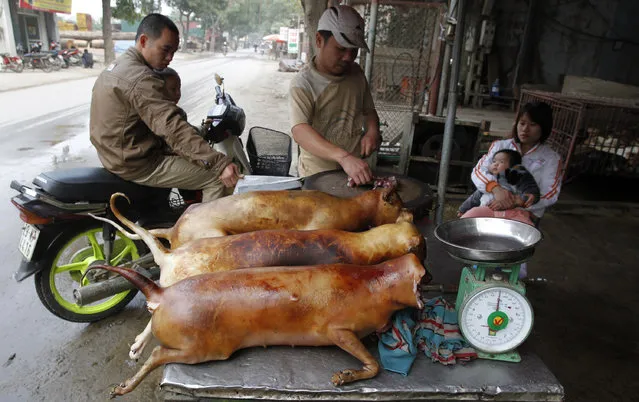
A vendor (C) cuts slaughtered dogs for sale at his roadside stall in Duong Noi village, outside Hanoi December 16, 2011. While animal rights activists have condemned eating dog meat as cruel treatment of the animals, it is still an accepted popular delicacy for some Vietnamese, as well in some other Asian countries. Duong Noi is well-known as a dog-meat village, where hundreds of dogs are killed each day for sale as popular traditional food. Dog-eating as a custom is rooted in Vietnam and was developed as a result of poverty. One kilogram of dog meat costs about 130,000 dongs ($6.2). (Photo by Reuters/Kham)