A displaced Pakistani girl collects recyclable goods from a garbage to earn living for her family in Islamabad, Pakistan, Tuesday, January 19, 2016. (Photo by B.K. Bangash/AP Photo)
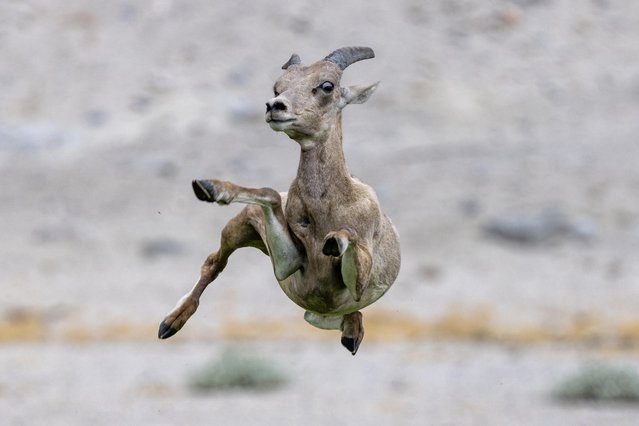
An endangered desert bighorn lamb leaps in play at a park where bighorns are tempted to leave the safety of their native habitat to eat grass and drink water in the summertime on August 9, 2023 near Indio, California. (Photo by David McNew/Getty Images)
Lindsay Knutson plays in the heavy snow with her family dog, Aspen, and daughter Flora Bejblik, 4, cq, as her husband Bob Bejblik, rear left, shovels, Tuesday, March 5, 2013 in southwest Minneapolis. The National Weather Service predicted a two-day snow total of 8 to 12 inches for much of southeastern and east-central Minnesota, including the Twin Cities. (Photo by Elizabeth Flores/AP Photo/The Star Tribune)
Girls dressed in traditional costumes run as men throw water on them as part of Easter celebrations during a presentation to the media in Mezokovesd, Hungary, April 13, 2017. (Photo by Laszlo Balogh/Reuters)
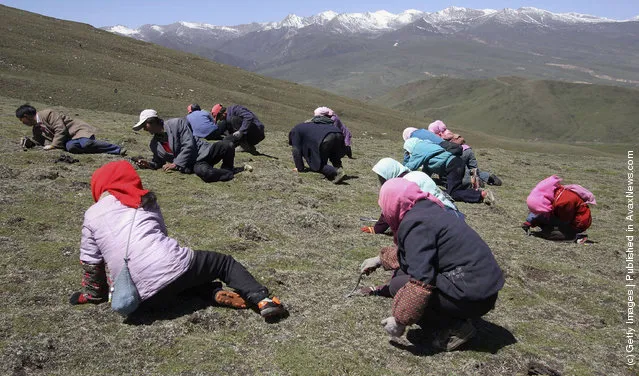
“There are over 680 documented species of the sac fungus genus Ophiocordyceps, and one of the best known of these is Ophiocordyceps sinensis, colloquially known as caterpillar fungus. The fungus is known in Tibetan as yartsa gunbu or yatsa gunbu. O. sinensis is known in the West as a medicinal mushroom and its use has a long history in Traditional Chinese medicine as well as Traditional Tibetan medicine. The highly valuable fungus-caterpillar combination is hand-collected and is used as an aphrodisiac and as a treatment for a variety of ailments from fatigue to cancer”. – Wikipedia
Photo: Nomads dig for Chinese caterpillar fungus from a mountain May 25, 2007 in Guide County, Hainan Prefecture, Qinghai Province, China. Nomads can earn about 2,000 yuan to 5,000 yuan (about U.S. $260 to $653 ) through their work during the fifty-day Chinese caterpillar fungus gathering season. (Photo by China Photos/Getty Images)
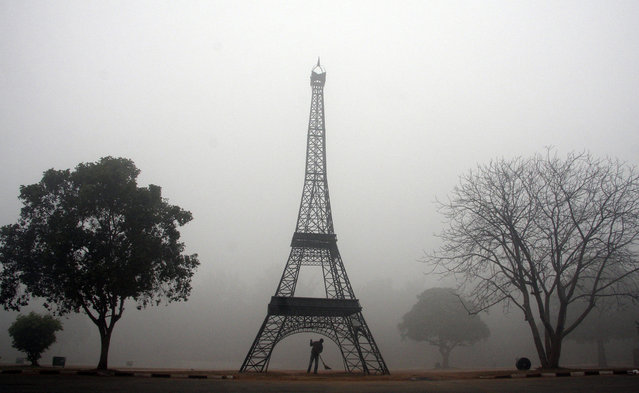
India: A sweeper cleans the side of a road near a replica of the Eiffel Tower amid heavy fog in the early morning in the northern Indian city of Chandigarh January 18, 2010. (Photo by Ajay Verma/Reuters)
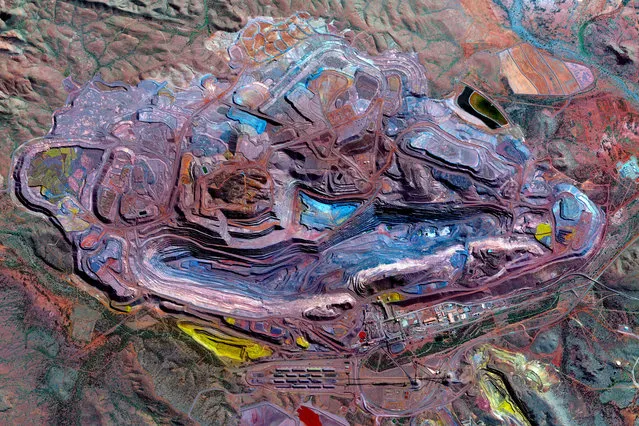
Mount Whaleback iron ore mine 23°21’32.3”S, 119°40’40.1”E. The Mount Whaleback Iron Ore Mine in the Pilbara region of Western Australia. Roughly 98% of the world’s mined iron ore is used to make steel and is thus a significant component in the construction of buildings, automobiles, and appliances such as refrigerators. (Photo by Daily Overview/DigitalGlobe, a Maxar Company)