Loading...
Done
Bangladeshi Muslim devotees arrive in an over-crowded train to attend the final day of an Islamic congregations' first phase in Tongi, 20 kilometers (13 miles) north of  Dhaka, Bangladesh, Sunday, January 10, 2016. The second phase of the annual event, one of the world's largest congregations of Muslims is scheduled to begin Friday. (Photo by A.M. Ahad/AP Photo)

Bangladeshi Muslim devotees arrive in an over-crowded train to attend the final day of an Islamic congregations' first phase in Tongi, 20 kilometers (13 miles) north of Dhaka, Bangladesh, Sunday, January 10, 2016. The second phase of the annual event, one of the world's largest congregations of Muslims is scheduled to begin Friday. (Photo by A.M. Ahad/AP Photo)
Details
11 Jan 2016 13:51:00
CGAP Photo Contest – South Asia Regional Winner: Bricks Worker, Bangladesh. A private enterprise worker is working at a brick field. These small businesses are creating new job opportunities for many poor people. (Photo by Moksumul Haque)

The shoemaker in Turkey, the potato seller in Vietnam, and the weaver in Bolivia are among the billions of low-income entrepreneurs who make the world go round. They are also the type of people who can benefit significantly from microfinance. Every year, the Consultative Group To Assist The Poor (or CGAP) hosts a photo contest asking entrants to submit photos based around the idea of microfinance.The purpose of the contest is to give amateur and professional photographers a chance to show the different ways that poor households manage their financial lives and make their lives better through financial inclusion. Photo: South Asia Regional Winner – “Bricks Worker”, Bangladesh. A private enterprise worker is working at a brick field. These small businesses are creating new job opportunities for many poor people. (Photo by Moksumul Haque)
Details
14 Aug 2014 10:58:00
A local resident rescues a baby owl after Cyclone Mocha's crashed ashore, in Kyauktaw in Myanmar's Rakhine state on May 14, 2023. Cyclone Mocha crashed ashore in Myanmar and southeastern Bangladesh on May 14, 2023, uprooting trees, scattering flimsy homes in Rohingya displacement camps and bringing a storm surge into low-lying areas. (Photo by Jack Taylor/AFP Photo)

A local resident rescues a baby owl after Cyclone Mocha's crashed ashore, in Kyauktaw in Myanmar's Rakhine state on May 14, 2023. Cyclone Mocha crashed ashore in Myanmar and southeastern Bangladesh on May 14, 2023, uprooting trees, scattering flimsy homes in Rohingya displacement camps and bringing a storm surge into low-lying areas. (Photo by Jack Taylor/AFP Photo)
Details
18 May 2023 03:21:00


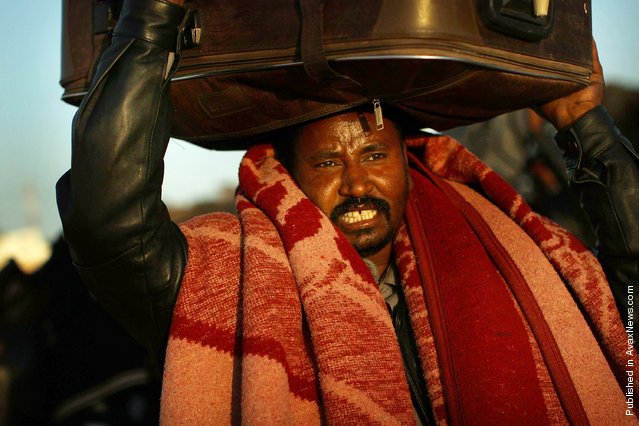
A Sudanese man walks to a United Nations displacement camp after crossing into Tunisia from Libya on March 06, 2011 in Ras Jdir, Tunisia. As fighting continues in and around the Libyan capital of Tripoli, tens of thousands of guest workers from Egypt, Tunisia, Bangladesh and other countries are fleeing to the border of Tunisia to escape the violence. The situation has turned into a humanitarian emergency as fledgling Tunisia is overwhelmed with the workers. Libyan leader Muammar Gaddafi has vowed to fight to the end. (Photo by Spencer Platt/Getty Images). RAS JDIR, TUNISIA – MARCH 06 2011
Details
10 Mar 2011 11:44:00
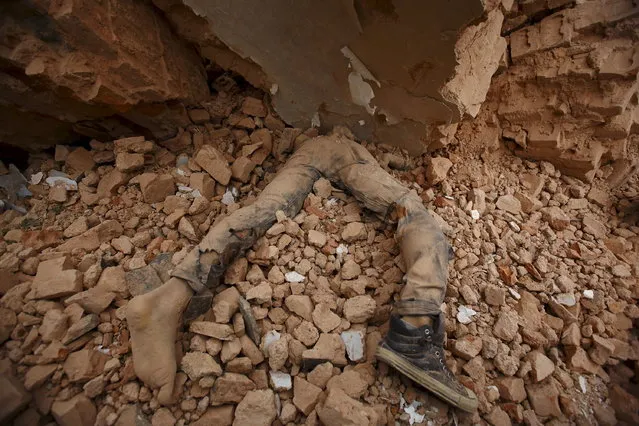
A body of a victim lies trapped in the debris after an earthquake hit, in Kathmandu, Nepal April 25, 2015. (Photo by Navesh Chitrakar/Reuters)

A body of a victim lies trapped in the debris after an earthquake hit, in Kathmandu, Nepal April 25, 2015. Rescue efforts in Nepal are intensifying after nearly 2,000 people were killed on Saturday in the worst earthquake there in more than 80 years. Many countries and charities have offered aid to deal with the disaster. Seventeen people have been killed on Mount Everest by avalanches – the mountain's worst-ever disaster. Meanwhile a powerful aftershock was felt on Sunday in Nepal, India and Bangladesh, and more avalanches were reported near Everest. (Photo by Navesh Chitrakar/Reuters)
Details
26 Apr 2015 09:11:00
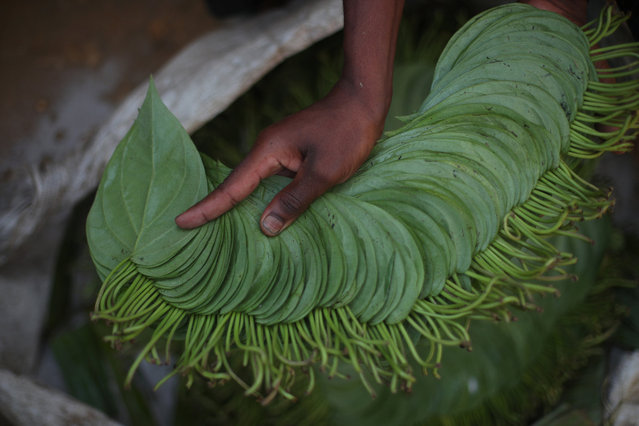
Faruk, 17, a Rohingya refugee trader holds betel leaves which are on sale at a stall in Palong Khali refugee camp near Cox's Bazar, Bangladesh, November 3, 2017. He left his village in Myanmar when the military opened fire towards the Rohingya. “I buy this betel leaf from Palong Khali market, in one bundle there are 160 pieces, I buy it for 80 taka and I sell it for 100 taka. Bangladeshi's and I sell for the same rate in the camp. Outside in the local market it is 80 taka per bundle. My problem is that I don't have money so I can't buy anything to eat, I can't buy fish to eat”, he said. (Photo by Hannah McKay/Reuters)

Faruk, 17, a Rohingya refugee trader holds betel leaves which are on sale at a stall in Palong Khali refugee camp near Cox's Bazar, Bangladesh, November 3, 2017. He left his village in Myanmar when the military opened fire towards the Rohingya. “I buy this betel leaf from Palong Khali market, in one bundle there are 160 pieces, I buy it for 80 taka and I sell it for 100 taka (1 Bangladeshi Taka = 0.012 US Dollar). Bangladeshi's and I sell for the same rate in the camp. Outside in the local market it is 80 taka per bundle. My problem is that I don't have money so I can't buy anything to eat, I can't buy fish to eat”, he said. (Photo by Hannah McKay/Reuters)
Details
27 Nov 2017 08:54:00
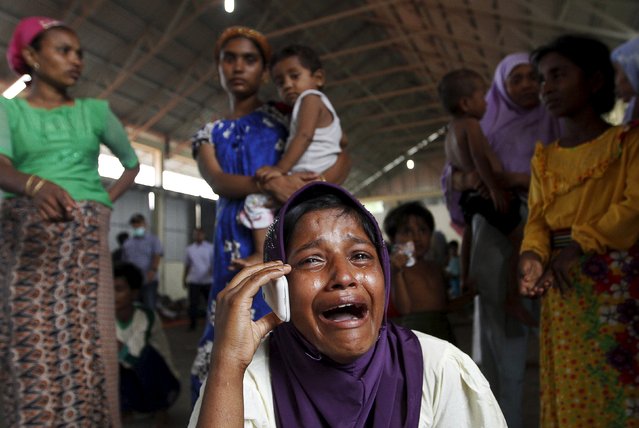
A Rohingya migrant who arrived in Indonesia by boat cries while speaking on a mobile phone with a relative in Malaysia, at a temporary shelter in Kuala Langsa in Indonesia's Aceh Province May 16, 2015. (Photo by Roni Bintang/Reuters)

A Rohingya migrant who arrived in Indonesia by boat cries while speaking on a mobile phone with a relative in Malaysia, at a temporary shelter in Kuala Langsa in Indonesia's Aceh Province May 16, 2015. Nearly 800 migrants were brought ashore in Indonesia on Friday, but other vessels crammed with them were sent back to sea despite a United Nations call to rescue thousands adrift in Southeast Asian waters with dwindling food and water. Thousands of Rohingya Muslims fleeing Myanmar and Bangladesh are stranded on boats as regional governments block them from landing. (Photo by Roni Bintang/Reuters)
Details
20 May 2015 08:53:00
Asia, Mongolia, March 27, 2011. A view of Ulaan Baator over the shoulder of a slumbering drunk. Alcoholism is a huge problem in the city, home to almost half of Mongolia's people. The capital's population has doubled in the past two years, expanding outward in a haphazard sprawl, and many inhabitants live in slums known as the “Gher District”. (Photo by Alessandro Grassani)

“Environmental Migrants: The Last Illusion” by photographer Alessandro Grassani, documents the life of people in Kenya, Mongolia and Bangladesh who migrate to escape environmental stresses to the city of their own countries in hopes for a better life. Here: Asia, Mongolia, March 27, 2011. A view of Ulaan Baator over the shoulder of a slumbering drunk. Alcoholism is a huge problem in the city, home to almost half of Mongolia's people. The capital's population has doubled in the past two years. High levels of unemployment and poverty await herders who abandon rural areas and arrive in the city, illiterate and untrained in any skills necessary for urban jobs. (Photo by Alessandro Grassani)
Details
21 Jul 2015 10:10:00