Loading...
Done
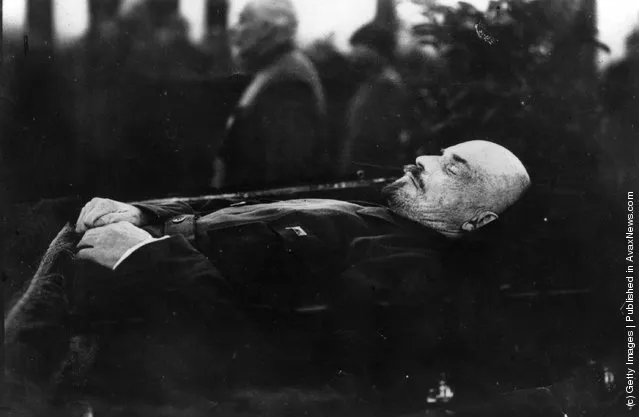
1924:  Vladimir Ilyich Lenin lying in state in the Kremlin

Photo: Vladimir Ilyich Lenin (1870 – 1924) lying in state in the Kremlin. (Photo by Hulton Archive/Getty Images). 1924

Important! For the same article in Russian language click here.

Something quite intriguing is happening within Russian-speaking internet during the last few – should you type a fully academic inquiry (at least, according to Russian academic requirements) in national search engines for "Lenin's mausoleum" – the first thing you get (even in top 10 searches) is website pages talking about black magic and occult. Website authors view this construction differently, but unconditionally agree on one thing: the mausoleum of the "leader of the world proletariat” – the essence of a magical artifact, a sort of “energy vampire”. It was built with a certain purpose: to drain the energy out of miserable Soviet citizens on one hand; and to poison the anthroposphere of one-sixth part of the earth with its vibes (the exact territory that was occupied by the former Soviet Union), depriving the Russian people of will to resist on the other hand. Complete nonsense? No doubt. Nevertheless, an intriguing one. Well, probably because some oddities do exist in mausoleum's history. These oddities are the thing we are going to discuss this time. First, let me refresh you memory on the subject.
Details
16 Oct 2011 11:27:00
Spectacular images offering insight into the lives of the Huaorani people in the Ecuadorian Amazon have been revealed showing how they use traditional methods to hunt monkeys for food. The stunning pictures were taken by conservation photographer Pete Oxford from Torquay, Devon in the Ecuadorian Amazon. “The Huaorani Indians are a forest people highly in tune with their environment. Many are now totally acculturated since the 1950s by missionaries”, said Pete. “Today they face radical change to their culture to the proximity of oil exploration within their territory and the Yasuni National Park and Biosphere Reserve, they are vastly changed. Some still live very traditionally and for this shoot, through my Huaorani friend, a direct relative of those photographed he wanted to depict them as close to their original culture as possible. They still largely hunt with blow pipes and spears eating a lot of monkeys and peccaries”. The Huaorani are also known as the Waorani, Waodani or the Waos and are native Amerindians. Their lands are located between the Curaray and Napo rivers and speak the Huaorani language. Pete says that during his visit he was welcomed into the group and hopes that ancient cultures can be saved. Here: The tribe were seen celebrating after a hunter returned to camp with a wild pig. (Photo by Pete Oxford/Mediadrumworld.com)

Spectacular images offering insight into the lives of the Huaorani people in the Ecuadorian Amazon have been revealed showing how they use traditional methods to hunt monkeys for food. The stunning pictures were taken by conservation photographer Pete Oxford from Torquay, Devon in the Ecuadorian Amazon. Here: The tribe were seen celebrating after a hunter returned to camp with a wild pig. (Photo by Pete Oxford/Mediadrumworld.com)
Details
20 Jan 2017 07:58:00
People look at a skeleton couple kissing installation dubbed “Till Death Do Us Part” during a Valentine's Day event in Bucharest, Romania, Tuesday, February 13, 2024. (Photo by Vadim Ghirda/AP Photo)

People look at a skeleton couple kissing installation dubbed “Till Death Do Us Part” during a Valentine's Day event in Bucharest, Romania, Tuesday, February 13, 2024. (Photo by Vadim Ghirda/AP Photo)
Details
20 Mar 2024 06:20:00
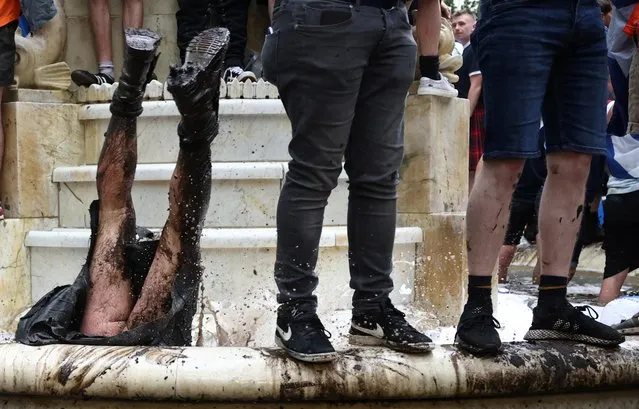
Scotland fans in Leicester Square in London, Britain before the match against England on June 18, 2021. (Photo by Henry Nicholls/Reuters)

Scotland fans climbed on English playwright William Shakespeare's statue in Leicester Square prior to the Euro 2020 soccer championship group D match between England and Scotland, in London, Friday, June 18, 2021. (Photo by Henry Nicholls/Reuters)
Details
20 Jun 2021 08:25:00
Thor Heyerdahl with a model of the balsa raft Kon Tiki

“Thor Heyerdahl (October 6, 1914, Larvik, Norway – April 18, 2002, Colla Micheri, Italy) was a Norwegian ethnographer and adventurer with a background in zoology and geography. He became notable for his Kon-Tiki expedition, in which he sailed 8,000 km (4,300 miles) by raft from South America to the Tuamotu Islands. All his expeditions are shown in the Kon-Tiki Museum, Oslo”. – Wikipedia

Photo: Norwegian anthropologist Thor Heyerdahl with a model of the balsa raft “Kon-Tiki” on which he drifted 4,300 miles from Peru to the Tuamotu Islands, proving his theory that Polynesia could originally have been populated by South Americans. (Photo by Express/Express/Getty Images). 1950
Details
09 Aug 2011 11:05:00
England fans celebrate their side's third goal of the game, scored by England's Marcus Rashford, at BoxPark Wembley, during a screening of the FIFA World Cup Group B match between Wales and England on Tuesday, November 29, 2022. (Photo by Henry Nicholls/Reuters)

England fans celebrate their side's third goal of the game, scored by England's Marcus Rashford, at BoxPark Wembley, during a screening of the FIFA World Cup Group B match between Wales and England on Tuesday, November 29, 2022. (Photo by Henry Nicholls/Reuters)
Details
01 Jan 2024 19:24:00
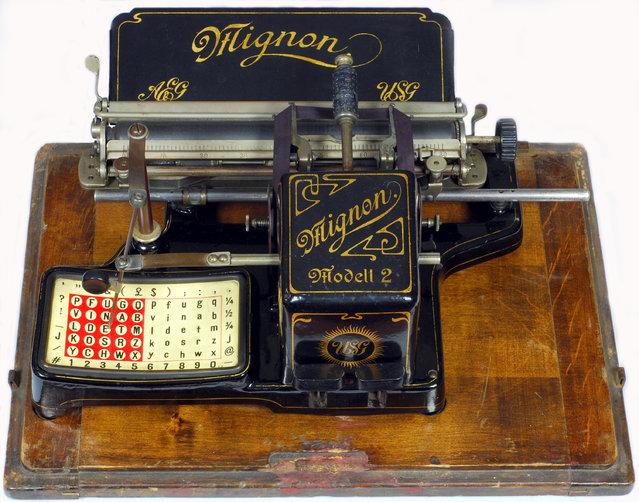
Mignon 2. A.E.G., Berlin, Germany, 1905. Despite its unusual appearance, the Mignon typewriter is of a very clever design, giving a smooth and fast operation for typing

«Mignon 2». A.E.G., Berlin, Germany, 1905. Despite its unusual appearance, the Mignon typewriter is of a very clever design, giving a smooth and fast operation for typing. (Photo and caption by Martin Howard/Martin Howard Collection)
Details
25 Sep 2013 08:37:00
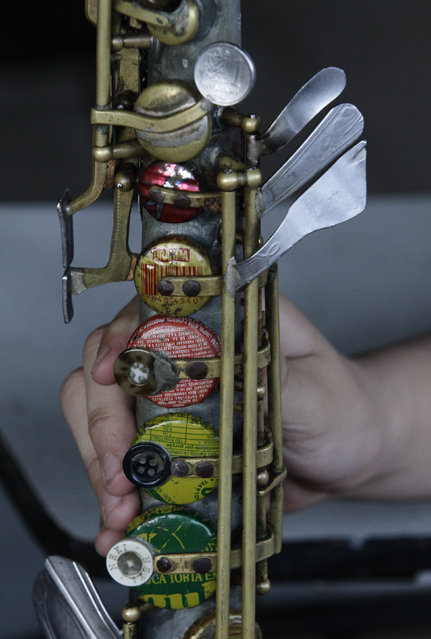
A student of the Orchestra of Recycled Instruments of Cateura holds an instrument made from recycled material by craftsman Nicolas Gomez, in Cateura, near Asuncion, May 9, 2013. The orchestra is the brainchild of its conductor Favio Chavez, who wanted to help the children of garbage pickers at the local landfill, and the instruments are made from salvaged materials by craftsman Gomez. (Photo by Jorge Adorno/Reuters)

A student of the Orchestra of Recycled Instruments of Cateura holds an instrument made from recycled material by craftsman Nicolas Gomez, in Cateura, near Asuncion, May 9, 2013. The orchestra is the brainchild of its conductor Favio Chavez, who wanted to help the children of garbage pickers at the local landfill, and the instruments are made from salvaged materials by craftsman Gomez. The orchestra now involves 30 schoolchildren who have toured countries in Latin America, North America and Europe to play music ranging from Beethoven and Mozart to the Beatles and Paraguayan folk songs. (Photo by Jorge Adorno/Reuters)
Details
12 Jul 2013 09:23:00