Loading...
Done
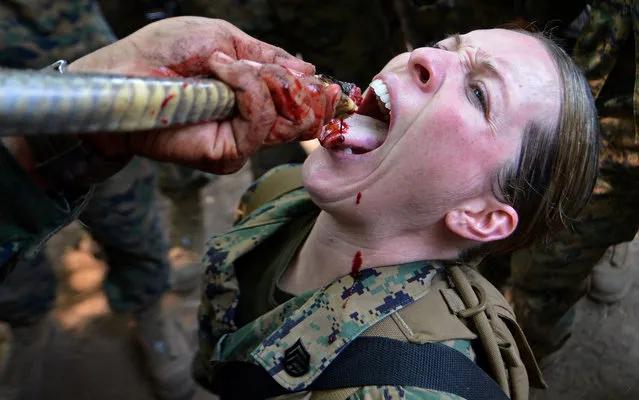
In a military base in the Thai province of Chon Buri February 20 U.S. Marines Navy with Thailand began their studies in jungle survival. The event is held in joint military exercises “Cobra Gold 2013”. During a jungle survival program February 20, 2013 taught by Royal Thai Special Forces in Sannapit, Thailand, U.S. Marines learned to catch cobras and drink their fresh blood, not to mention eat forest insects and pull the heads off of chicken. The training was part of Operation Cobra Gold 13, the 32nd edition of international military exercises hosted by the Thai. According to a U.S. Marines press release, Cobra Gold is the largest exercise of its kind in Asia and incorporates troops from five other nations in addition to the U.S. and Thailand. The Daily Mail reports that the Marines were invited to experience the local custom of drinking cobra blood after being taught to catch and kill cobras in the wild. As CNN notes, Cobra blood is believed to be a panacea and aphrodiasic in parts of Southeast Asia. In Jakarta, vendors can earn over $100 a night selling shots of cobra blood mixed with liquor. (Photo by Pornchai Kittiwongsakul/AFP Photo)

During a jungle survival program February 20, 2013 taught by Royal Thai Special Forces in Sannapit, Thailand, U.S. Marines learned to catch cobras and drink their fresh blood, not to mention eat forest insects and pull the heads off of chicken. The training was part of Operation Cobra Gold 13, the 32nd edition of international military exercises hosted by the Thai. According to a U.S. Marines press release, Cobra Gold is the largest exercise of its kind in Asia and incorporates troops from five other nations in addition to the U.S. and Thailand. The Daily Mail reports that the Marines were invited to experience the local custom of drinking cobra blood after being taught to catch and kill cobras in the wild. As CNN notes, Cobra blood is believed to be a panacea and aphrodiasic in parts of Southeast Asia. In Jakarta, vendors can earn over $100 a night selling shots of cobra blood mixed with liquor. (Photo by Pornchai Kittiwongsakul/AFP Photo)
Details
23 Feb 2013 11:52:00
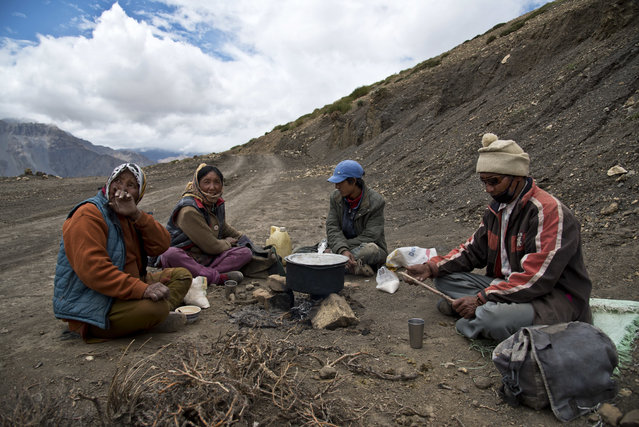
In this August 17, 2016, photo, from left to right, Chhering Chodom, 60, Tashi Yangzom, 50, Lobsang Chhering, 27, and Dorje Tandup, 58, drink milk tea on the side of the road. For centuries, the sleepy valley nestled in the Indian Himalayas remained a hidden Buddhist enclave forbidden to outsiders. Enduring the harsh year-round conditions of the high mountain desert, the people of Spiti Valley lived by a simple communal code – share the Earth's bounty, be hospitable to neighbors, and eschew greed and temptation at all turns. That's all starting to change, for better or worse. Since India began allowing its own citizens as well as outsiders to visit the valley in the early 1990s, tourism and trade have boomed. And the marks of modernization, such as solar panels, asphalt roads and concrete buildings, have begun to appear around some of the villages that dot the remote landscape at altitudes above 4,000 meters (13,000 feet). (Photo by Thomas Cytrynowicz/AP Photo)

In this August 17, 2016, photo, from left to right, Chhering Chodom, 60, Tashi Yangzom, 50, Lobsang Chhering, 27, and Dorje Tandup, 58, drink milk tea on the side of the road. For centuries, the sleepy valley nestled in the Indian Himalayas remained a hidden Buddhist enclave forbidden to outsiders. Enduring the harsh year-round conditions of the high mountain desert, the people of Spiti Valley lived by a simple communal code – share the Earth's bounty, be hospitable to neighbors, and eschew greed and temptation at all turns. That's all starting to change, for better or worse. (Photo by Thomas Cytrynowicz/AP Photo)
Details
15 Sep 2016 09:22:00
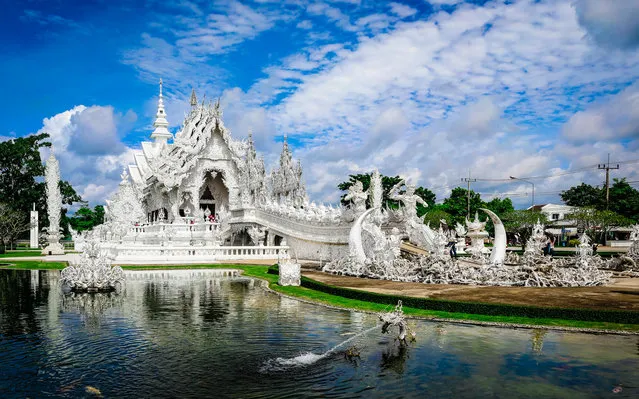
Wat Rong Khun Temple In Chiang Rai Thailand

Wat Rong Khun (Thai: วัดร่องขุ่น), more well-known among foreigners as the White Temple, is a contemporary unconventional Buddhist temple in Chiang Rai Province, Thailand. It was designed by Chalermchai Kositpipat in 1997.
Details
17 Aug 2014 08:29:00
A picture made available on 07 March 2016 shows visitors petting and holding a Fennec fox, native to the Sahara, in the petting room at the Little Zoo Cafe, a business built to capitalize on Thais' love for exotic animals, and food, on the outskirts of Bangkok, Thailand, 05 March 2016. (Photo by Barbara Walton/EPA)

A picture made available on 07 March 2016 shows visitors petting and holding a Fennec fox, native to the Sahara, in the petting room at the Little Zoo Cafe, a business built to capitalize on Thais' love for exotic animals, and food, on the outskirts of Bangkok, Thailand, 05 March 2016. The cafe boasts Fennec foxes, Meerkat, native to parts of Africa, Silver Fox, Raccoon and Chinchillas, along with a menu of Thai food and Cheesecake, among other sweet deserts. Nature is a faraway fantasy in the bustling exhaust-filled cement city of Bangkok, fuelling a demand to own and be close to exotic pets. The trend to be near to a species that was once wild, in a city environment, far from the natural setting, has drawn criticism but continues to grow. (Photo by Barbara Walton/EPA)
Details
13 Mar 2016 09:38:00
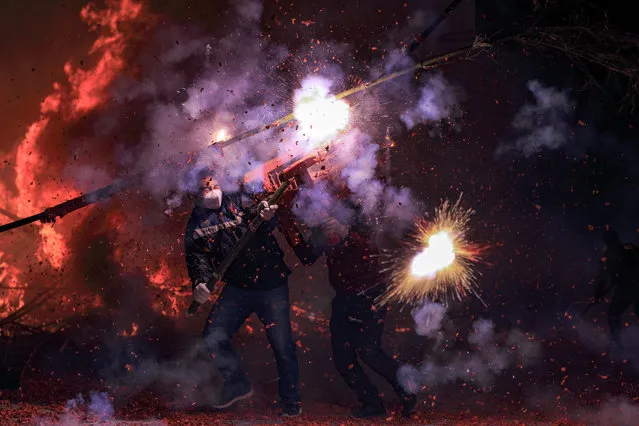
Villagers from Jiexi Jiantan village perform a ritual of “Zha Laoye”, or “Cracking local spirits”, in Chaoshan, Guangdong Province, China, 10 February 2019. Jiexi Jiantan Village celebrates the annual custom of “Zha Laoye” where Laoye are local spirits. Every third day of the lunar New Year, statues of local spirits known as the “Thousand-mile Eye” Laoye and “Ear Following the Wind” Laoye are brought out to the village committee to receive incensed tea offered by believers. By the sixth day of the year, the “Zha Laoye” activities begin with each man holding one of the statues on a chair above his head while run around a bonfire. Two other men light firecrackers strung up on a long bamboo poles and chase the spirit around the bonfire, signifying a bountiful new year. (Photo by EPA/EFE/ZNSEN)

Villagers from Jiexi Jiantan village perform a ritual of “Zha Laoye”, or “Cracking local spirits”, in Chaoshan, Guangdong Province, China, 10 February 2019. Jiexi Jiantan Village celebrates the annual custom of “Zha Laoye” where Laoye are local spirits. Every third day of the lunar New Year, statues of local spirits known as the “Thousand-mile Eye” Laoye and “Ear Following the Wind” Laoye are brought out to the village committee to receive incensed tea offered by believers. (Photo by EPA/EFE/ZNSEN)
Details
23 Feb 2019 00:07:00
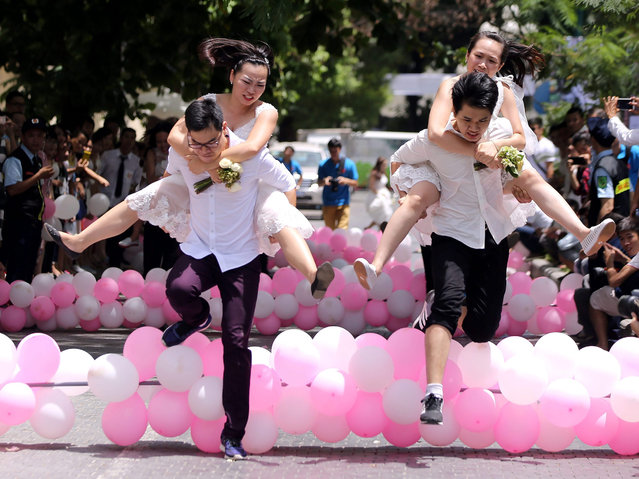
Couples take part in the “Love and Challenge Marathon” in Hanoi, Vietnam, 16 August 2015. Fifty couples, who are going to get married, participated in the event which is held the fifth time. This year, the winners of the marathon received a honeymoon trip to Malaysia. (Photo by Luong Thai Linh/EPA)

Couples take part in the “Love and Challenge Marathon” in Hanoi, Vietnam, 16 August 2015. Fifty couples, who are going to get married, participated in the event which is held the fifth time. This year, the winners of the marathon received a honeymoon trip to Malaysia. (Photo by Luong Thai Linh/EPA)
Details
17 Aug 2015 12:14:00
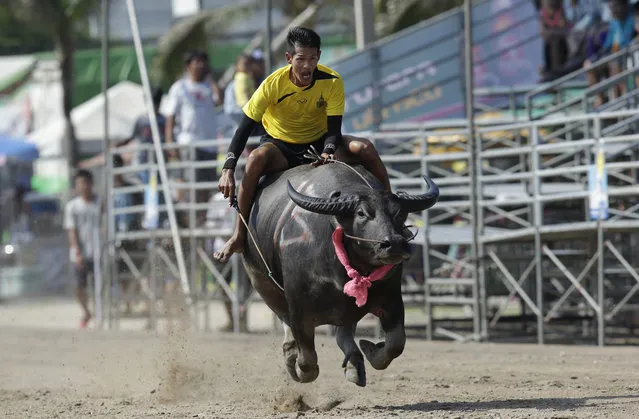
A Thai jockey competes during an annual water buffalo race in Chonburi Province, south of Bangkok, Thailand, Monday, Oct. 26, 2015. The annual race is a celebration among rice farmers before harvest. (AP Photo/Sakchai Lalit)

A Thai jockey competes during an annual water buffalo race in Chonburi Province, south of Bangkok, Thailand, Monday, October 26, 2015. The annual race is a celebration among rice farmers before harvest. (Photo by Sakchai Lalit/AP Photo)
Details
29 Oct 2015 08:06:00
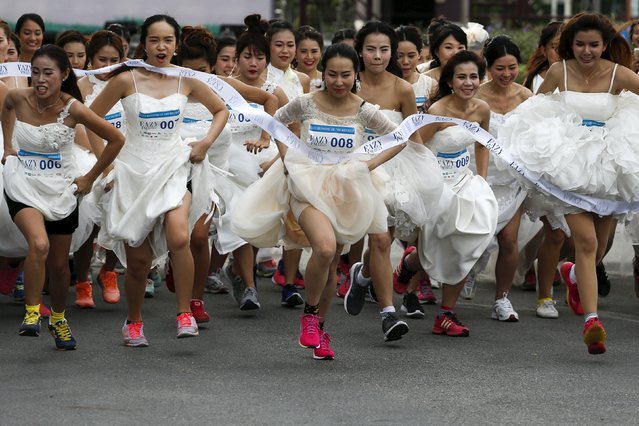
Brides-to-be participate in the "Running of the Brides" race in a park in Bangkok November 28, 2015. A hundred husbands and wives-to-be wore their wedding dresses and running shoes and competed in an event for a combined prize worth 1 million Thai baht ($27,928), according to the organisers. (Photo by Athit Perawongmetha/Reuters)

Brides-to-be participate in the "Running of the Brides" race in a park in Bangkok November 28, 2015. A hundred husbands and wives-to-be wore their wedding dresses and running shoes and competed in an event for a combined prize worth 1 million Thai baht ($27,928), according to the organisers. (Photo by Athit Perawongmetha/Reuters)
Details
30 Nov 2015 08:05:00