Loading...
Done
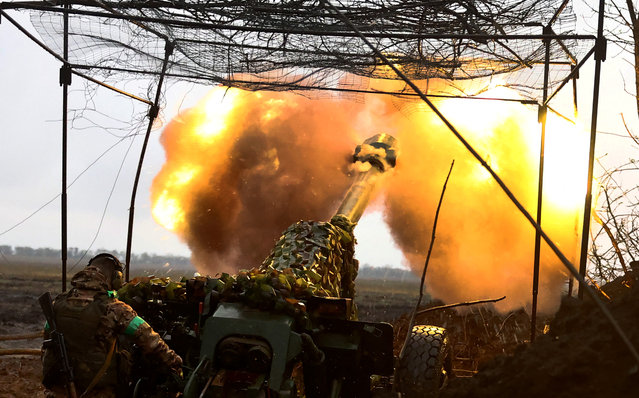
Ukrainian soldiers of the 71st Jaeger Brigade fire a M101 howitzer towards Russian positions at the frontline, near Avdiivka, Donetsk region, Ukraine, Friday, March 22, 2024. (Photo by Efrem Lukatsky/AP Photo)

Ukrainian soldiers of the 71st Jaeger Brigade fire a M101 howitzer towards Russian positions at the frontline, near Avdiivka, Donetsk region, Ukraine, Friday, March 22, 2024. (Photo by Efrem Lukatsky/AP Photo)
Details
24 Apr 2024 05:14:00
A Ukrainian serviceman stands on a flag of Russia's mercenary group Wagner near the Russian border in Sumy region, Ukraine on August 13, 2024. (Photo by Viacheslav Ratynskyi/Reuters)

A Ukrainian serviceman stands on a flag of Russia's mercenary group Wagner near the Russian border in Sumy region, Ukraine on August 13, 2024. (Photo by Viacheslav Ratynskyi/Reuters)
Details
23 Aug 2024 04:00:00
A Ukrainian serviceman hugs his relative after returning from captivity during a POWs exchange between Russia and Ukraine, in Ukraine, Monday December 30, 2024. (Photo by Evgeniy Maloletka/AP Photo)

A Ukrainian serviceman hugs his relative after returning from captivity during a POWs exchange between Russia and Ukraine, in Ukraine, Monday December 30, 2024. (Photo by Evgeniy Maloletka/AP Photo)
Details
20 Jan 2025 00:10:00
A woman looks at traditional Ukrainian Easter eggs “Pysanka”, installed as part of the upcoming celebrations of Easter, in central Kiev, Ukraine, April 29, 2016. A pysanka is a Ukrainian Easter egg, decorated with traditional Ukrainian folk designs using a wax-resist (batik) method. The word pysanka comes from the verb pysaty, “to write”, as the designs are not painted on, but written with beeswax. Many other eastern European ethnic groups decorate eggs using wax resist for Easter. These include the Belarusians, Bulgarians, Croats, Czechs, Hungarians, Lithuanians, Poles, Romanians, Serbs, Slovaks, Slovenes and Sorbs. (Photo by Valentyn Ogirenko/Reuters)

A woman looks at traditional Ukrainian Easter eggs “Pysanka”, installed as part of the upcoming celebrations of Easter, in central Kiev, Ukraine, April 29, 2016. A pysanka is a Ukrainian Easter egg, decorated with traditional Ukrainian folk designs using a wax-resist (batik) method. The word pysanka comes from the verb pysaty, “to write”, as the designs are not painted on, but written with beeswax. Many other eastern European ethnic groups decorate eggs using wax resist for Easter. These include the Belarusians, Bulgarians, Croats, Czechs, Hungarians, Lithuanians, Poles, Romanians, Serbs, Slovaks, Slovenes and Sorbs. (Photo by Valentyn Ogirenko/Reuters)
Details
30 Apr 2016 09:00:00
A pro-Russian rebel guards a captured former Ukrainian Army checkpoint outside Vuhlehirsk, Donetsk region, eastern Ukraine, Thursday, February 5, 2015. The rebels have closed in around the town in a strategy they triumphantly refer to as the Debaltseve cauldron. Separatists recently burst through government lines in the rural settlement of Vuhlehirsk. (Photo by Vadim Braydov/AP Photo)

A pro-Russian rebel guards a captured former Ukrainian Army checkpoint outside Vuhlehirsk, Donetsk region, eastern Ukraine, Thursday, February 5, 2015. The rebels have closed in around the town in a strategy they triumphantly refer to as the Debaltseve cauldron. Separatists recently burst through government lines in the rural settlement of Vuhlehirsk. (Photo by Vadim Braydov/AP Photo)
Details
06 Feb 2015 13:11:00
Deputies clash during a session of the parliament in Kiev April 8, 2014. (Photo by Valentyn Ogirenko/Reuters)

Deputies in the Ukrainian parliament brawled in the chamber on Tuesday, April 8, 2014 after a communist leader accused nationalists of playing into the hands of Russia by adopting extreme tactics early in the Ukrainian crisis. Two deputies from the Svoboda far-right nationalist party took exception to the charges by communist Petro Symonenko and seized him while he was talking from the rostrum. (Photo by Valentyn Ogirenko/Reuters)
Details
09 Apr 2014 08:54:00
Olena Korzeniuk, a 15-year-old girl poses on the stairs during a bid to set the national record for the longest hair on a child in Kiev, Ukraine on March 12, 2019. During a ceremony, the experts of the National Register of Records found the blonde hair of the Ukrainian Rapunzel to be 2.35m (6.5ft) long. (Photo by Tarasov/Ukrinform/Barcroft Images)

Olena Korzeniuk, a 15-year-old girl poses on the stairs during a bid to set the national record for the longest hair on a child in Kiev, Ukraine on March 12, 2019. During a ceremony, the experts of the National Register of Records found the blonde hair of the Ukrainian Rapunzel to be 2.35m (6.5ft) long. (Photo by Tarasov/Ukrinform/Barcroft Images)
Details
14 Mar 2019 00:05:00
An artist is seen preparing during the Kramatorsk tent show in Kramatorsk, Ukraine on August 29, 2021. Traditional tent shows are still very popular in the twenty first century among Ukrainian people of all ages. (Photo by Andriy Andriyenko/SOPA Images/Rex Features/Shutterstock)

An artist is seen preparing during the Kramatorsk tent show in Kramatorsk, Ukraine on August 29, 2021. Traditional tent shows are still very popular in the twenty first century among Ukrainian people of all ages. (Photo by Andriy Andriyenko/SOPA Images/Rex Features/Shutterstock)
Details
16 Sep 2021 08:59:00