Loading...
Done
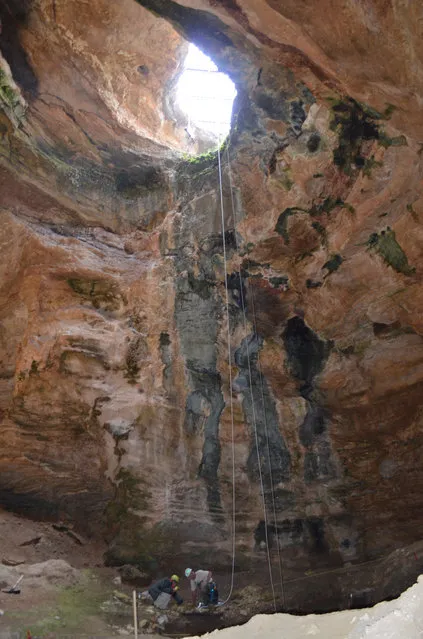
This July 2014 image provided by the Bureau of Land Management shows the interior of the Natural Trap Cave in north-central Wyoming. The cave holds the remains of tens of thousands of animals, including many now-extinct species, from the late Pleistocene period tens of thousands of years ago. Scientists have resumed digging for the first time in more than 30 years. (Photo by AP Photo/Bureau of Land Management)

This July 2014 image provided by the Bureau of Land Management shows the interior of the Natural Trap Cave in north-central Wyoming. The cave holds the remains of tens of thousands of animals, including many now-extinct species, from the late Pleistocene period tens of thousands of years ago. Scientists have resumed digging for the first time in more than 30 years. (Photo by AP Photo/Bureau of Land Management)
Details
10 Aug 2014 10:35:00
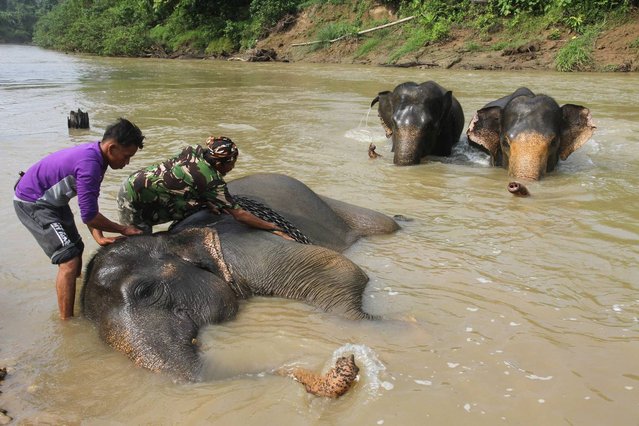
Indonesian mahouts (elephant masters) bathe elephants prior to a daily patrol at a Conservation Respons Unite (CRU) to control elephant-human conflicts in Serbajadi, East Aceh on April 7, 2016. Elephants have joined the front line in the fight against poaching and illegal logging in the dense jungles of Sumatra. Guided by their Indonesian mahouts, they trek alongside rivers, over rough terrain and deep into the rainforest in an area that is home to numerous endangered species, from orangutans to tigers, but which has suffered devastating deforestation in recent years. (Photo by AFP Photo/Januar)

Indonesian mahouts (elephant masters) bathe elephants prior to a daily patrol at a Conservation Respons Unite (CRU) to control elephant-human conflicts in Serbajadi, East Aceh on April 7, 2016. Elephants have joined the front line in the fight against poaching and illegal logging in the dense jungles of Sumatra. Guided by their Indonesian mahouts, they trek alongside rivers, over rough terrain and deep into the rainforest in an area that is home to numerous endangered species, from orangutans to tigers, but which has suffered devastating deforestation in recent years. (Photo by AFP Photo/Januar)
Details
11 Apr 2016 10:24:00
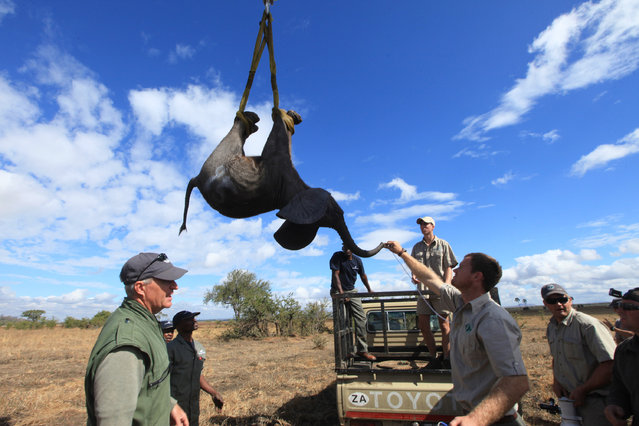
In this Tuesday July 12, 2016 photo, an elephant is lifted by a crane in an upside down position in Lilongwe, Malawi, in the first step of an assisted migration of 500 of the threatened species. African Parks, which manages three Malawian reserves is moving the 500 elephants from Liwonde National Park, this month and next, and again next year when vehicles can maneuver on the rugged terrain during Southern Africa's dry winter. (Photo by Tsvangirayi Mukwazhi/AP Photo)

In this Tuesday July 12, 2016 photo, an elephant is lifted by a crane in an upside down position in Lilongwe, Malawi, in the first step of an assisted migration of 500 of the threatened species. African Parks, which manages three Malawian reserves is moving the 500 elephants from Liwonde National Park, this month and next, and again next year when vehicles can maneuver on the rugged terrain during Southern Africa's dry winter. (Photo by Tsvangirayi Mukwazhi/AP Photo)
Details
20 Jul 2016 10:19:00
Convention goers dressed as bright colored Wookiees, a fictional species from the US epic space opera franchise Star Wars, prepare for a group photo outside the Comic Con 2016 in San Diego, California, USA, 22 July 2016. The San Diego Comic Con 2016 runs from 21 until 24 July. (Photo by David Maung/EPA)

Convention goers dressed as bright colored Wookiees, a fictional species from the US epic space opera franchise Star Wars, prepare for a group photo outside the Comic Con 2016 in San Diego, California, USA, 22 July 2016. The San Diego Comic Con 2016 runs from 21 until 24 July. (Photo by David Maung/EPA)
Details
24 Jul 2016 11:07:00
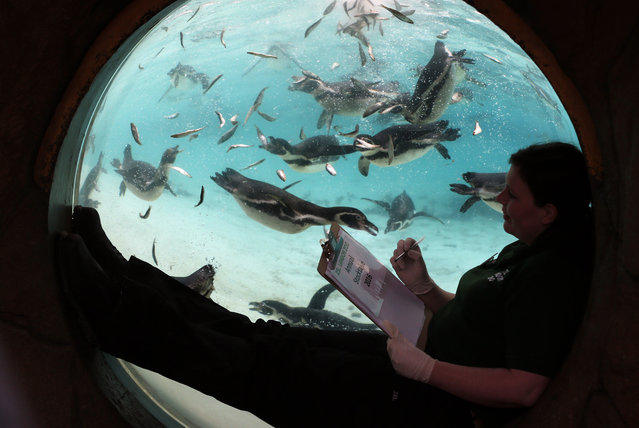
Humboldt Penguins swim in their pool as a keeper looks on through a spherical window during the annual stocktake press preview at London Zoo in Regents Park in London Monday, January 4, 2016. A requirement of ZSL London Zoo's license, the annual audit takes keepers a week to complete and all of the information is shared with zoos around the world via the International Species Information System, where it's used to manage the worldwide breeding programmes for endangered animals. (Photo by Alastair Grant/AP Photo)

Humboldt Penguins swim in their pool as a keeper looks on through a spherical window during the annual stocktake press preview at London Zoo in Regents Park in London Monday, January 4, 2016. A requirement of ZSL London Zoo's license, the annual audit takes keepers a week to complete and all of the information is shared with zoos around the world via the International Species Information System, where it's used to manage the worldwide breeding programmes for endangered animals. (Photo by Alastair Grant/AP Photo)
Details
06 Jan 2016 08:01:00
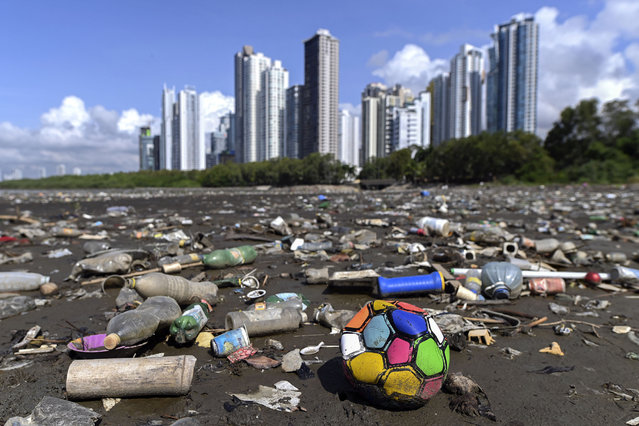
Garbage, including plastic waste, is seen at the beach of Costa del Este, in Panama City, on April 19, 2021. Every two weeks, Marine Biology students descend about five meters in the sea to take care of a coral nursery of the staghorn species (Acropora cervicornis) in Portobelo, Panama, with which they aim to restore reefs damaged by climate change and pollution, as part of the Reef2Reef project. (Photo by Luis Acosta/AFP Photo)

Garbage, including plastic waste, is seen at the beach of Costa del Este, in Panama City, on April 19, 2021. Every two weeks, Marine Biology students descend about five meters in the sea to take care of a coral nursery of the staghorn species (Acropora cervicornis) in Portobelo, Panama, with which they aim to restore reefs damaged by climate change and pollution, as part of the Reef2Reef project. (Photo by Luis Acosta/AFP Photo)
Details
21 Jun 2021 07:30:00
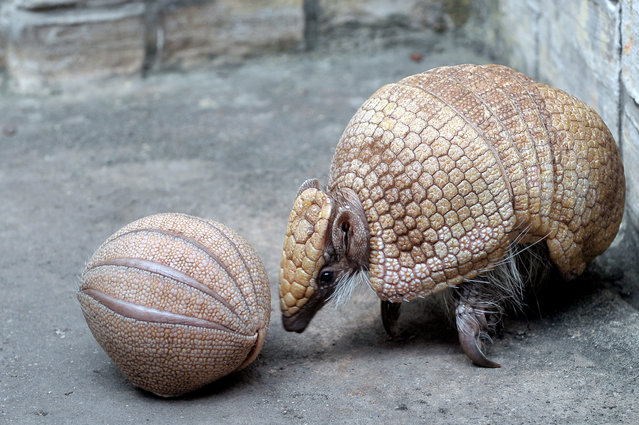
A four-week old southern three-banded armadillo (Tolypeutes matacus) is rolled up into a ball next to its mother in the tropical house of Budapest Zoo in Budapest, Hungary on May 3, 2019. The South American insect-eating mammal and its close relative, the Brasilian three-banded armadillo (Tolypeutes tricinctus) are the only two species of armadillos capable of rolling into a complete ball to defend themselves when feeling threatened. (Photo by Attila Kovács/EPA/EFE)

A four-week old southern three-banded armadillo (Tolypeutes matacus) is rolled up into a ball next to its mother in the tropical house of Budapest Zoo in Budapest, Hungary on May 3, 2019. The South American insect-eating mammal and its close relative, the Brasilian three-banded armadillo (Tolypeutes tricinctus) are the only two species of armadillos capable of rolling into a complete ball to defend themselves when feeling threatened. (Photo by Attila Kovács/EPA/EFE)
Details
05 May 2019 00:03:00
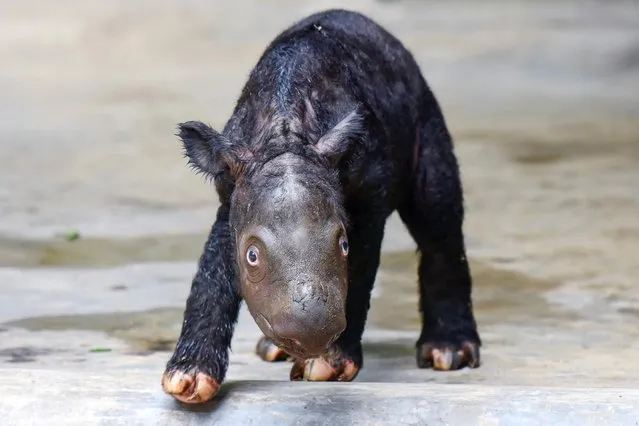
In this undated photo released by Indonesian Ministry of Environment and Forestry, a newly born Sumatran rhino calf walks in its enclosure at Sumatran Rhino Sanctuary at Way Kambas National Park, Indonesia. The critically endangered Sumatran rhino was born on Sumatra Island Saturday, November 25, 2023, the second Sumatran rhino born in the country this year and a welcome addition to a species that currently numbers fewer than 50 animals. (Photo by Indonesian Ministry of Environment and Forestry via AP Photo)

In this undated photo released by Indonesian Ministry of Environment and Forestry, a newly born Sumatran rhino calf walks in its enclosure at Sumatran Rhino Sanctuary at Way Kambas National Park, Indonesia. The critically endangered Sumatran rhino was born on Sumatra Island Saturday, November 25, 2023, the second Sumatran rhino born in the country this year and a welcome addition to a species that currently numbers fewer than 50 animals. (Photo by Indonesian Ministry of Environment and Forestry via AP Photo)
Details
17 Dec 2023 05:52:00