Loading...
Done
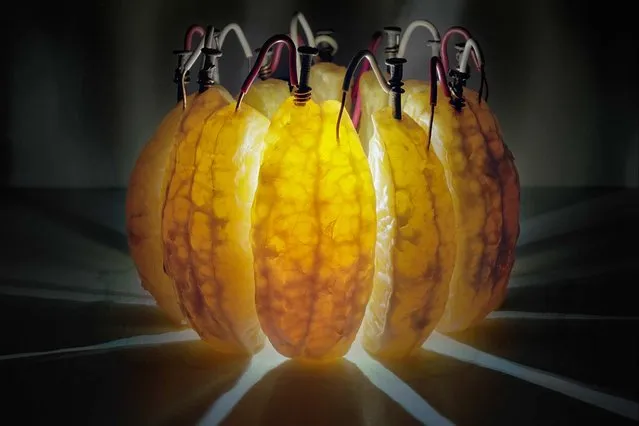
Wedges of an orange generate enough current and electrical juice – 3.5 volts – to power an LED. The fruit’s citric acid helps electrons flow from galvanized nails to copper wire in this 14-hour exposure. This image was published in September’s Visions of Earth, a trio of photos that appear in each issue of National Geographic. (Photo by Caleb Charland/National Geographic)

Wedges of an orange generate enough current and electrical juice – 3.5 volts – to power an LED. The fruit’s citric acid helps electrons flow from galvanized nails to copper wire in this 14-hour exposure. This image was published in September’s Visions of Earth, a trio of photos that appear in each issue of National Geographic. (Photo by Caleb Charland/National Geographic)
Details
06 Jan 2014 12:09:00
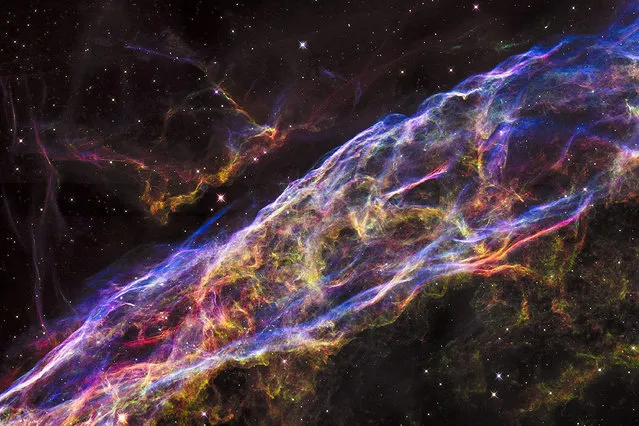
A small section of the expanding remains of the Veil Nebula, a massive star that exploded about 8,000 years ago. The entire nebula is 110 light-years across, covering six full moons on the sky as seen from Earth, and resides about 2,100 light-years away in the constellation Cygnus, the Swan. (Photo by Reuters/NASA/ESA/Hubble)

A small section of the expanding remains of the Veil Nebula, a massive star that exploded about 8,000 years ago. The entire nebula is 110 light-years across, covering six full moons on the sky as seen from Earth, and resides about 2,100 light-years away in the constellation Cygnus, the Swan. (Photo by Reuters/NASA/ESA/Hubble)
Details
29 Feb 2016 11:30:00
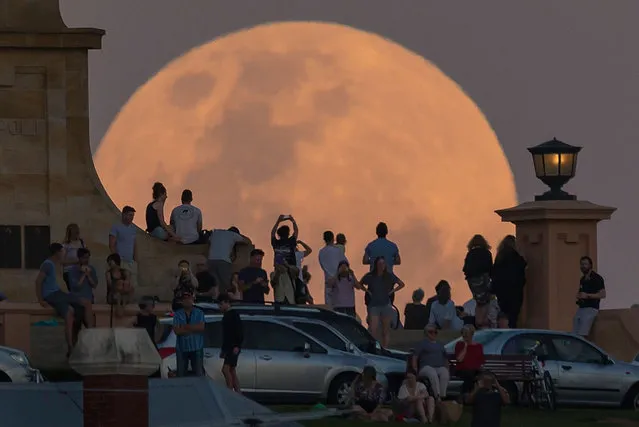
Crowds look on as the super moon rises behind the Fremantle War Memorial at Monument Hill on November 14, 2016 in Fremantle, Australia. A super moon occurs when a full moon passes closes to earth than usual, with the November 14th moon expected to be closer than it has been in over 70 years. (Photo by Paul Kane/Getty Images)

Crowds look on as the super moon rises behind the Fremantle War Memorial at Monument Hill on November 14, 2016 in Fremantle, Australia. A super moon occurs when a full moon passes closes to earth than usual, with the November 14th moon expected to be closer than it has been in over 70 years. (Photo by Paul Kane/Getty Images)
Details
15 Nov 2016 11:30:00
Indigenous people march during the annual Free Earth camp, where they discuss rights, territorial protection and their role in COP30, which will take place for the first time in the Amazon, in Brasilia, Brazil, Tuesday, April 8, 2025. (Photo by Eraldo Peres/AP Photo)

Indigenous people march during the annual Free Earth camp, where they discuss rights, territorial protection and their role in COP30, which will take place for the first time in the Amazon, in Brasilia, Brazil, Tuesday, April 8, 2025. (Photo by Eraldo Peres/AP Photo)
Details
15 Jun 2025 04:21:00
A woman dressed up for Halloween travels on a Metro train in São Paulo, Brazil on October 30, 2017. (Photo by Cris Faga/Rex Features/Shutterstock)

A woman dressed up for Halloween travels on a Metro train in São Paulo, Brazil on October 30, 2017. (Photo by Cris Faga/Rex Features/Shutterstock)
Details
01 Nov 2017 08:45:00
Passengers travel in an overcrowded train in the eastern Indian city of Patna, February 23, 2010. (Photo by Krishna Murari Kishan/Reuters)

Passengers travel in an overcrowded train in the eastern Indian city of Patna, February 23, 2010. (Photo by Krishna Murari Kishan/Reuters)
Details
26 Feb 2016 10:20:00
LAPD chopper flies in a foregraund of the Super Moon in Los Angeles, California on May 05, 2012

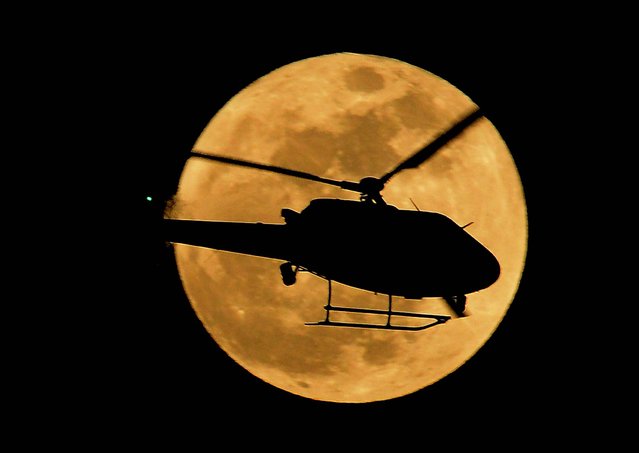
LAPD chopper flies in a foregraund of the Super Moon in Los Angeles, California on May 05, 2012. Tonight's moon is set to appear 14 percent larger and 30 percent brighter from our perspective on Earth. The Supermoon lines up much closely with perigee – the moon's closest point to Earth. The 2012 May full moon falls some six minutes after perigee, the moon's closest point to Earth for this month. At perigee, the moon lies only 221,802 miles (356,955 kilometers ) away. Later this month, on May 19, the moon will swing out to apogee – its farthest point for the month – at 252,555 miles (406,448 kilometers) distant. (Photo by AFP/File, Joe Klamar)
Details
08 May 2012 10:54:00
SpaceX’s Dragon spacecraft, March 6, 2014. SpaceX's Falcon 9 rocket and Dragon spacecraft launched from Launch Complex 40 at the Cape Canaveral Air Force Station, Florida, for their third official Commercial Resupply (CRS) mission to the orbiting lab on April 18, 2014. Dragon is the only operational spacecraft capable of returning a significant amount of supplies back to Earth, including experiments. (Photo by Ron Lin/SpaceX Photos)

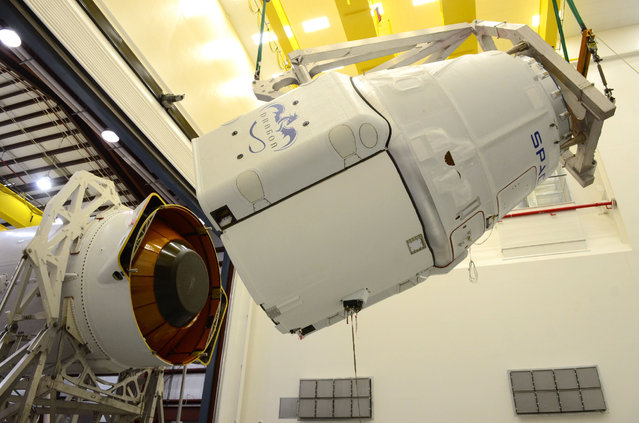
SpaceX’s Dragon spacecraft, March 6, 2014. SpaceX's Falcon 9 rocket and Dragon spacecraft launched from Launch Complex 40 at the Cape Canaveral Air Force Station, Florida, for their third official Commercial Resupply (CRS) mission to the orbiting lab on April 18, 2014. Dragon returned to Earth with a parachute-assisted splashdown off the coast of southern California on May 14, 2014. Dragon is the only operational spacecraft capable of returning a significant amount of supplies back to Earth, including experiments. (Photo by Ron Lin/SpaceX Photos)
Details
30 Mar 2015 13:11:00