Loading...
Done
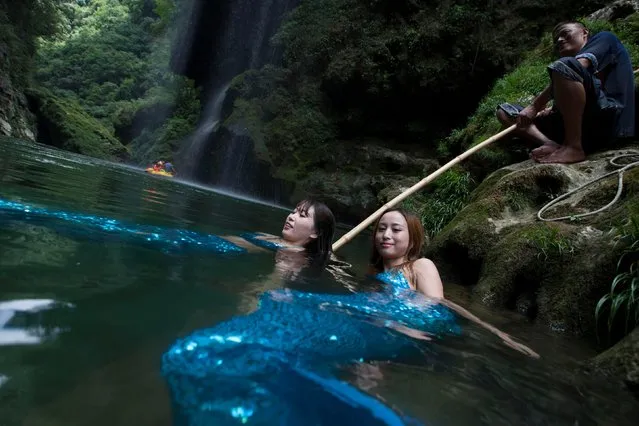
Looking for a reason to visit the Philippines? This mermaid school should do the trick. No, seriously, there’s an actual school that will teach you how to be a mermaid. It’s called the Philippines Mermaid Swimming Academy. A couple of years ago, the academy was founded by Anamie Saenz and Normeth Preglo. The duo was looking for a new fitness craze and thought of mermaids! It’s all pretty simple; students are given mermaid tails that help them focus on their core muscles while they swim around like Ariel. If you’re really looking to get involved, you can kick things up a notch with mermaid scuba diving and mermaid water scootering. The best part about the mermaid school? You can be any age and any gender – it really doesn’t matter! All you need to do is pull together $40 for an introductory class. You get to use a mermaid tail, and you’ll also get photos while taking part in the class. (Photo by Philippine Mermaid Swimming Academy/Exclusivepix Media)

Looking for a reason to visit the Philippines? This mermaid school should do the trick. No, seriously, there’s an actual school that will teach you how to be a mermaid. It’s called the Philippines Mermaid Swimming Academy. (Photo by Philippine Mermaid Swimming Academy/Exclusivepix Media)
Details
21 Dec 2016 10:14:00
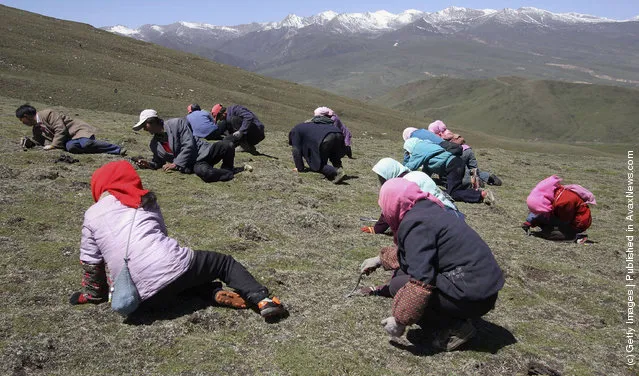
Ophiocordyceps Sinensis A.K.A. Caterpillar Fungus

“There are over 680 documented species of the sac fungus genus Ophiocordyceps, and one of the best known of these is Ophiocordyceps sinensis, colloquially known as caterpillar fungus. The fungus is known in Tibetan as yartsa gunbu or yatsa gunbu. O. sinensis is known in the West as a medicinal mushroom and its use has a long history in Traditional Chinese medicine as well as Traditional Tibetan medicine. The highly valuable fungus-caterpillar combination is hand-collected and is used as an aphrodisiac and as a treatment for a variety of ailments from fatigue to cancer”. – Wikipedia

Photo: Nomads dig for Chinese caterpillar fungus from a mountain May 25, 2007 in Guide County, Hainan Prefecture, Qinghai Province, China. Nomads can earn about 2,000 yuan to 5,000 yuan (about U.S. $260 to $653 ) through their work during the fifty-day Chinese caterpillar fungus gathering season. (Photo by China Photos/Getty Images)

Details
26 Sep 2011 10:47:00
A dog catches a wave during the Surf City Surf Dog Contest in Huntington Beach, California September 27, 2015. (Photo by Lucy Nicholson/Reuters)

A dog catches a wave during the Surf City Surf Dog Contest in Huntington Beach, California September 27, 2015. (Photo by Lucy Nicholson/Reuters)
Details
01 Oct 2015 08:04:00
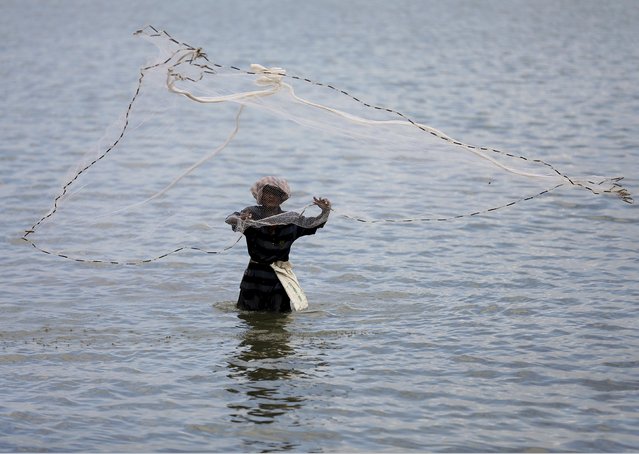
A fisherman throws his net to catch fish in a lagoon in Batticaloa November 24, 2015. (Photo by Dinuka Liyanawatte/Reuters)

A fisherman throws his net to catch fish in a lagoon in Batticaloa November 24, 2015. (Photo by Dinuka Liyanawatte/Reuters)
Details
26 Nov 2015 08:03:00
“Catch a drop!”. (Photo and caption by memberx)

“Catch a drop!”. (Photo and caption by memberx)
Details
14 Jun 2013 10:43:00
A fisherman waits to catch fish as he sits atop a stilt in the sea in Koggala, Sri Lanka on July 4, 2019. (Photo by Dinuka Liyanawatte/Reuters)

A fisherman waits to catch fish as he sits atop a stilt in the sea in Koggala, Sri Lanka on July 4, 2019. (Photo by Dinuka Liyanawatte/Reuters)
Details
11 Feb 2020 00:03:00
Spectacular images offering insight into the lives of the Huaorani people in the Ecuadorian Amazon have been revealed showing how they use traditional methods to hunt monkeys for food. The stunning pictures were taken by conservation photographer Pete Oxford from Torquay, Devon in the Ecuadorian Amazon. “The Huaorani Indians are a forest people highly in tune with their environment. Many are now totally acculturated since the 1950s by missionaries”, said Pete. “Today they face radical change to their culture to the proximity of oil exploration within their territory and the Yasuni National Park and Biosphere Reserve, they are vastly changed. Some still live very traditionally and for this shoot, through my Huaorani friend, a direct relative of those photographed he wanted to depict them as close to their original culture as possible. They still largely hunt with blow pipes and spears eating a lot of monkeys and peccaries”. The Huaorani are also known as the Waorani, Waodani or the Waos and are native Amerindians. Their lands are located between the Curaray and Napo rivers and speak the Huaorani language. Pete says that during his visit he was welcomed into the group and hopes that ancient cultures can be saved. Here: The tribe were seen celebrating after a hunter returned to camp with a wild pig. (Photo by Pete Oxford/Mediadrumworld.com)

Spectacular images offering insight into the lives of the Huaorani people in the Ecuadorian Amazon have been revealed showing how they use traditional methods to hunt monkeys for food. The stunning pictures were taken by conservation photographer Pete Oxford from Torquay, Devon in the Ecuadorian Amazon. Here: The tribe were seen celebrating after a hunter returned to camp with a wild pig. (Photo by Pete Oxford/Mediadrumworld.com)
Details
20 Jan 2017 07:58:00
A man takes a photograph of his friend as thick smoke rises from a fire, which broke out at oil wells set ablaze by Islamic State militants before they fled the oil-producing region of Qayyara, Iraq, January 28, 2017. (Photo by Muhammad Hamed/Reuters)

A man takes a photograph of his friend as thick smoke rises from a fire, which broke out at oil wells set ablaze by Islamic State militants before they fled the oil-producing region of Qayyara, Iraq, January 28, 2017. (Photo by Muhammad Hamed/Reuters)
Details
30 Jan 2017 09:55:00