Loading...
Done
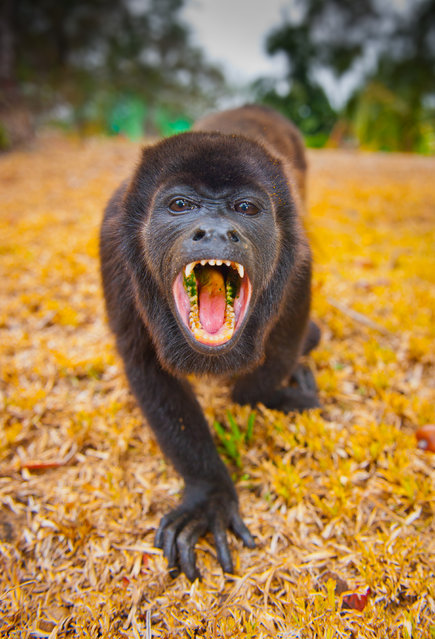
“Attacking Howler Monkey”. Due to a major tropical rainstorm my wife and I were forced to stay overnight in a Howler Monkey Rescue center in Panama. I used the time to explore the area and to take photos of the monkeys. Just after the rain finally stopped, I ran into this monkey that tried to mock attack me. I quickly took a couple of photos before retreating to a (more) safe distance. (Photo and caption by Christian Mueller-Planitz/National Geographic Traveler Photo Contest)

“Attacking Howler Monkey”. Due to a major tropical rainstorm my wife and I were forced to stay overnight in a Howler Monkey Rescue center in Panama. I used the time to explore the area and to take photos of the monkeys. Just after the rain finally stopped, I ran into this monkey that tried to mock attack me. I quickly took a couple of photos before retreating to a (more) safe distance. (Photo and caption by Christian Mueller-Planitz/National Geographic Traveler Photo Contest)

ATTENTION! All pictures are presented in high resolution. To see Hi-Res images – just TWICE click on any picture. In other words, click small picture – opens the BIG picture. Click BIG picture – opens VERY BIG picture.
Details
30 Jun 2013 12:25:00
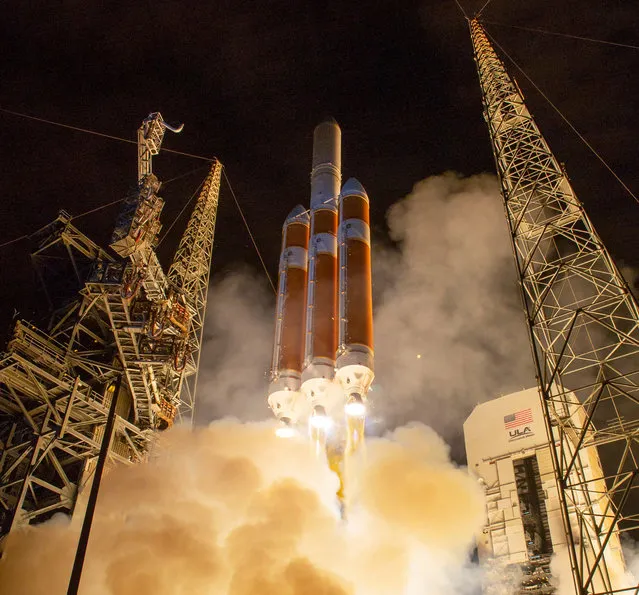
A handout photo made available by the NASA shows the United Launch Alliance Delta IV Heavy rocket launches NASA's Parker Solar Probe to touch the Sun, from Launch Complex 37 at Cape Canaveral Air Force Station, Florida, USA, 12 August 2018. Parker Solar Probe is humanity’s first-ever mission into a part of the Sun’s atmosphere called the corona. Here it will directly explore solar processes that are key to understanding and forecasting space weather events that can impact life on Earth. (Photo by Bill Ingalls/EPA-EFE/NASA)

A handout photo made available by the NASA shows the United Launch Alliance Delta IV Heavy rocket launches NASA's Parker Solar Probe to touch the Sun, from Launch Complex 37 at Cape Canaveral Air Force Station, Florida, USA, 12 August 2018. Parker Solar Probe is humanity’s first-ever mission into a part of the Sun’s atmosphere called the corona. Here it will directly explore solar processes that are key to understanding and forecasting space weather events that can impact life on Earth. (Photo by Bill Ingalls/EPA-EFE/NASA)
Details
13 Aug 2018 07:26:00
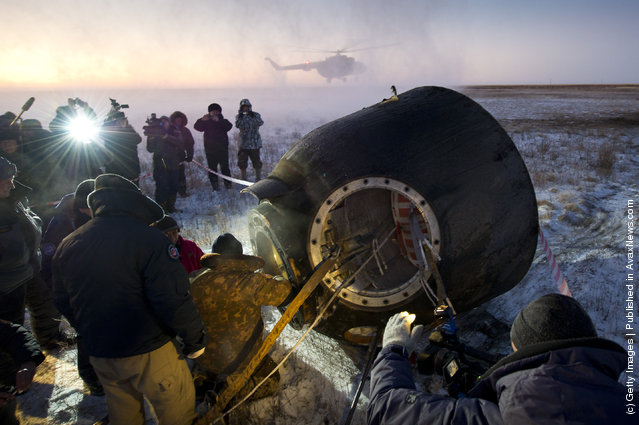
Russian support personnel work to help get Expedition 29 crew members out of the Soyuz TMA-02M spacecraft shortly after the capsule landed

Russian support personnel work to help get Expedition 29 crew members out of the Soyuz TMA-02M spacecraft shortly after the capsule landed with Expedition 29 Commander Mike Fossum, and Flight Engineers Sergei Volkov and Satoshi Furukawa on November 22, 2011 outside of the town of Arkalyk, Kazakhstan. NASA Astronaut Fossum, Russian Cosmonaut Volkov and JAXA (Japan Aerospace Exploration Agency) Astronaut Furukawa are returning from more than five months onboard the International Space Station (ISS) where they served as members of the Expedition 28 and 29 crews. (Photo by Bill Ingalls/NASA via Getty Images)
Details
22 Nov 2011 13:41:00
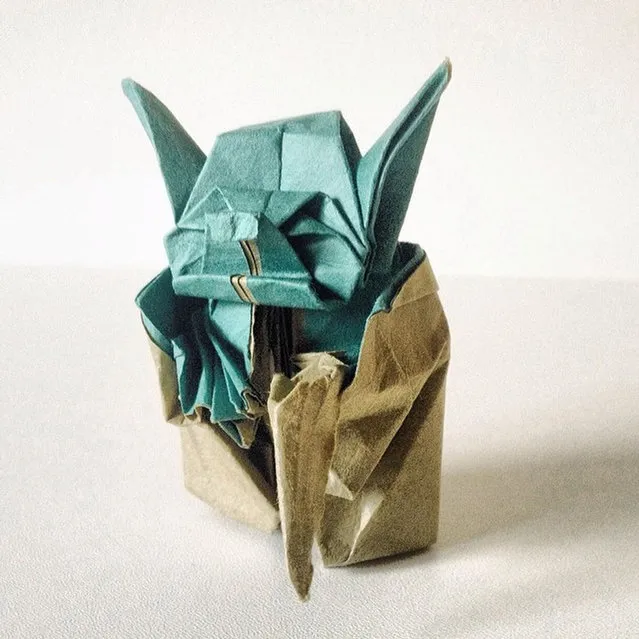
Origami By Ross Symons

As kids we have the natural desire to explore and to create. Whenever our parents would make for us a paper plane, we would become overjoyed seeing it fly across the room. However, planes are not the only thing that can be made from paper, and not only kids are fascinated by it. Some people master the art of origami and are able to create pretty much anything. You never know what’s going to come out when the artist twists and turns a piece of paper in meticulous ways. Finally, the figurine is complete, and you immediately see the striking resemblance of this piece of paper with an animal or some other creature. Ross Symons is one of those artists. He creates his figurines simply for the joy it brings him. Maybe, he uses this as a medium to enter his childhood, or maybe he has other motifs – we will never know. (Photo by Ross Symons)
Details
31 Oct 2014 12:12:00
Abandoned Six Flags - New Orleans

Six Flags New Orleans, also abbreviated to SFNO, is an abandoned theme park in New Orleans, Louisiana, that has been closed since just before Hurricane Katrina struck in August 2005 and is currently owned by the city of New Orleans. Six Flags had previously owned the park since March 2002, but after assessing the devastation caused by Hurricane Katrina and the related exorbitant expenses of repairing the damage, sought to terminate their 75-year lease with the city, beginning in July 2006 and finally succeeding in September 2009. The park is located in Eastern New Orleans, in the Ninth Ward of the city, off Interstate 10. Despite various announced plans to redevelop the site, as of 2014, it is still an abandoned amusement park in extremely poor condition. It is a well-known urban exploration destination.
Details
29 Apr 2014 12:06:00
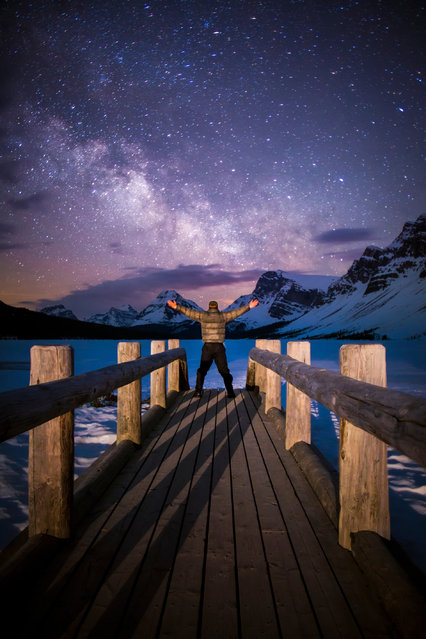
Paul Zizka in “Galactic Gateway”, Bow Lake, Banff National Park, May 11, 2013. (Photo by Paul Zizka/Caters News)

“These are the stunning shots of one photographer who is putting everyday “selfies” to shame. Paul Zizka, 34, began experimenting with night photography just two years ago and immediately became fascinated with the spectacular scenes he discovered. To create something more unique he started adding himself into the shot – as well as showing others the beautiful surroundings he had been exploring. Using lengthy exposure, the photographer felt that featuring himself in some of his shots – the night sky illuminating the mountains around him – created a relationship between the central figure in the image and the nature around him”. – Caters News. Photo: Paul Zizka in “Galactic Gateway”, Bow Lake, Banff National Park, May 11, 2013. (Photo by Paul Zizka/Caters News)
Details
22 May 2014 04:38:00
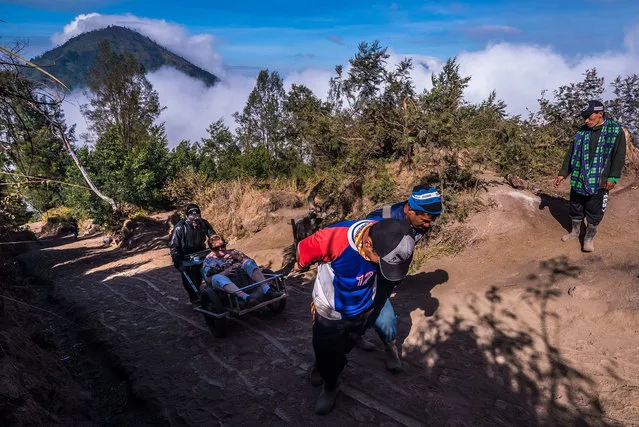
Miners pulling up lazy tourists to the rim of Kawah Ijen (Ijen Volcano), East Java, Indonesia on September 21, 2017. They will earn as much as they would bring down a load of sulfur. Nomadic Explorer, Cultural Lifestyle Photographer Claudio Sieber captured striking images of miners working at Ijen volcanic range in East Java, Indonesia. The sulphur miners risk their lives daily as they climb the active volcano carrying heavy loads, which they sell to sugar refineries. Shortly after midnight curious tourists are flocking in hundreds through the gate of Ijen's foothills to be right on time, driven by the images others took before them. Kawah Ijen is the one of the world's largest acidic volcanic crater lake; famous for its turquoise color as well as the unreal atmosphere it offers during darkness. A dusty path zigzags 3 kilometers up to the crater rim. This doesn't mean anything challenging; in particular, special sights have to be deserved anyway. The irritating smell of sulfur announces the near of the crater's existence. Arriving on the crater's rim the reward for the torture becomes visible. Blue fire darts its tongues through the fumes of sulfur dioxide. Somehow, the spectacle isn't as romantic as expected, since it is also the rough working space of approx. 150 sulfur miners who start their shift at 1 am. Lately, harvesting the abundance of devil's gold received international attention. This did obviously not really improve a miner's lifestyle; neither did it contribute to a better wage. (Photo by Claudio Sieber/Barcroft Images)

Miners pulling up lazy tourists to the rim of Kawah Ijen (Ijen Volcano), East Java, Indonesia on September 21, 2017. They will earn as much as they would bring down a load of sulfur. Nomadic Explorer, Cultural Lifestyle Photographer Claudio Sieber captured striking images of miners working at Ijen volcanic range in East Java, Indonesia. The sulphur miners risk their lives daily as they climb the active volcano carrying heavy loads, which they sell to sugar refineries. (Photo by Claudio Sieber/Barcroft Images)
Details
02 Oct 2017 08:31:00


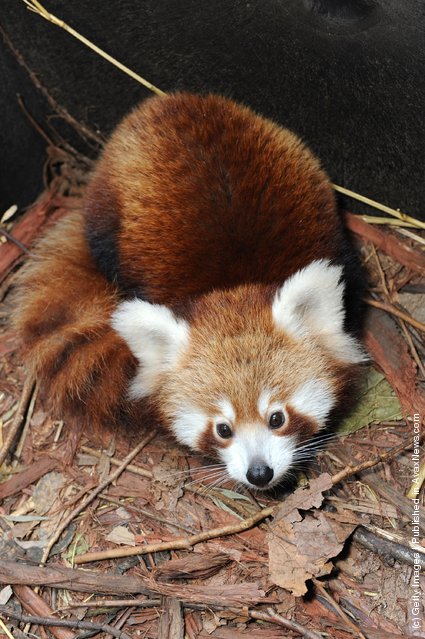
“The red panda (Ailurus fulgens, or shining-cat), is a small arboreal mammal native to the eastern Himalayas and southwestern China. It is the only species of the genus Ailurus. Slightly larger than a domestic cat, it has reddish-brown fur, a long, shaggy tail, and a waddling gait due to its shorter front legs. It feeds mainly on bamboo, but is omnivorous and may also eat eggs, birds, insects, and small mammals. It is a solitary animal, mainly active from dusk to dawn, and is largely sedentary during the day”. – Wikipedia

Photo: In this handout image provided by Taronga Zoo, Seba, a baby Red Panda, explores his new home at Taronga Zoo on April 7, 2011 in Sydney, Australia. The Red Panda cub was born at Christmas and is the 45th to be born at the zoo since 1977. (Photo by Peter Hardin/Taronga Zoo via Getty Images)
Details
07 Apr 2011 08:51:00