Loading...
Done
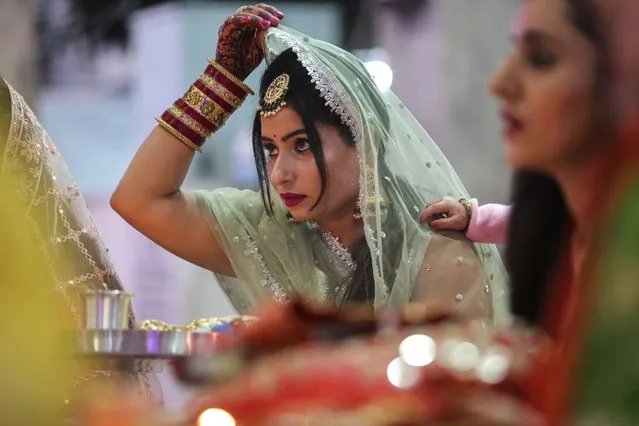
An Indian Hindu married woman offers prayers during Karva Chauth festival in Jammu, India, Sunday, October 24, 2021. Hindu married women decorate their hands with henna, wear colorful bangles and observe a fast to pray for the longevity and well being of their husbands during this festival. (Photo by Channi Anand/AP Photo)

An Indian Hindu married woman offers prayers during Karva Chauth festival in Jammu, India, Sunday, October 24, 2021. Hindu married women decorate their hands with henna, wear colorful bangles and observe a fast to pray for the longevity and well being of their husbands during this festival. (Photo by Channi Anand/AP Photo)
Details
30 Oct 2021 08:47:00
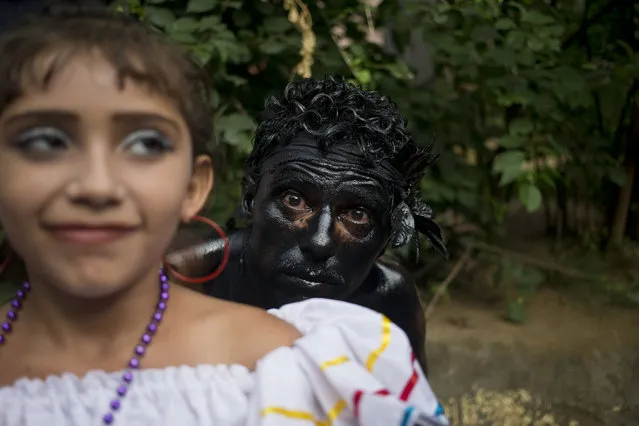
A man covered in motor oil, poses for a picture next to a girl dress a traditional clothes during a festivities in honor of Santo Domingo de Guzman in Managua, Nicaragua, Saturday, August 1, 2015. (Photo by Esteban Felix/AP Photo)

A man covered in motor oil, poses for a picture next to a girl dress a traditional clothes during a festivities in honor of Santo Domingo de Guzman in Managua, Nicaragua, Saturday, August 1, 2015. Some of the faithful coat their bodies in a black motor oil, red paint and wear traditional clothes as a promise for a prayer or miracle they believe was performed or answered by Managua's patron saint, Santo Domingo de Guzman. (Photo by Esteban Felix/AP Photo)
Details
02 Aug 2015 12:41:00
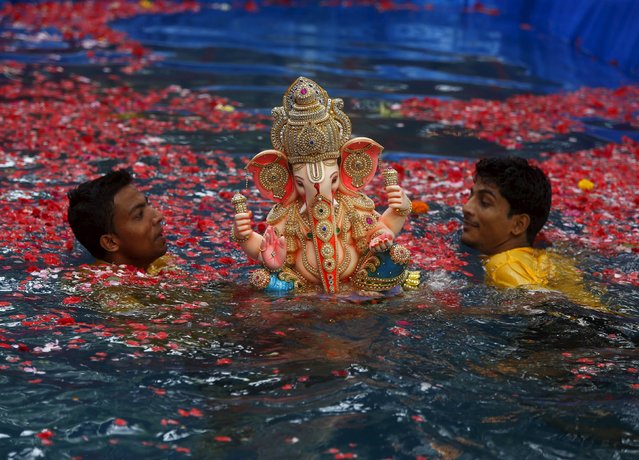
Volunteers carry an idol of the Hindu elephant god Ganesh, the deity of prosperity, in a pond for its immersion during the ten-day-long Ganesh Chaturthi festival in Mumbai, India, September 18, 2015. (Photo by Shailesh Andrade/Reuters)

Volunteers carry an idol of the Hindu elephant god Ganesh, the deity of prosperity, in a pond for its immersion during the ten-day-long Ganesh Chaturthi festival in Mumbai, India, September 18, 2015. During the festival, the idols will be taken through the streets in a procession accompanied by dancing and singing, and will be immersed in a river or the sea in accordance with the Hindu faith. (Photo by Shailesh Andrade/Reuters)
Details
19 Sep 2015 12:55:00
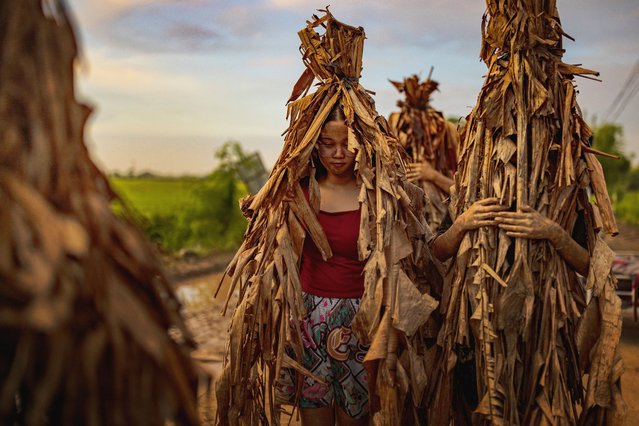
Devotees of the small farming village of Bibiclat celebrate the Feast of Saint John the Baptist while covered in banana leaves and mud on June 24, 2025 in Aliaga, Philippines. Known as the “Taong Putik” (mud people), the ritual happens yearly in this small farming village as their own version of expressing their faith and celebrating the feast of Saint John the Baptist whom the survivors of the Japanese occupation in 1944 in their area prayed to for rain to save their fellow villagers. A marker near the church entrance of the village tells a story of a heavy torrential rain that happened that day that forced the Japanese military to call off the execution of 14 villagers. The Philippines is the only predominantly Catholic country in Southeast Asia after more than 300 years of Spanish rule. (Photo by Ezra Acayan/Getty Images)

Devotees of the small farming village of Bibiclat celebrate the Feast of Saint John the Baptist while covered in banana leaves and mud on June 24, 2025 in Aliaga, Philippines. Known as the “Taong Putik” (mud people), the ritual happens yearly in this small farming village as their own version of expressing their faith and celebrating the feast of Saint John the Baptist whom the survivors of the Japanese occupation in 1944 in their area prayed to for rain to save their fellow villagers. (Photo by Ezra Acayan/Getty Images)
Details
29 Aug 2025 03:18:00
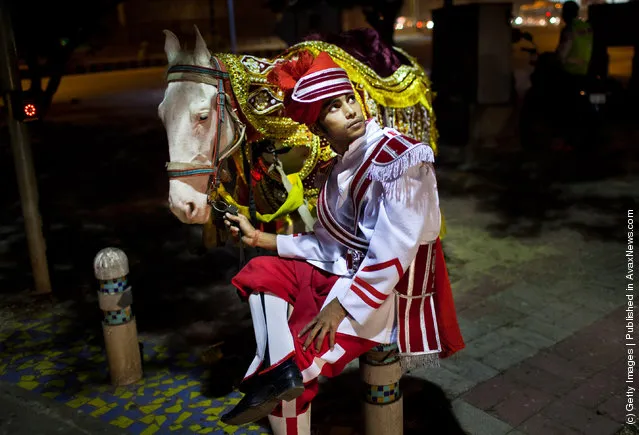
Business Flourishes For Brass Bands During Indian Wedding Season

A musician from the Rajan Band, Kotla Mubarakpur holds on to a decorated horse as he and others wait prior to performing at a wedding on November 22, 2011 in New Delhi, India. (Photo by Daniel Berehulak/Getty Images)
Details
27 Nov 2011 14:43:00
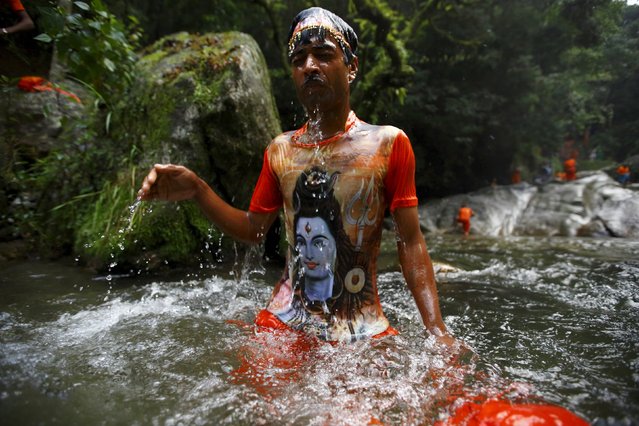
A Hindu devotee wearing a t-shirt printed with a portrait of Lord Shiva takes a holy dip while participating in the “Bol Bom” pilgrimage in Kathmandu August 10, 2015. (Photo by Navesh Chitrakar/Reuters)

A Hindu devotee wearing a t-shirt printed with a portrait of Lord Shiva takes a holy dip while participating in the “Bol Bom” pilgrimage in Kathmandu August 10, 2015. The faithful, chanting the name of Lord Shiva, run about 15 km (9 miles) barefooted toward Pashupatinath temple seeking good health, wealth and happiness. (Photo by Navesh Chitrakar/Reuters)
Details
11 Aug 2015 13:34:00
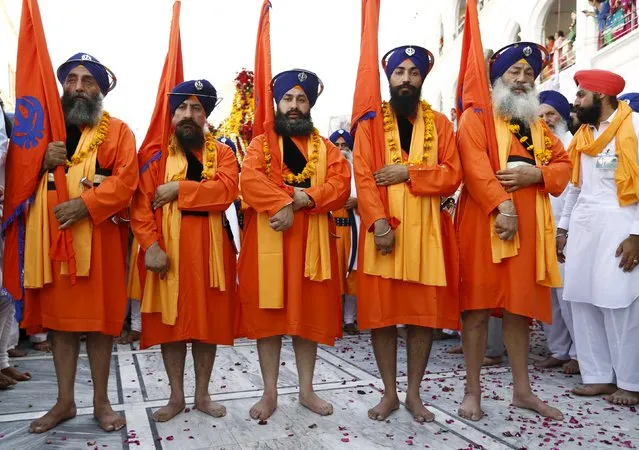
Sikh devotees participate in the Baisakhi festival at Panja Sahib shrine in Hassan Abdel April 13, 2015. (Photo by Caren Firouz/Reuters)

Sikh devotees participate in the Baisakhi festival at Panja Sahib shrine in Hassan Abdel April 13, 2015. Hundreds of Indian Sikh pilgrims arrived into Pakistan to celebrate the Baisakhi festival with Pakistani Sikhs at the shrines of Panja Sahib and Nankana Sahib, the birth place of Sikh faith founder Guru Nanak Dev. (Photo by Caren Firouz/Reuters)
Details
14 Apr 2015 10:42:00
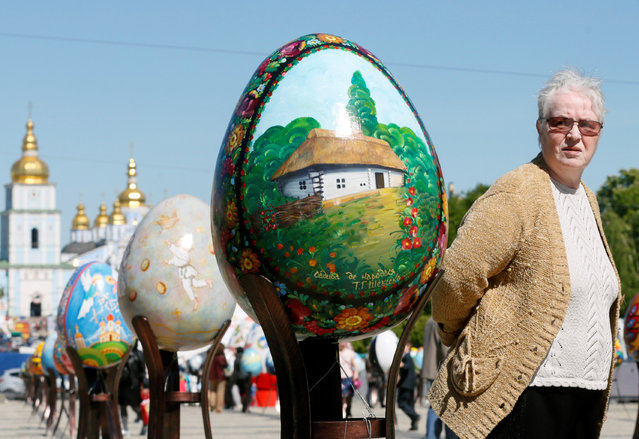
A woman looks at traditional Ukrainian Easter eggs “Pysanka”, installed as part of the upcoming celebrations of Easter, in central Kiev, Ukraine, April 29, 2016. A pysanka is a Ukrainian Easter egg, decorated with traditional Ukrainian folk designs using a wax-resist (batik) method. The word pysanka comes from the verb pysaty, “to write”, as the designs are not painted on, but written with beeswax. Many other eastern European ethnic groups decorate eggs using wax resist for Easter. These include the Belarusians, Bulgarians, Croats, Czechs, Hungarians, Lithuanians, Poles, Romanians, Serbs, Slovaks, Slovenes and Sorbs. (Photo by Valentyn Ogirenko/Reuters)

A woman looks at traditional Ukrainian Easter eggs “Pysanka”, installed as part of the upcoming celebrations of Easter, in central Kiev, Ukraine, April 29, 2016. A pysanka is a Ukrainian Easter egg, decorated with traditional Ukrainian folk designs using a wax-resist (batik) method. The word pysanka comes from the verb pysaty, “to write”, as the designs are not painted on, but written with beeswax. Many other eastern European ethnic groups decorate eggs using wax resist for Easter. These include the Belarusians, Bulgarians, Croats, Czechs, Hungarians, Lithuanians, Poles, Romanians, Serbs, Slovaks, Slovenes and Sorbs. (Photo by Valentyn Ogirenko/Reuters)
Details
30 Apr 2016 09:00:00