Loading...
Done
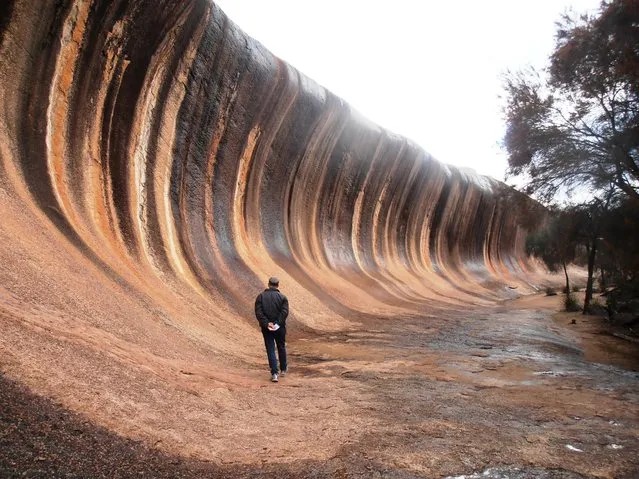
Wave Rock, Arizona

Wave Rock is a natural rock formation that is shaped like a tall breaking ocean wave. The "wave" is about 14 m (46 ft) high and around 110 m (360 ft) long. It forms the north side of a solitary hill, which is known as “Hyden Rock”. This hill, which is a granite inselberg, lies about 3 km (2 mi) east of the small town of Hyden and 296 km (184 mi) east-southeast of Perth, Western Australia. Wave Rock and Hyden Rock are part of a 160 ha (395-acre) nature reserve, Hyden Wildlife Park.
Details
12 Aug 2014 10:21:00
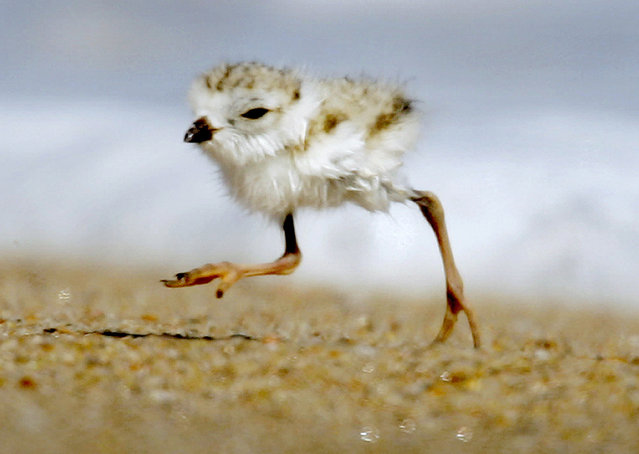
In this July 12, 2007 file photo, a two-day-old piping plover runs along a beach in the Quonochontaug Conservation Area in Westerly, R.I. A court fight to protect the piping plover, a bird listed as “threatened” under the federal Endangered Species Act, is holding up a $207 million plan to replenish sand along a 19-mile stretch of shoreline on New York's Fire Island. The sand was eroded during Superstorm Sandy. (Photo by Steven Senne/AP Photo)

In this July 12, 2007 file photo, a two-day-old piping plover runs along a beach in the Quonochontaug Conservation Area in Westerly, R.I. (Photo by Steven Senne/AP Photo)
Details
25 Nov 2014 11:28:00
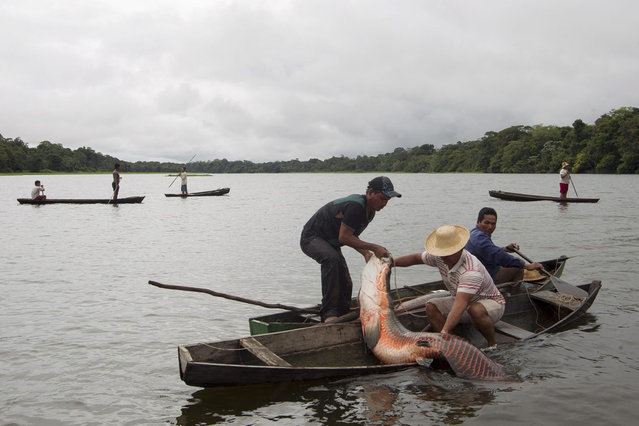
Villagers from the Porto Novo community load into their canoes arapaima or pirarucu, the largest freshwater fish species in South America and one of the largest in the world, while fishing in Poco Fundo lake along a branch of the Solimoes river, one of the main tributaries of the Amazon, in the Mamiraua nature reserve near Fonte Boa about 600 km (373 miles) west of Manaus, November 26, 2013. (Photo by Bruno Kelly/Reuters)

Villagers from the Porto Novo community load into their canoes arapaima or pirarucu, the largest freshwater fish species in South America and one of the largest in the world, while fishing in Poco Fundo lake along a branch of the Solimoes river, one of the main tributaries of the Amazon, in the Mamiraua nature reserve near Fonte Boa about 600 km (373 miles) west of Manaus, November 26, 2013. Catching the arapaima, a fish that is sought after for its meat and is considered by biologists to be a living fossil, is only allowed once a year by Brazil's environmental protection agency. The minimum size allowed for a fisherman to keep an arapaima is 1.5 meters (4.9 feet). (Photo by Bruno Kelly/Reuters)
Details
17 Dec 2013 08:03:00
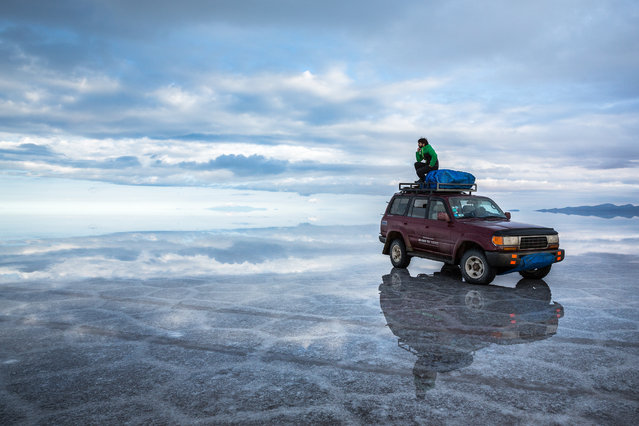
At 10,582 square kilometres, the Bolivian salt flats – otherwise known as Salar de Uyuni – are the largest on the planet and contain between 50 and 70% of the world’s lithium reserves. After exploring Chile and Argentina, photographer Joel Santos decided to travel to Bolivia in January 2017 to check the salt flats off his bucket list. With an electrical storm rolling in, Joel and his two travelling companions were the only souls left on the vast flats and captured the eerie flats without a person in sight. (Photo by Joel Santos/Barcroft Images)

At 10,582 square kilometres, the Bolivian salt flats – otherwise known as Salar de Uyuni – are the largest on the planet and contain between 50 and 70% of the world’s lithium reserves. After exploring Chile and Argentina, photographer Joel Santos decided to travel to Bolivia in January 2017 to check the salt flats off his bucket list. With an electrical storm rolling in, Joel and his two travelling companions were the only souls left on the vast flats and captured the eerie flats without a person in sight. (Photo by Joel Santos/Barcroft Images)
Details
12 Aug 2019 00:03:00
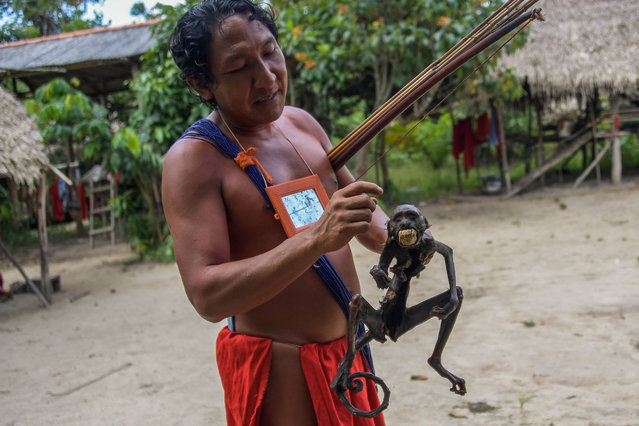
Chieftain Japarupi Waiapi shows a roasted monkey -part of Waiapi's diet, also based in Manioc and fruits- at the reserve in Amapa state in Brazil on October 13, 2017. When Waiapis walks into the Amazon forest surrounding their village, they do not see trees, but a kind of shopping mall providing medicine, food, shelter, tools and weapons  all under the eye of multiple spirits. (Photo by Apu Gomes/AFP Photo)

Chieftain Japarupi Waiapi shows a roasted monkey -part of Waiapi's diet, also based in Manioc and fruits- at the reserve in Amapa state in Brazil on October 13, 2017. When Waiapis walks into the Amazon forest surrounding their village, they do not see trees, but a kind of shopping mall providing medicine, food, shelter, tools and weapons all under the eye of multiple spirits. (Photo by Apu Gomes/AFP Photo)
Details
27 Oct 2017 08:39:00
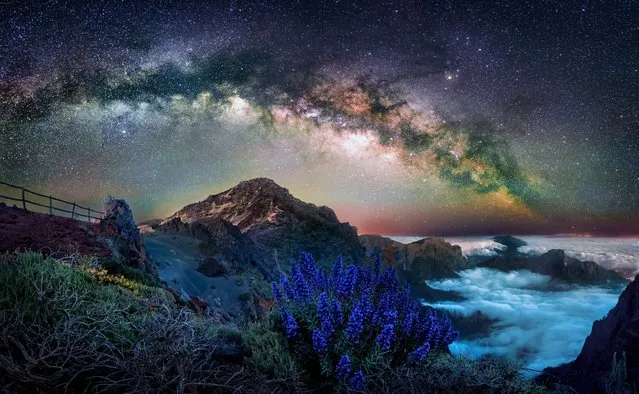
Tony North; First place, Breathing Spaces; Overall Winner; Blue Tajinaste, La Palma, Canary Islands, Spain. “Echium thyrsiflorum is endemic to the mountains of La Palma island – from high up, there was a magnificent view of both the caldera below, and the stars above. The Unesco La Palma biosphere reserve encompasses the entire island, with the Caldera de Taburiente containing mountains with a highest peak of 2,426 metres – the Roque de los Muchachos”. (Photo by Tony North/IGPOTY)

Tony North; First place, Breathing Spaces; Overall Winner; Blue Tajinaste, La Palma, Canary Islands, Spain. “Echium thyrsiflorum is endemic to the mountains of La Palma island – from high up, there was a magnificent view of both the caldera below, and the stars above. The Unesco La Palma biosphere reserve encompasses the entire island, with the Caldera de Taburiente containing mountains with a highest peak of 2,426 metres – the Roque de los Muchachos”. (Photo by Tony North/IGPOTY)
Details
10 Feb 2023 04:41:00
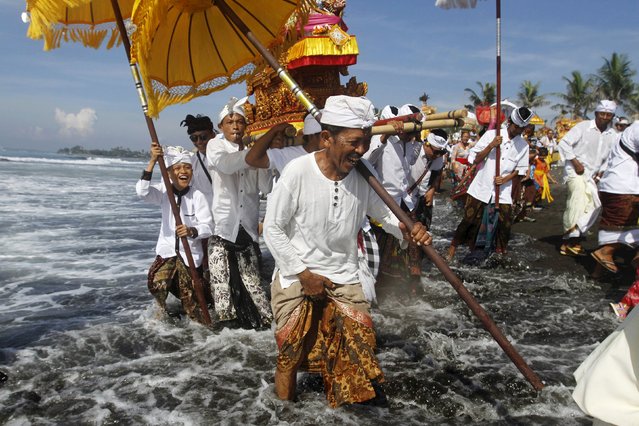
Balinese Hindus carry Pratimas, or symbols of God, on the beach during Melasti, a purification ceremony, ahead of the holy day of Nyepi, in Gianyar on the Indonesian resort island of Bali, March 6, 2016. Nyepi is a day of silence to celebrate the Balinese new year, reserved for self-reflection, where people are not allowed to use lights, light fires, work, travel or enjoy entertainment. (Photo by Roni Bintang/Reuters)

Balinese Hindus carry Pratimas, or symbols of God, on the beach during Melasti, a purification ceremony, ahead of the holy day of Nyepi, in Gianyar on the Indonesian resort island of Bali, March 6, 2016. Nyepi is a day of silence to celebrate the Balinese new year, reserved for self-reflection, where people are not allowed to use lights, light fires, work, travel or enjoy entertainment. (Photo by Roni Bintang/Reuters)
Details
07 Mar 2016 11:19:00
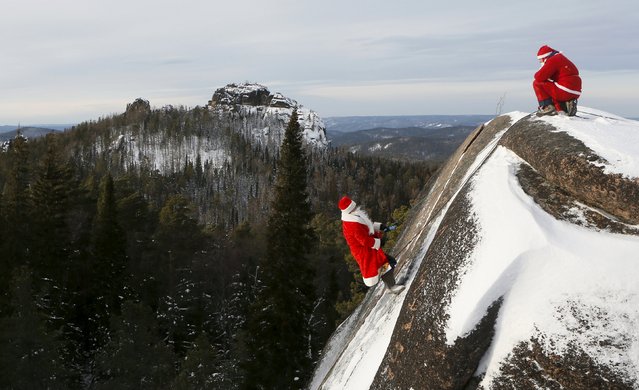
A member of the “Sibspas” Siberian search and rescue group dressed as Santa Claus (R), waits for his team mate, dressed as Father Frost, the Russian equivalent of Santa Claus, as he climbs the rock named “The Fourth Stolb” (the Fourth Pillar) at the Stolby national nature reserve during a training session of the Russian Emergencies Ministry, outside the Siberian city of Krasnoyarsk, Russia December 15, 2015. (Photo by Ilya Naymushin/Reuters)

A member of the “Sibspas” Siberian search and rescue group dressed as Santa Claus (R), waits for his team mate, dressed as Father Frost, the Russian equivalent of Santa Claus, as he climbs the rock named “The Fourth Stolb” (the Fourth Pillar) at the Stolby national nature reserve during a training session of the Russian Emergencies Ministry, outside the Siberian city of Krasnoyarsk, Russia December 15, 2015. (Photo by Ilya Naymushin/Reuters)
Details
16 Dec 2015 12:32:00