Loading...
Done
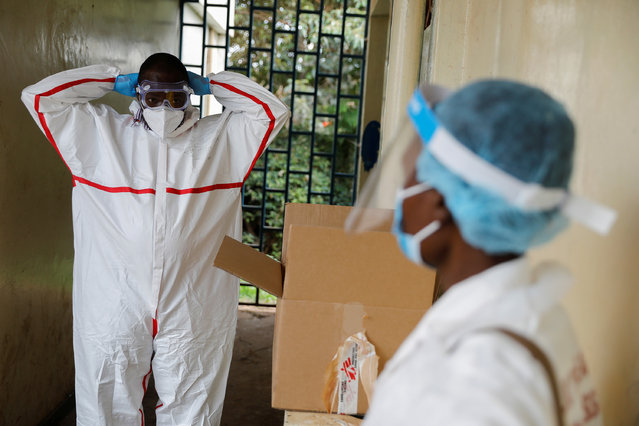
A health worker dresses in a protective suit before starting to perform the coronavirus testing in an effort to stop the spread of the coronavirus disease (COVID-19) in the Kibera slum of Nairobi, Kenya, May 26, 2020. (Photo by Baz Ratner/Reuters)

A health worker dresses in a protective suit before starting to perform the coronavirus testing in an effort to stop the spread of the coronavirus disease (COVID-19) in the Kibera slum of Nairobi, Kenya, May 26, 2020. (Photo by Baz Ratner/Reuters)
Details
28 May 2020 00:03:00
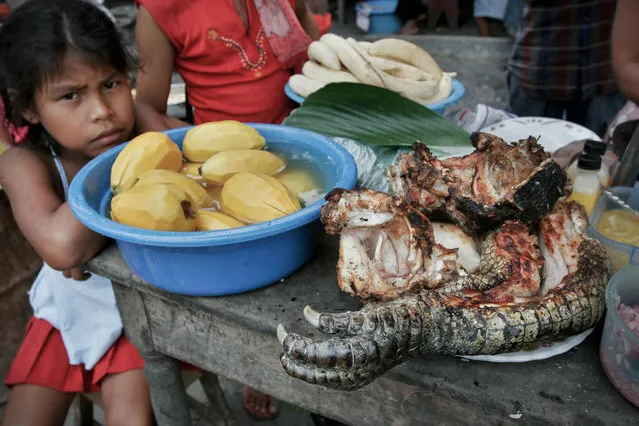
Peru, Iquitos. Restaurant in Bellavista, an area by the Amazon on April 2005. (Photo by Jean-Claude Coutausse)

Peru, Iquitos. Restaurant in Bellavista, an area by the Amazon on April 2005. (Photo by Jean-Claude Coutausse)
Details
05 Nov 2012 12:07:00
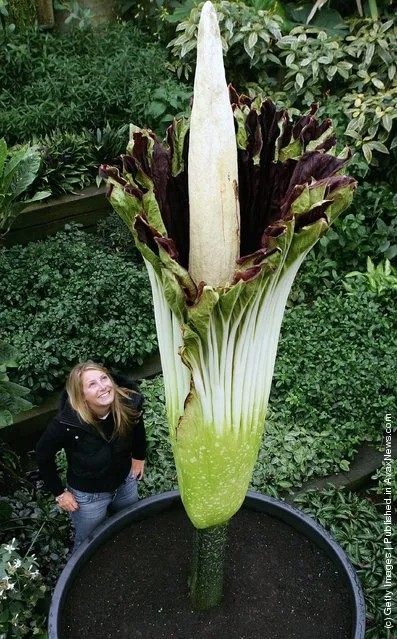
Kew Gardens employee Lauren Bird Royal examines the flowering of the Titan Arum lily at the Botanical Gardens

“The titan arum or Amorphophallus titanum (from Ancient Greek amorphos, “without form, misshapen” + phallos, “phallus”, and titan, “giant”) is a flowering plant with the largest unbranched inflorescence in the world. The titan arum's inflorescence is not as large as that of the Talipot palm, Corypha umbraculifera, but the inflorescence of the Talipot palm is branched rather than unbranched”. – Wikipedia

Photo: Kew Gardens employee Lauren Bird Royal examines the flowering of the Titan Arum lily at the Botanical Gardens at Kew on September 30, 2005 in London, England. For the first time in horticultural history, the Titan Arum lily can be seen at all three active stages in its lifecycle – in flower, fruit and leaf.The flowering corm is nearly three metres tall and weighs 91kg and is very rarely seen outside of the rainforests of Sumatra, Indonesia. (Photo by Scott Barbour/Getty Images)

Details
20 Sep 2011 11:13:00
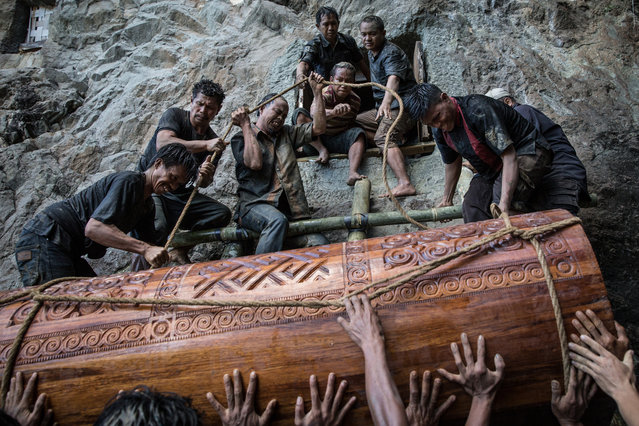
It is said that Torajans are people who “live to die”. For this Indonesian ethnic group, funerals are such extravagant events that they sometimes attract tourists. Families can postpone burials years (and the deceased are considered sick and hosted at home until the funeral) until the family can raise enough money and gather as many relatives as possible. And then it’s a jubilant multiday social event with a parade, dances and animal sacrifices. Agung Parameswara photographed these funerary practices when he traveled to South Sulawesi province, where the Torajans live. But often, their funeral isn’t the last time the dead are seen. In August, crypts are opened, coffins are slid back out and bodies delicately unsheathed. This tender ritual is known as Ma’Nene, which is customarily performed every few years. (Photo by Agung Parameswara/The Washington Post)

It is said that Torajans are people who “live to die”. For this Indonesian ethnic group, funerals are such extravagant events that they sometimes attract tourists. Families can postpone burials years (and the deceased are considered sick and hosted at home until the funeral) until the family can raise enough money and gather as many relatives as possible. And then it’s a jubilant multiday social event with a parade, dances and animal sacrifices. Agung Parameswara photographed these funerary practices when he traveled to South Sulawesi province, where the Torajans live. (Photo by Agung Parameswara/The Washington Post)
Details
06 Oct 2016 09:15:00


Partisans arresting suspected fascists in Rome. (Photo by Keystone/Getty Images). Circa 1946
Details
17 Mar 2011 11:55:00
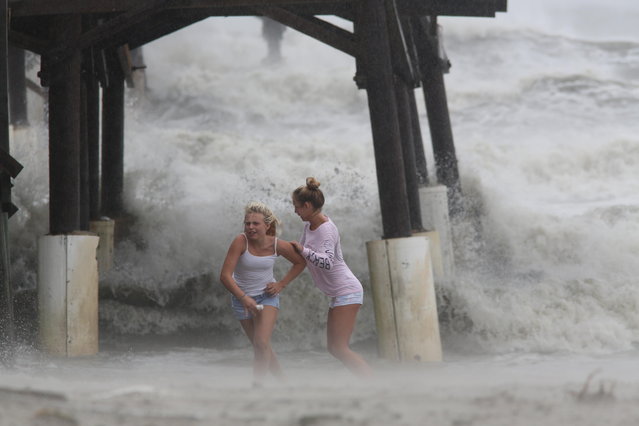
Cocoa Beach, Florida, USA. 7th October, 2016. Kaleigh Black, 14, left, and Amber Olsen, 12, run for cover as a squall with rain and wind pelt them while they explore the Cocoa Beach Pier on Friday (10/7/16) after hurricane Matthew passed to the east on Florida's east coast.(Photo by Douglas R. Clifford/Tampa Bay Times/ZUMA Wire/Alamy Live News)

Cocoa Beach, Florida, USA. 7th October, 2016. Kaleigh Black, 14, left, and Amber Olsen, 12, run for cover as a squall with rain and wind pelt them while they explore the Cocoa Beach Pier on Friday (10/7/16) after hurricane Matthew passed to the east on Florida's east coast.(Photo by Douglas R. Clifford/Tampa Bay Times/ZUMA Wire/Alamy Live News)
Details
09 Oct 2016 07:17:00
People take part in the “The Burial of the Sardine” funeral procession, which marks the end of carnival festivities, in Madrid, Spain, February 10, 2016. (Photo by Juan Medina/Reuters)

People take part in the “The Burial of the Sardine” funeral procession, which marks the end of carnival festivities, in Madrid, Spain, February 10, 2016. “Mourners” carry a coffin with a mock sardine through the streets to celebrate the countdown to Lent. Spanish painter Francisco de Goya's painting “El entierro de la sardina” (The Burial of the Sardine) was inspired by this tradition, which started in Madrid in the 18th century, around the time of Spanish King Carlos III. (Photo by Juan Medina/Reuters)
Details
11 Feb 2016 12:29:00
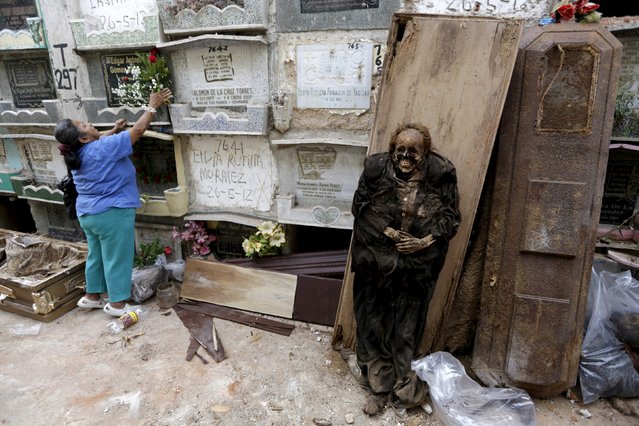
A woman (L) places flowers at a grave next to a mummified body during exhumation works at the General Cemetery in Guatemala City, April 15, 2015. (Photo by Jorge Dan Lopez/Reuters)

A woman (L) places flowers at a grave next to a mummified body during exhumation works at the General Cemetery in Guatemala City, April 15, 2015. If a lease on a grave has expired or not been paid, grave cleaners will break open the crypts to remove and rebury the bodies. Any remains that have not been claimed are packed into plastic bags, labeled and stored in mass graves. Bodies that have been stored in the upper crypt are exposed to dry and sunny conditions which means they do not decompose and instead become mummified. (Photo by Jorge Dan Lopez/Reuters)
Details
16 Apr 2015 13:01:00