Loading...
Done
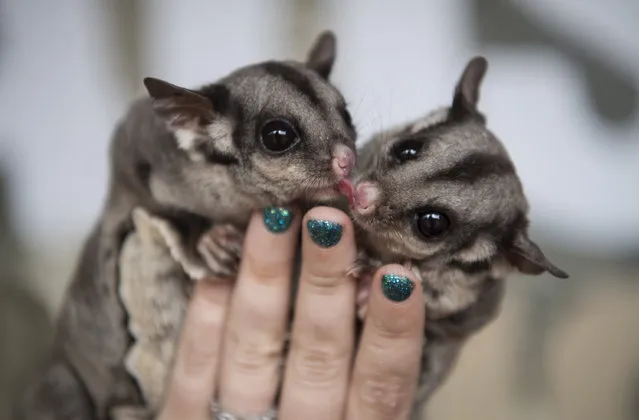
Sugar gliders, Candy and Popcorn, enjoy their favourite food, Nectar, at Wild Life Sydney Zoo on February 14, 2017 in Sydney, Australia. The treat made up of honey, high protein baby cereal and egg yolks is the human equivalent to chocolate to the Sugar Gliders. St. Valentine's Day or the Feast of Saint Valentine began as a celebration of the early Christian Saint Valentinus. From the 18th Century onwards it has steadily transformed into a celebration of romantic love and sentiment in many countries around the world. (Photo by James D. Morgan/Getty Images)

Sugar gliders, Candy and Popcorn, enjoy their favourite food, Nectar, at Wild Life Sydney Zoo on February 14, 2017 in Sydney, Australia. The treat made up of honey, high protein baby cereal and egg yolks is the human equivalent to chocolate to the Sugar Gliders. St. Valentine's Day or the Feast of Saint Valentine began as a celebration of the early Christian Saint Valentinus. From the 18th Century onwards it has steadily transformed into a celebration of romantic love and sentiment in many countries around the world. (Photo by James D. Morgan/Getty Images)
Details
19 Feb 2017 00:00:00
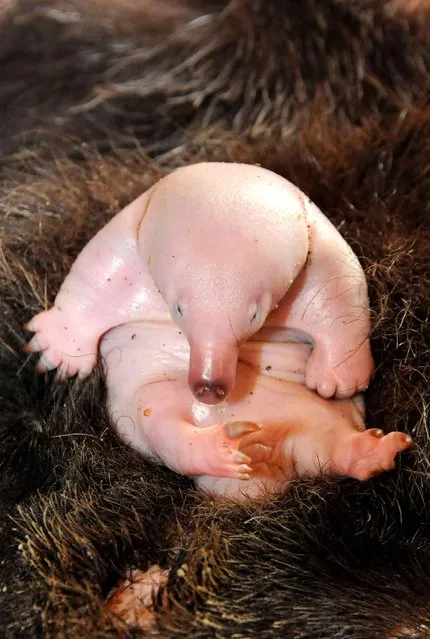
It's a 30-day-old Echidna baby, known as a “puggle” – one of only 24 ever bred in captivity. The proud parents are Tippy and Pickle of Australia Zoo. The tiny baby, whose s*x has not yet been identified, hatched from a soft egg and will continue to develop and nurse inside Tippy's warm pouch. (Photo by Australia Zoo/Rex/Sipa Press)

It's a 30-day-old Echidna baby, known as a “puggle” – one of only 24 ever bred in captivity. The proud parents are Tippy and Pickle of Australia Zoo. The tiny baby, whose s*x has not yet been identified, hatched from a soft egg and will continue to develop and nurse inside Tippy's warm pouch. (Photo by Australia Zoo/Rex/Sipa Press)
Details
21 Sep 2013 10:30:00
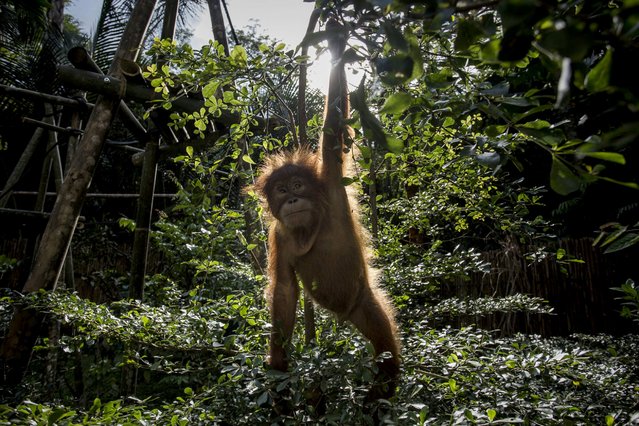
A Baby sumatran orangutan (Pongo abelii) plays around in a tree as they train at Sumatran Orangutan Conservation Programme's rehabilitation center on November 12, 2016 in Kuta Mbelin, North Sumatra, Indonesia. The Orangutans in Indonesia have been known to be on the verge of extinction as a result of deforestation and poaching. Found mostly in South-East Asia, where they live on the islands of Sumatra and Borneo, the endangered species continue to lose their habitat as a result of corporate expansion in a developing economy. Indonesia approved palm oil concessions on nearly 15 million acres of peatlands over the past years and thousands of square miles have been cleared for plantations, including the lowland areas that are the prime habitat for orangutans. (Photo by Ulet Ifansasti/Getty Images)

A Baby sumatran orangutan (Pongo abelii) plays around in a tree as they train at Sumatran Orangutan Conservation Programme's rehabilitation center on November 12, 2016 in Kuta Mbelin, North Sumatra, Indonesia. The Orangutans in Indonesia have been known to be on the verge of extinction as a result of deforestation and poaching. Found mostly in South-East Asia, where they live on the islands of Sumatra and Borneo, the endangered species continue to lose their habitat as a result of corporate expansion in a developing economy. Indonesia approved palm oil concessions on nearly 15 million acres of peatlands over the past years and thousands of square miles have been cleared for plantations, including the lowland areas that are the prime habitat for orangutans. (Photo by Ulet Ifansasti/Getty Images)
Details
16 Nov 2016 11:14:00
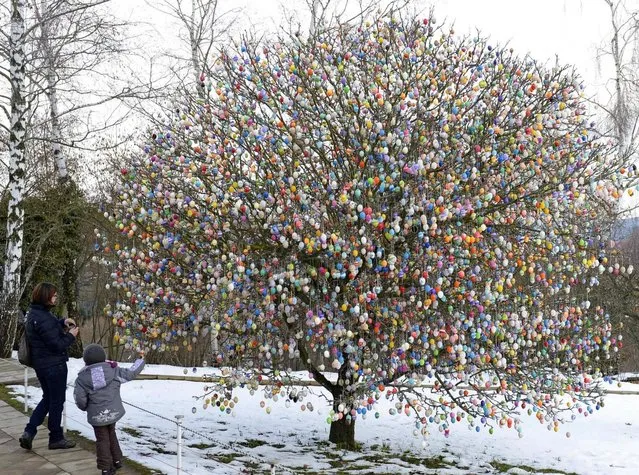
Visitors watch a tree decorated with about 10,000 Easter eggs in the garden of the retired couple Christa and Volker Kraft in Saalfeld, central Germany, Tuesday, March 19, 2013. The Kraft family has been decorating their tree at Easter for more than forty years. (Photo by Jens Meyer/AP Photo)

Visitors watch a tree decorated with about 10,000 Easter eggs in the garden of the retired couple Christa and Volker Kraft in Saalfeld, central Germany, Tuesday, March 19, 2013. The Kraft family has been decorating their tree at Easter for more than forty years. (Photo by Jens Meyer/AP Photo)
Details
20 Mar 2013 07:20:00
An anti-government protester sits on the ground in front of police during a demonstration in Sarajevo February 6, 2014. Hundreds of people turned out in solidarity in the capital Sarajevo, with teenagers throwing eggs and stones at a government building and fought with police. Four officers were taken to hospital, officials said. (Photo by Dado Ruvic/Reuters)

An anti-government protester sits on the ground in front of police during a demonstration in Sarajevo February 6, 2014. Hundreds of people turned out in solidarity in the capital Sarajevo, with teenagers throwing eggs and stones at a government building and fought with police. Four officers were taken to hospital, officials said. (Photo by Dado Ruvic/Reuters)
Details
09 Feb 2014 13:26:00
A young girl takes selfie with Easter rabbit sculpture during the Easter eggs (Pysanka) and rabbit exhibition in front of St. Sophia Cathedral in Kiev, Ukraine, 05 April 2018. Ukrainians will mark Orthodox Easter on 08 April 2018, according to Julian calendar. (Photo by Sergey Dolzhenko/EPA/EFE/Rex Features/Shutterstock)

A young girl takes selfie with Easter rabbit sculpture during the Easter eggs (Pysanka) and rabbit exhibition in front of St. Sophia Cathedral in Kiev, Ukraine, 05 April 2018. Ukrainians will mark Orthodox Easter on 08 April 2018, according to Julian calendar. (Photo by Sergey Dolzhenko/EPA/EFE/Rex Features/Shutterstock)
Details
10 Apr 2018 09:03:00
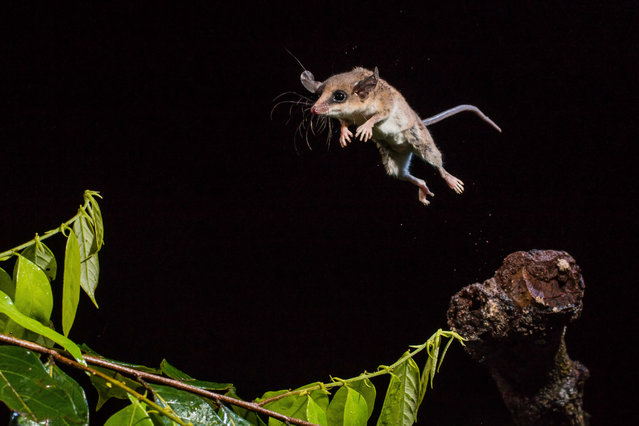
Tropical acrobatics by Adrià López Baucells in Manaus, Brazil. An unidentified South American marsupial, although the characteristic black markings on its face indicate it may be a mouse opossum. These small creatures are nocturnal and feed on bugs, fruit and bird eggs. (Photo by Adrià López Baucells/2019 Royal Society of Biology Photography Competition)

Tropical acrobatics by Adrià López Baucells in Manaus, Brazil. An unidentified South American marsupial, although the characteristic black markings on its face indicate it may be a mouse opossum. These small creatures are nocturnal and feed on bugs, fruit and bird eggs. (Photo by Adrià López Baucells/2019 Royal Society of Biology Photography Competition)
Details
10 Oct 2019 00:03:00
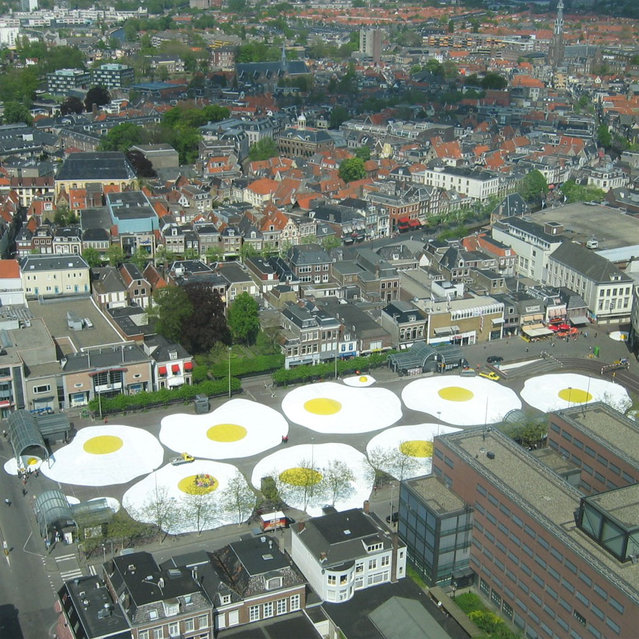
Art Eggcident By Henk Hofstra

With "Art Eggcident," Dutch artist Henk Hofstra demonstrates what it would look like if God threw giant eggs down at us. The eight large, sunny side up eggs measure almost 100 feet wide in diameter. The installation took place in Leeuwarden, a city in the north of the Netherlands.
"I hope it becomes a meeting place with room for art," says Henk. "Art that is different than a framed picture on the wall or a boring bronze sculpture. Art that shows us a different look, surprises us, or makes us angry or happy. Art that allows photographers to grab their cameras and arouses journalists. Art that evokes emotion, or provokes wild laughter."
Details
07 May 2014 10:54:00