Loading...
Done
Tube passengers take a selfie next to a London underground roundel designed for the launching of the Night Tubes on display at Oxford Circus underground station in London, Britain, 19 August 2016. The long delayed Night Tubes service launched on 19 August. The 24-hour service will operate on Fridays and Saturdays. (Photo by Hannah Mckay/EPA)

Tube passengers take a selfie next to a London underground roundel designed for the launching of the Night Tubes on display at Oxford Circus underground station in London, Britain, 19 August 2016. The long delayed Night Tubes service launched on 19 August. The 24-hour service will operate on Fridays and Saturdays. (Photo by Hannah Mckay/EPA)
Details
01 Sep 2016 11:20:00


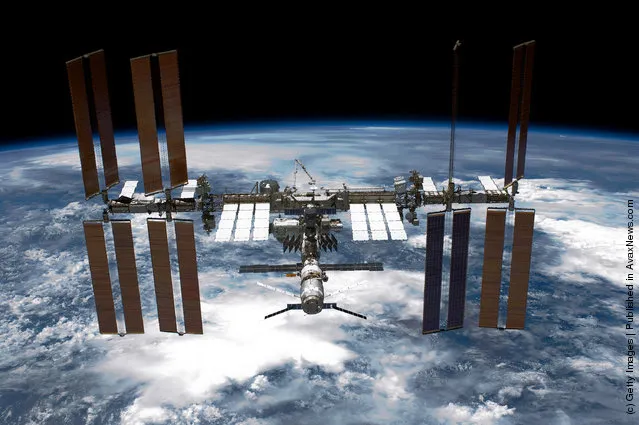
Back dropped by planet Earth the International Space Station (ISS) is seen from NASA space shuttle Endeavour after the station and shuttle began their post-undocking relative separation May 29, 2011 in space. After 20 years, 25 missions and more than 115 million miles in space, NASA space shuttle Endeavour is on the last leg of its final flight to the International Space Station before being retired and donated to the California Science Center in Los Angeles. Capt. Mark E. Kelly, U.S. Rep. Gabrielle Giffords' (D-AZ) husband, has lead mission STS-134 as it delivered the Express Logistics Carrier-3 (ELC-3) and the Alpha Magnetic Spectrometer (AMS-2) to the International Space Station. (Photo by NASA via Getty Images)
Details
01 Jun 2011 06:47:00
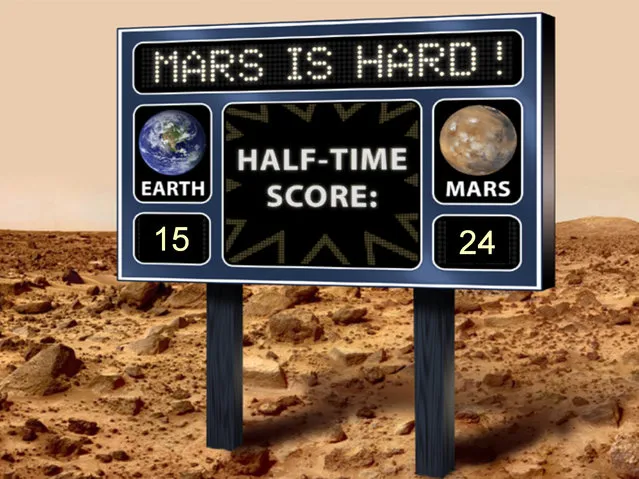
This artist's scoreboard displays a fictional game between Mars and Earth, with Mars in the lead. (Image by NASA/JPL-Caltech)

This artist's scoreboard displays a fictional game between Mars and Earth, with Mars in the lead. It refers to the success rate of sending missions to Mars, both as orbiters and landers. Of the previous 39 missions targeted for Mars from around the world, 15 have been successes and 24 failures. For baseball fans, that's a batting average of .385. The United States has had 13 successes out of 18 attempts, or a “batting average” of .722. NASA's Curiosity rover, set to land on the Red Planet the evening of Aug. 5, 2012 PDT (morning of Aug. 6 EDT), will mark the United States' 19th attempt to tackle the challenge of Mars, and the world's 40th attempt. (Image by NASA/JPL-Caltech)
Details
06 Aug 2012 09:47:00
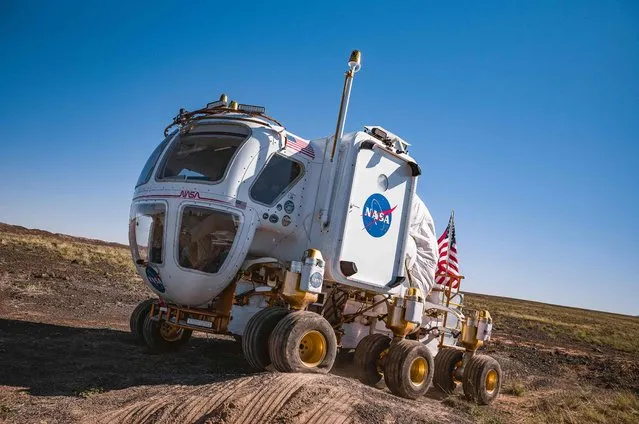
NASAs Desert Research and Technology Studies (Desert RATS) team members practice with a Moon rover prototype for future Artemis missions at the Black Point Lava Flow near Flagstaff, Arizona, on October 24, 2022. (Photo by Olivier Touron/AFP Photo)

NASAs Desert Research and Technology Studies (Desert RATS) team members practice with a Moon rover prototype for future Artemis missions at the Black Point Lava Flow near Flagstaff, Arizona, on October 24, 2022. (Photo by Olivier Touron/AFP Photo)
Details
20 Dec 2023 22:31:00
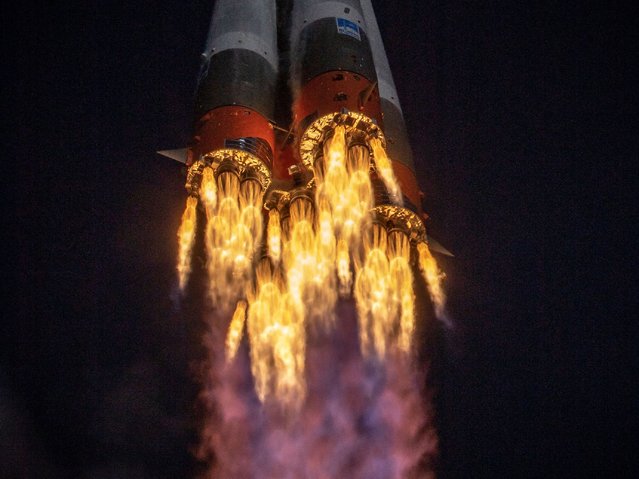
The Soyuz MS-17 spacecraft carrying the International Space Station (ISS) expedition 64 crew of NASA astronaut Kate Rubins and Russian cosmonauts Sergey Ryzhikov and Sergey Kud-Sverchkov blasts off to the ISS from the Russian-leased Baikonur cosmodrome in Kazakhstan on October 14, 2020. (Photo by Roscosmos/Handout via AFP Photo)

The Soyuz MS-17 spacecraft carrying the International Space Station (ISS) expedition 64 crew of NASA astronaut Kate Rubins and Russian cosmonauts Sergey Ryzhikov and Sergey Kud-Sverchkov blasts off to the ISS from the Russian-leased Baikonur cosmodrome in Kazakhstan on October 14, 2020. (Photo by Roscosmos/Handout via AFP Photo)
Details
16 Oct 2020 00:07:00
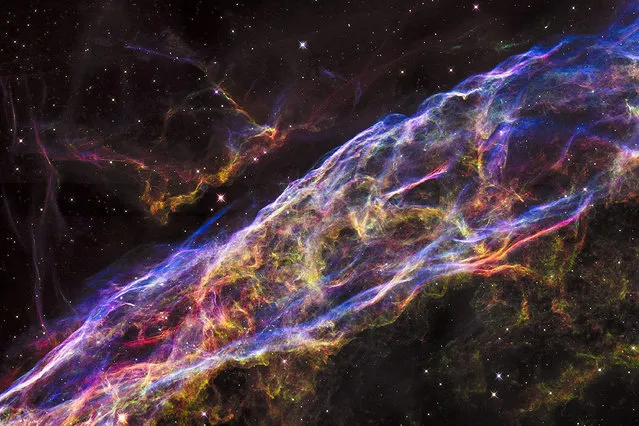
A small section of the expanding remains of the Veil Nebula, a massive star that exploded about 8,000 years ago. The entire nebula is 110 light-years across, covering six full moons on the sky as seen from Earth, and resides about 2,100 light-years away in the constellation Cygnus, the Swan. (Photo by Reuters/NASA/ESA/Hubble)

A small section of the expanding remains of the Veil Nebula, a massive star that exploded about 8,000 years ago. The entire nebula is 110 light-years across, covering six full moons on the sky as seen from Earth, and resides about 2,100 light-years away in the constellation Cygnus, the Swan. (Photo by Reuters/NASA/ESA/Hubble)
Details
29 Feb 2016 11:30:00
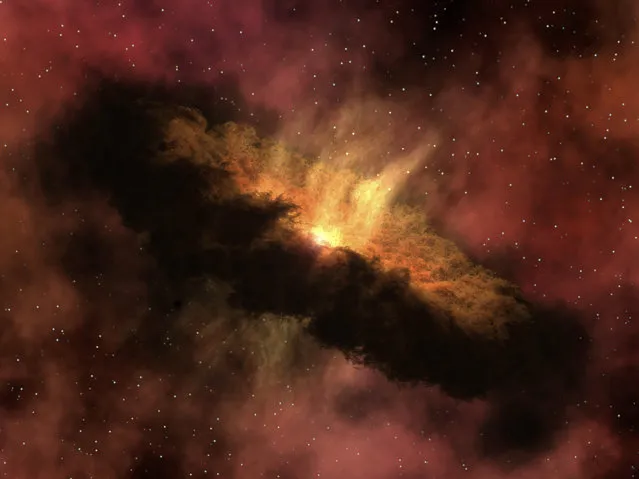
A fledgling solar system containing deep within it enough water vapor to fill all the oceans on Earth five times, located in our Milky Way galaxy about 1,000 light years from Earth in the constellation Perseus. (Photo by Reuters/NASA/JPL-Caltech)

A fledgling solar system containing deep within it enough water vapor to fill all the oceans on Earth five times, located in our Milky Way galaxy about 1,000 light years from Earth in the constellation Perseus. (Photo by Reuters/NASA/JPL-Caltech)
Details
28 Sep 2016 11:01:00
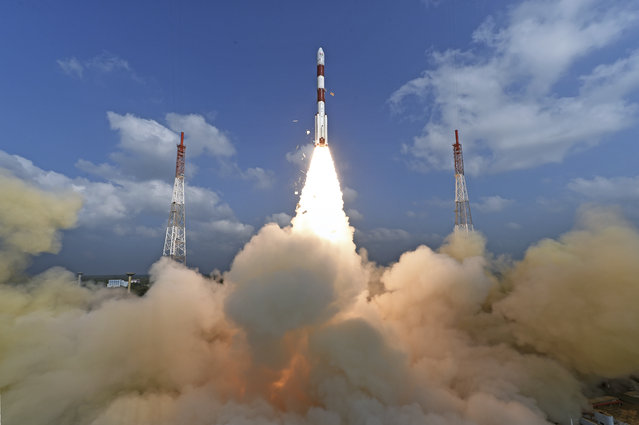
This photograph released by Indian Space Research Organization shows its polar satellite launch vehicle lifting off from a launch pad at the Satish Dhawan Space Centre in Sriharikota, India, Wednesday, February 15, 2017. India's space agency said it successfully launched more than 100 foreign nano satellites into orbit Wednesday aboard a single rocket.(Photo by Indian Space Research Organization via AP Photo)

This photograph released by Indian Space Research Organization shows its polar satellite launch vehicle lifting off from a launch pad at the Satish Dhawan Space Centre in Sriharikota, India, Wednesday, February 15, 2017. India's space agency said it successfully launched more than 100 foreign nano satellites into orbit Wednesday aboard a single rocket.(Photo by Indian Space Research Organization via AP Photo)
Details
16 Feb 2017 11:18:00