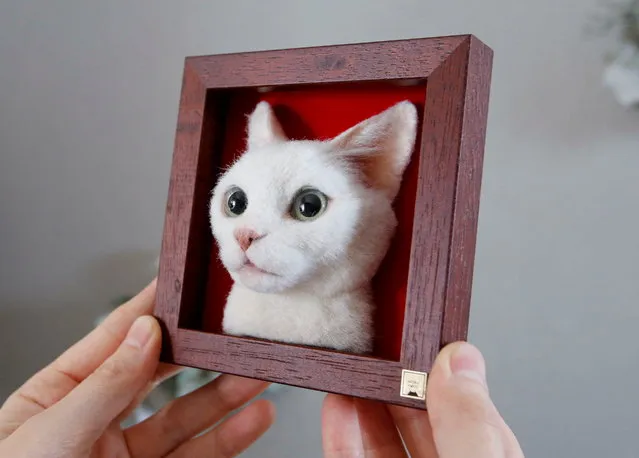
Japanese artist Sachi shows off her creation of a realistic 3D cat portrait, made by using felted wool, at her house in Sagamihara, Japan, January 21, 2022. (Photo by Akira Tomoshige/Reuters)
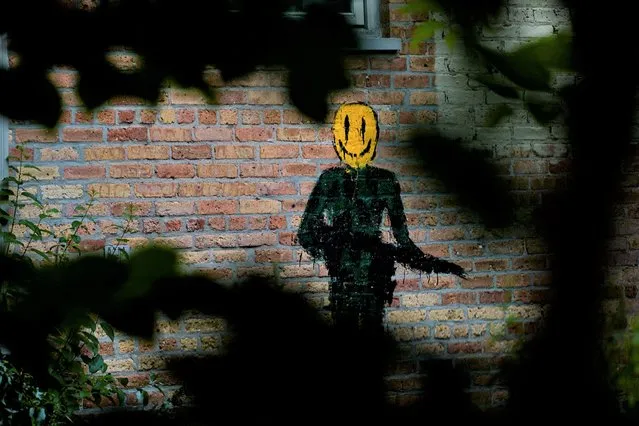
A painted figure is seen on a wall of the home of the mother of Robert E. Crimo III, the 21-year-old suspect facing seven counts of first-degree murder in an attack on a Fourth of July parade, in Highland Park, Illinois, U.S. July 6, 2022. (Photo by Cheney Orr/Reuters)
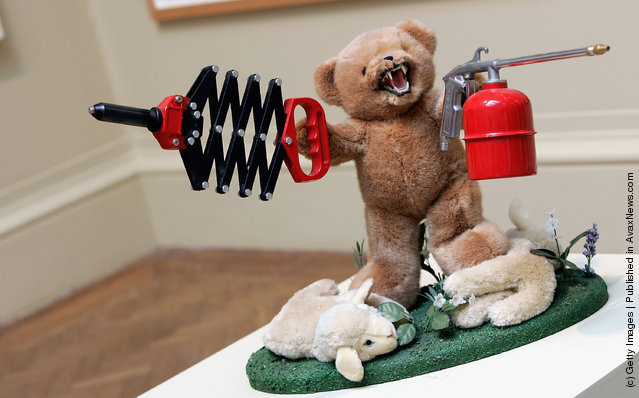
LONDON - JUNE 04: A piece entitled “Entrance into wood” by Elke Krystufek goes on show at The Royal Academy Summer Exhibition on June 4, 2008 in London. In it's 240th year, the exhibition displays a wide range of recent work by both established and emerging artists. 10,000 artists submitted work for selection this year. (Photo by Peter Macdiarmid/Getty Images)
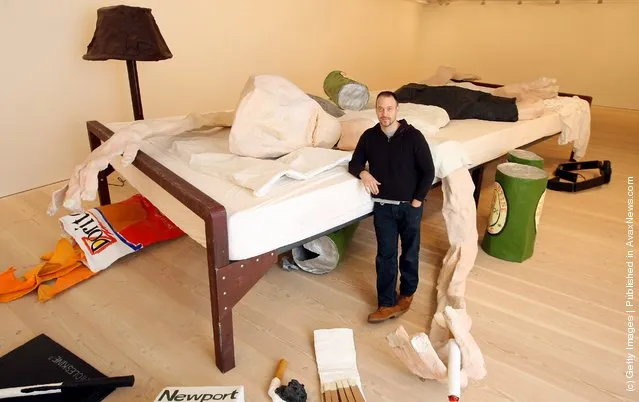
Artist Will Ryman poses for photographs next to his installation entitled “The Bed” at the Saatchi Gallery in Chelsea on January 7, 2008 in London, England. (Photo by Chris Jackson/Getty Images)
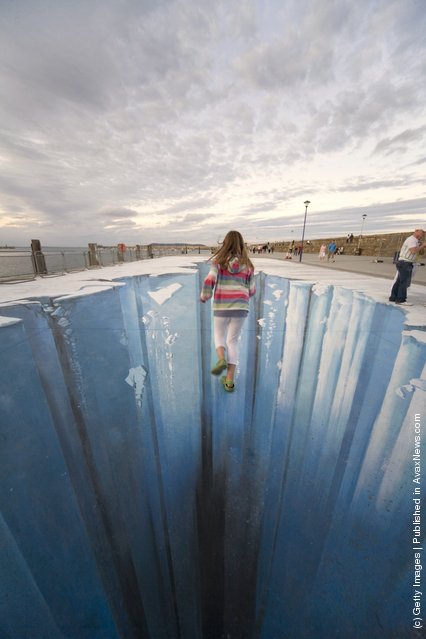
The 3D street painting “Crevasse” by artist Edgar Mueller is seen in this undated picture during the “Festival of culture”, 2008 in Dun Laoghaire, Irland. Edgar Mueller put a part of the eastern Pier into the ice age. This project has been supported by the Goethe Institution Germany. (Photo by Edgar Mueller/Getty Images)
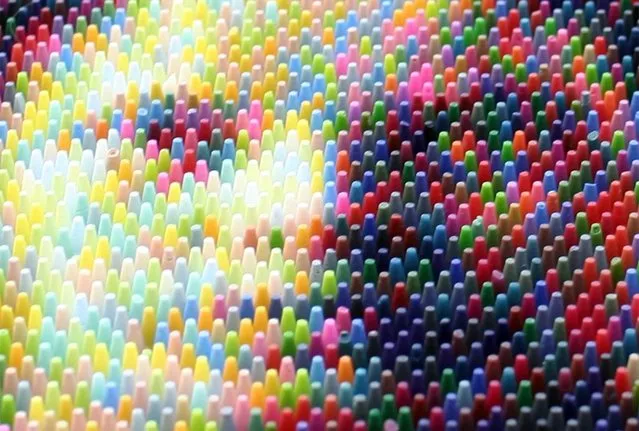
Christian Faur is an artist based in Granville, Ohio. Looking for a new technique, he experimented with painting with wax, but he didn’t feel the results were satisfactory.Then, at Christmas in 2005, his young daughter opened a box of 120 Crayola crayons he’d bought her, and everything clicked into place. Faur decided he would create pictures out of the crayons themselves, packing thousands of them together so they become like the colored pixels on a TV screen. He starts each work by scanning a photo into a computer and breaking the image down into colored blocks He then draws a grid that shows him exactly where to place each crayon The finished artworks are packed tightly into wooden frames. He actually makes the crayons himself, hand-casting each one in a mould.
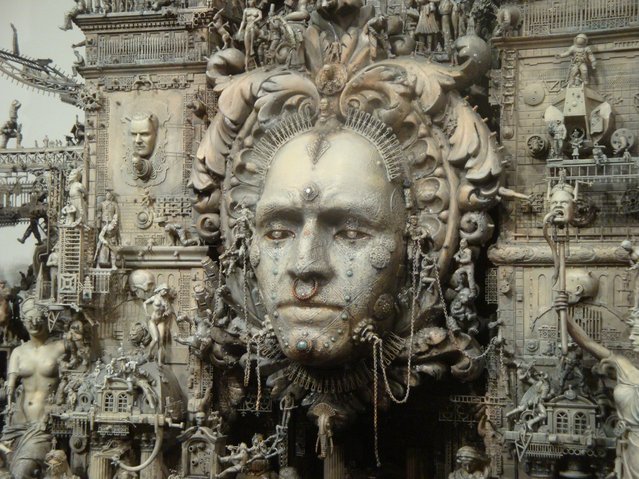
A post-industrial Rococo master, Kris Kuksi obsessively arranges characters and architecture in asymmetric compositions with an exquisite sense of drama. Instead of stones and shells he uses screaming plastic soldiers, miniature engine blocks, towering spires and assorted debris to form his landscapes.
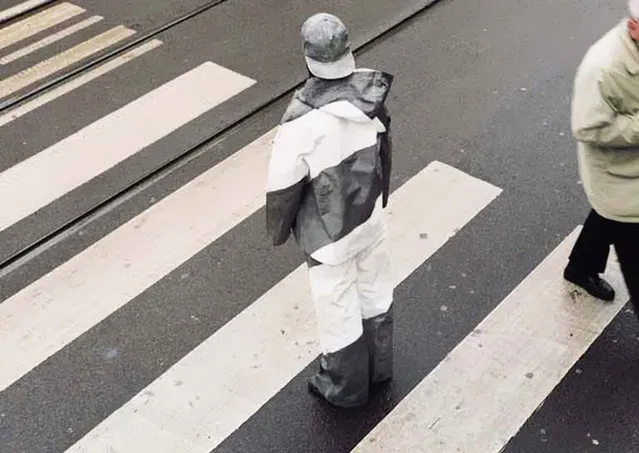
“The artist herself produces the camouflage suit. For each photo, for each environment of her choice, she designs a new suit, which again and again has to be made with the greatest precision, or the illusive effect will not work. By uniting the figure with the background, Desiree Palmen reaches a surprising visual effect that requests a special effort for the observing eye: it must disentangle what is flat and what is spatial.”