Loading...
Done
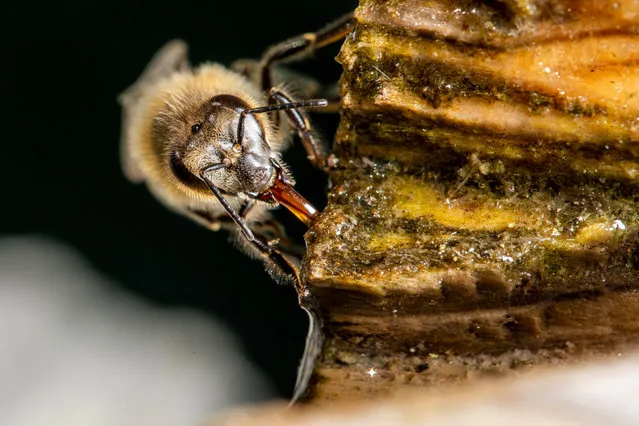
A Western honey bee feeds off acacia pollen at an apiary in Nagyszenas, eastern Hungary, 25 April 2020. The preparation of the bees for the acacia bloom began two weeks later than usual this year; due to the late frosts, this season's yield of Hungaricum acacia honey is expected to be lower. (Photo by Tibor Rosta/EPA/EFE)

A Western honey bee feeds off acacia pollen at an apiary in Nagyszenas, eastern Hungary, 25 April 2020. The preparation of the bees for the acacia bloom began two weeks later than usual this year; due to the late frosts, this season's yield of Hungaricum acacia honey is expected to be lower. (Photo by Tibor Rosta/EPA/EFE)
Details
08 Jan 2023 06:19:00
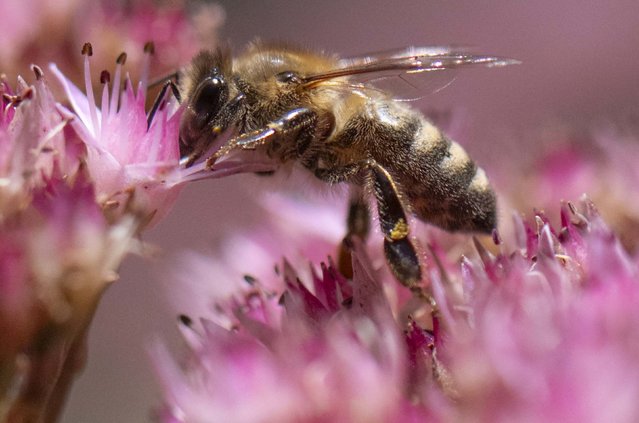
A bee searches for nectar on a flower in Frankfurt am Main, Germany, on Friday, September 19, 2025. (Photo by Boris Roessler/dpa/picture alliance/Getty Images)

A bee searches for nectar on a flower in Frankfurt am Main, Germany, on Friday, September 19, 2025. (Photo by Boris Roessler/dpa/picture alliance/Getty Images)
Details
19 Oct 2025 03:44:00
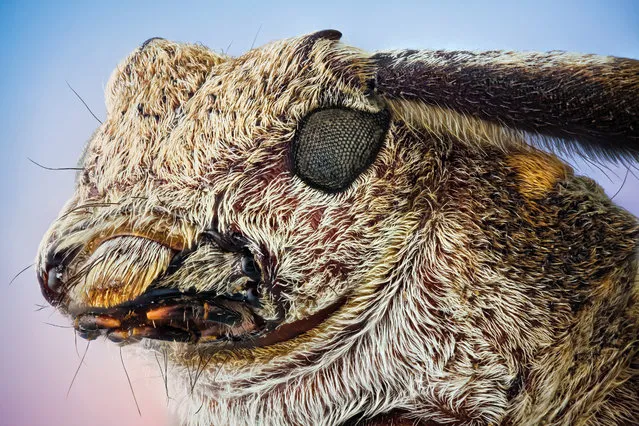
Studio stack: Rabbit? Acanthocinus aedilis, Cerambycidae, A female Timberman (Timbermam perhaps?). Stacked from 216 exposures in Zerene Stacker (PMAX).

Studio stack: Rabbit? Acanthocinus aedilis, Cerambycidae, A female Timberman (Timbermam perhaps?). Stacked from 216 exposures in Zerene Stacker (PMAX). (Photo by John Hallmén). P.S. All pictures are presented in high resolution.
Details
30 Aug 2012 10:55:00
Participants react as they climb a greased pole to collect vouchers for gifts during a “Panjat Pinang” event organised in celebration of Indonesia's 71st Independence day in Jakarta, Indonesia August 17, 2016. (Photo by Darren Whiteside/Reuters)

Participants react as they climb a greased pole to collect vouchers for gifts during a “Panjat Pinang” event organised in celebration of Indonesia's 71st Independence day in Jakarta, Indonesia August 17, 2016. (Photo by Darren Whiteside/Reuters)
Details
18 Aug 2016 11:35:00
A rusty revolver is seen near the body of a man, who police said was killed by police operatives, and two sachets of “Shabu” or methampethamine chloride were found on his pockets in Manila, Philippines August 17, 2017. (Photo by Erik De Castro/Reuters)

A rusty revolver is seen near the body of a man, who police said was killed by police operatives, and two sachets of “Shabu” or methampethamine chloride were found on his pockets in Manila, Philippines August 17, 2017. (Photo by Erik De Castro/Reuters)
Details
19 Aug 2017 08:54:00
These black-and-white photos are taken from the new book “Armoured Warfare in the First World War 1916 – 1918” by Anthony Tucker-Jones and published by Pen & Sword Military. “Interestingly the British, French and Germans took completely different approaches with varying results”. The British military produced “Little Willie” in Autumn 1915 weighing 18 tonnes, which had a crew of two plus four gunners. “Inspired by a tracked artillery tractor “Little Willie” was referred to as a water tank – hence the name tank – to ensure secrecy”, said Anthony. “This led to the strange looking Mark I with its peculiar rhomboid shape, designed to cross trenches with guns in sponsons on either side. The Germans saw the tank as unchivalrous and were slow to grasp its utility. They favoured the Stormtrooper (specialist soldiers used to infiltrate enemy trenches) and artillery, not the tank”, said Anthony. “However, they didn’t hesitate to make use of captured British tanks. Although the tank helped secure victory and German soldiers dubbed it “Germany’s Downfall” the country was ultimately brought to its knees by the Allies blockade”. Here: British troops hitch a ride on a Mark IV after the massed tank fleet spearheading attack at Cambrai on November 20, 1917. (Photo by Anthony Tucker-Jones/Mediadrumworld.com)

These black-and-white photos are taken from the new book “Armoured Warfare in the First World War 1916 – 1918” by Anthony Tucker-Jones and published by Pen & Sword Military. Here: British troops hitch a ride on a Mark IV after the massed tank fleet spearheading attack at Cambrai on November 20, 1917. (Photo by Anthony Tucker-Jones/Mediadrumworld.com)
Details
23 Feb 2017 00:02:00
A pink grasshopper is spotted at the Messingham Sand Quarry in Scunthorpe, Lincolnshire, UK in the second decade of July 2023. The dazzling creature is incredibly rare, with experts estimating that a person has a chance of about 1 per cent of seeing one in their lifetime. (Photo by Calvin Taylor Lee/Animal News Agency)

A pink grasshopper is spotted at the Messingham Sand Quarry in Scunthorpe, Lincolnshire, UK in the second decade of July 2023. The dazzling creature is incredibly rare, with experts estimating that a person has a chance of about 1 per cent of seeing one in their lifetime. (Photo by Calvin Taylor Lee/Animal News Agency)
Details
05 Sep 2023 03:43:00
A dragonfly rests on a leaf in Hinojedo, Cantabria, northern Spain, 01 June 2023. (Photo by Pedro Puente Hoyos/EPA/EFE/Rex Features/Shutterstock)

A dragonfly rests on a leaf in Hinojedo, Cantabria, northern Spain, 01 June 2023. (Photo by Pedro Puente Hoyos/EPA/EFE/Rex Features/Shutterstock)
Details
26 Jul 2023 04:23:00