Loading...
Done
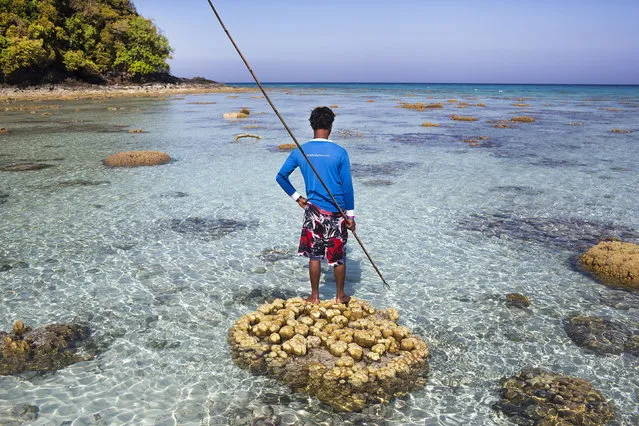
Hook, an indigenous Moken man, holds a three-pronged throwing spear and searches for fish in the waters of Ko Surin National Park. March 1, 2013 – Ko Surin, Thailand. (Photo by Taylor Weidman/zReportage via ZUMA Press)

“For centuries, the Moken sea nomads have traveled the islands between Thailand and Myanmar fishing and foraging for food on the sea floor. Throughout the Mergui Archipelago, Moken migrate in flotillas of Kabangs (traditional boat of the Moken people), stopping at different islands and beaches. Expert freedivers, the Moken have adapted physically to an aquatic life, developing unique characteristics that let them see better and hold their breath longer while underwater”. – Taylor Weidman. Photo: Hook, an indigenous Moken man, holds a three-pronged throwing spear and searches for fish in the waters of Ko Surin National Park. March 1, 2013 – Ko Surin, Thailand. (Photo by Taylor Weidman/zReportage via ZUMA Press)
Details
24 Mar 2014 06:45:00
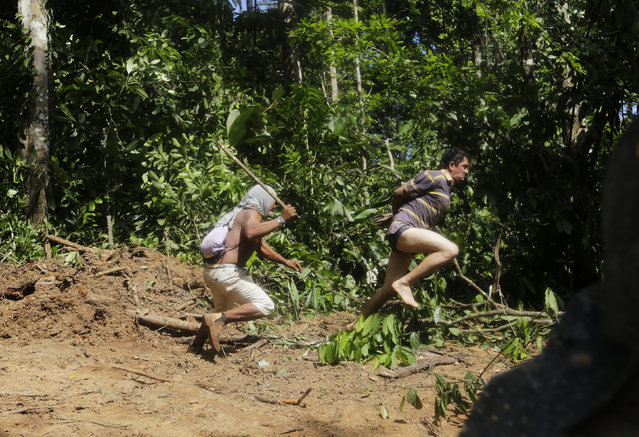
A Ka'apor Indian warrior (L) chases a logger who tried to escape after they captured him during a jungle expedition to search for and expel loggers from the Alto Turiacu Indian territory, near the Centro do Guilherme municipality in the northeast of Maranhao state in the Amazon basin, August 7, 2014. (Photo by Lunae Parracho/Reuters)

A Ka'apor Indian warrior (L) chases a logger who tried to escape after they captured him during a jungle expedition to search for and expel loggers from the Alto Turiacu Indian territory, near the Centro do Guilherme municipality in the northeast of Maranhao state in the Amazon basin, August 7, 2014. Tired of what they say is a lack of sufficient government assistance in keeping loggers off their land, the Ka'apor Indians, who along with four other tribes are the legal inhabitants and caretakers of the territory, have sent their warriors out to expel all loggers they find and set up monitoring camps in the areas that are being illegally exploited. (Photo by Lunae Parracho/Reuters)
Details
05 Sep 2014 11:41:00
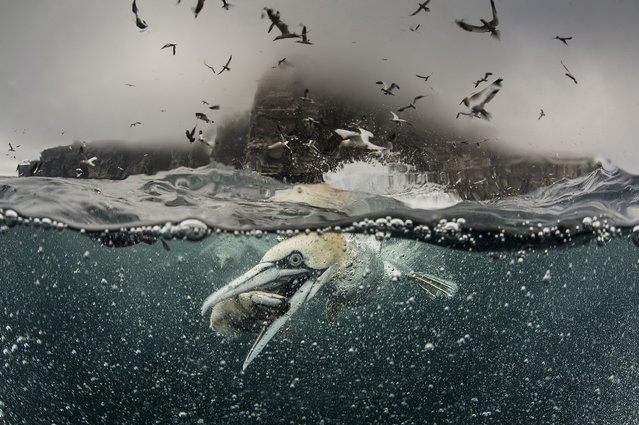
A gannet grabs a fish by its beak, 2014, in Shetland, Scotland. Hundreds of gannets crash into the sea in search of food – leaving a trail of air bubbles in their wake. Richard Shucksmith, 41, on the Shetland Isles, Scotland captured the remarkable scene as he took a boat to feed the large colony of seabirds that nested on the cliffs. The photographer has taken images of the gannets every summer for the last three years as the birds gather on the cliffs to breed. (Photo by Richard Shucksmith/Barcroft media)

A gannet grabs a fish by its beak, 2014, in Shetland, Scotland. Hundreds of gannets crash into the sea in search of food – leaving a trail of air bubbles in their wake. Richard Shucksmith, 41, on the Shetland Isles, Scotland captured the remarkable scene as he took a boat to feed the large colony of seabirds that nested on the cliffs. The photographer has taken images of the gannets every summer for the last three years as the birds gather on the cliffs to breed. (Photo by Richard Shucksmith/Barcroft media)
Details
26 Sep 2014 13:54:00
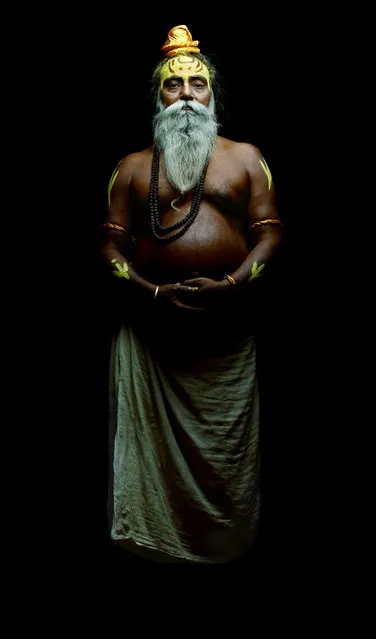
Sadhu Project by Photographer Denis Rouvre

“They’ve been obsessing me for years. I searched and found them in Benares, on the banks of the river Gange (India). They arrive here to get rid of everything and to wait for death. This existence can last for years, sometimes decades, almost a life. Opposite to mine, well organised and filled as a human life can be, to try in vain to push the limits of its end”. – Denis Rouvre. (Photo by Denis Rouvre)
Details
15 Dec 2013 11:12:00
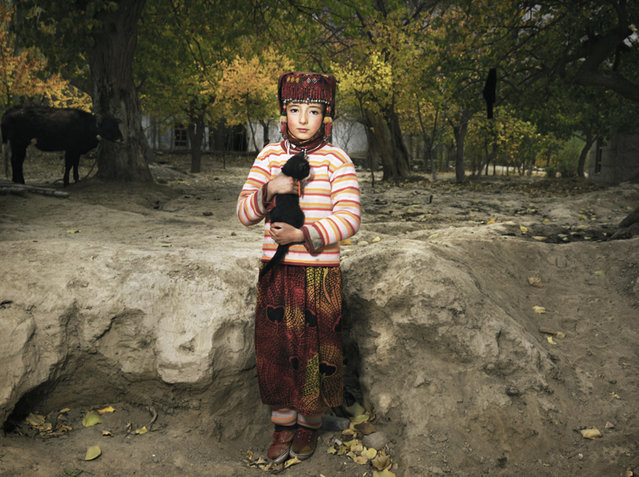
The Tashkurgan Tajik Autonomous County in Xinjiang Province People

“As a photographer, peregrinator and naturalist, I have been searching for the ultimate unworldly world. I've always been drawn to unusual travel destinations. For me, to lose myself in a different culture is a great way to find balance in my life...”. – Li Xinzhao. (Photo by Li Xinzhao)
Details
11 Feb 2013 11:26:00
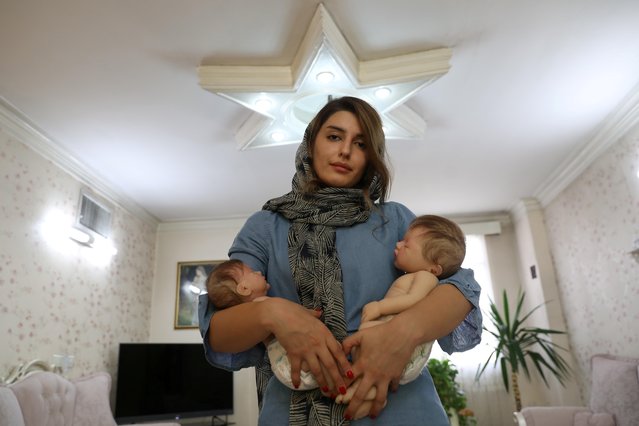
Twenty-four-year-old Maryam Aghayee makes hyper-realistic baby dolls acting as surrogates for some Iranian families who are apprehensive of having more children. “It has been about three or four months since I started this work”, says Maryam in Tehran, Iran on October 7, 2020. “After making my second doll, many orders have been coming in. The second doll was much more realistic than the previous one. After making my second doll, I said that from now on I can take customer orders. I did not intend to start a business from the beginning because it was a hobby, but after the second doll, the demand for these kinds of dolls increased, customers want to have such dolls”. (Photo by Majid Asgaripour/WANA (West Asia News Agency) via Reuters)

Twenty-four-year-old Maryam Aghayee makes hyper-realistic baby dolls acting as surrogates for some Iranian families who are apprehensive of having more children. “It has been about three or four months since I started this work”, says Maryam in Tehran, Iran on October 7, 2020. “After making my second doll, many orders have been coming in. The second doll was much more realistic than the previous one. After making my second doll, I said that from now on I can take customer orders. I did not intend to start a business from the beginning because it was a hobby, but after the second doll, the demand for these kinds of dolls increased, customers want to have such dolls”. (Photo by Majid Asgaripour/WANA (West Asia News Agency) via Reuters)
Details
25 Oct 2020 00:01:00
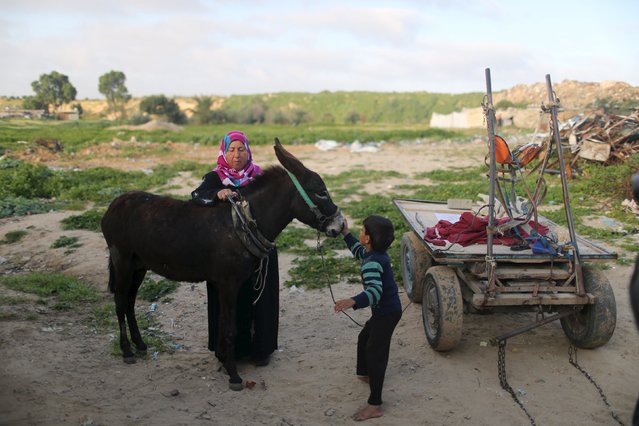
Palestinian woman Jihan Abu Muhsen prepares her donkey with her son Kareem before going work collecting bricks for sale from sites of demolished buildings, at her dwelling in Khan Younis in the southern Gaza Strip March 8, 2016. Abu Muhsen gathers bricks from the sites of demolished buildings and sells them to recycling factories. She earns around 20 shekels ($5) a day and her 10-year-old son Mohammad helps her when he is not at school. (Photo by Ibraheem Abu Mustafa/Reuters)

Palestinian woman Jihan Abu Muhsen prepares her donkey with her son Kareem before going work collecting bricks for sale from sites of demolished buildings, at her dwelling in Khan Younis in the southern Gaza Strip March 8, 2016. Abu Muhsen gathers bricks from the sites of demolished buildings and sells them to recycling factories. She earns around 20 shekels ($5) a day and her 10-year-old son Mohammad helps her when he is not at school. (Photo by Ibraheem Abu Mustafa/Reuters)
Details
19 Apr 2016 13:32:00
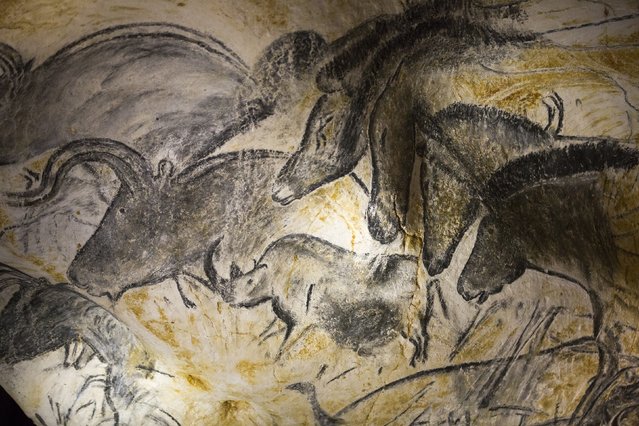
A replica of pre-historic drawings showing horses, rhinoceros and aurochs is seen on a wall during a press visit at the site of the Cavern of Pont-d'Arc project in Vallon Pont d'Arc April 8, 2015. (Photo by Robert Pratta/Reuters)

A replica of pre-historic drawings showing horses, rhinoceros and aurochs is seen on a wall during a press visit at the site of the Cavern of Pont-d'Arc project in Vallon Pont d'Arc April 8, 2015. The Cavern of Pont-d'Arc project is a replica of the pre-historic Decorated Cave of Pont-d'Arc known as Grotte Chauvet, in Vallon Pont-d'Arc in the Ardeche region, containing the world's earliest known art which was recently named a UNESCO World Heritage site. The facsimile cavern, which condenses some 8000m² of the original site into 3000m², will display faithful reproductions of paintings and engravings and will be inaugurated on April 10 and will open to the public on April 25. (Photo by Robert Pratta/Reuters)
Details
09 Apr 2015 14:23:00