Loading...
Done
Christian people crowd a bush taxi on a road 55km north of Bangui as they are on their way to the capital where they expect to sell some products on the market on January 19, 2014. Fresh fighting broke out in the strife-torn Central African Republic on the eve of an announcement on Sunday of the candidates seeking to become the new interim president. (Photo by Eric Feferberg/AFP Photo)

Christian people crowd a bush taxi on a road 55km north of Bangui as they are on their way to the capital where they expect to sell some products on the market on January 19, 2014. Fresh fighting broke out in the strife-torn Central African Republic on the eve of an announcement on Sunday of the candidates seeking to become the new interim president. Sectarian violence has gripped the landlocked country after a March 2013 coup launched by the mostly Muslim Seleka rebels, and the UN has warned that the bloodshed could turn into genocide. (Photo by Eric Feferberg/AFP Photo)
Details
26 Jan 2014 12:39:00
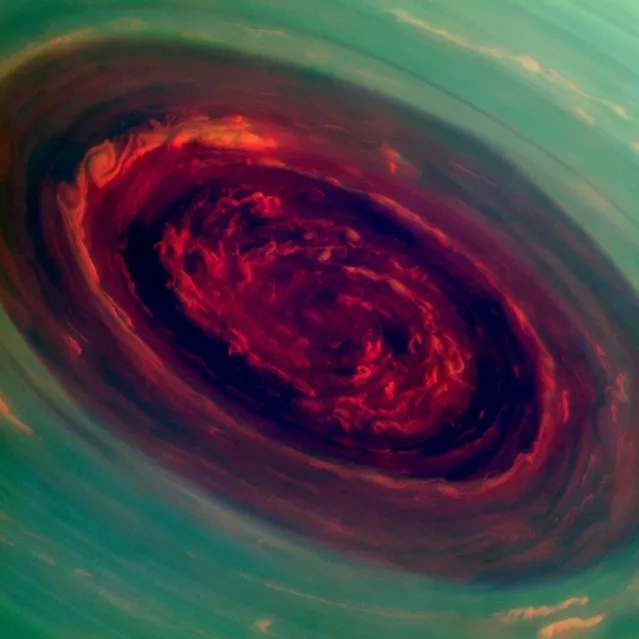
The spinning vortex of Saturn's north polar storm resembles a deep red rose of giant proportions surrounded by green foliage in this false-color image from NASA's Cassini spacecraft. (Photo by NASA/JPL-Caltech/SSI)

NASA's Cassini spacecraft has provided scientists the first close-up, visible-light views of a behemoth hurricane swirling around Saturn's north pole. In high-resolution pictures and video, scientists see the hurricane's eye is about 1,250 miles (2,000 kilometers) wide, 20 times larger than the average hurricane eye on Earth. Thin, bright clouds at the outer edge of the hurricane are traveling 330 mph(150 meters per second). The hurricane swirls inside a large, mysterious, six-sided weather pattern known as the hexagon. Photo: The spinning vortex of Saturn's north polar storm resembles a deep red rose of giant proportions surrounded by green foliage in this false-color image from NASA's Cassini spacecraft. (Photo by NASA/JPL-Caltech/SSI)
Details
31 May 2015 09:11:00
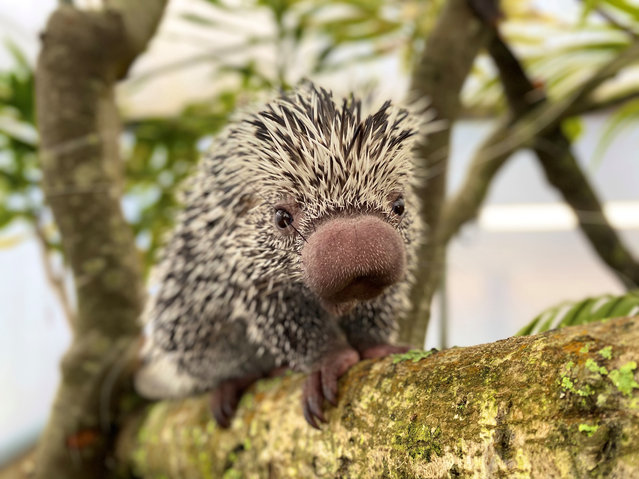
Runner-up, Heart and Minds: Nifty nose, by Samantha Allworthy at Longleat. Species: prehensile tailed porcupines. (Photo by Samantha Allworthy/BIAZA 2020 Photography Competition)

The British and Irish Association of Zoos and Aquariums (BIAZA) has announced the winning images in its annual photography competition. The 2020 winners show the important work of zoos and aquariums at an immensely challenging time. After months of closures, these conservation organisations are reeling from the financial impacts of the coronavirus pandemic. Here: Runner-up, Heart and Minds: Nifty nose, by Samantha Allworthy at Longleat. Species: prehensile tailed porcupines. (Photo by Samantha Allworthy/BIAZA 2020 Photography Competition)
Details
24 Jul 2020 00:03:00
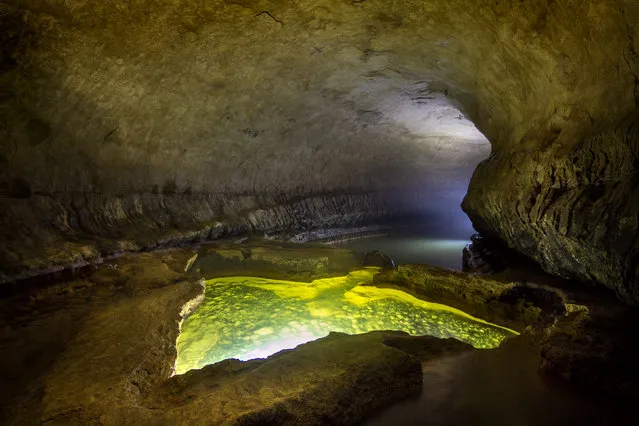
A large pool of water inside one of the tunnels. (Photo by Vladimir Mulde/Caters News)

These otherworldly images give a rare glimpse inside caves barely ever seen by the human eye. With its peculiar pools of water and strange colored sediments, the bizarre looking tunnels of the Shakuranskaya cave could be a set straight out of a science fiction film. Found in the disputed region of Abkhazia, around 75 miles outside of Sochi, Russia, it is rumored the incredible underground chambers were formed after a huge earthquake struck the area in 1892. After causing part of a nearby mountain to collapse into the Amtkel River, it is thought the dam-like affect has created a series of interconnecting underground tunnels. Here: a large pool of water inside one of the tunnels. (Photo by Vladimir Mulde/Caters News)
Details
07 Nov 2014 12:45:00
Switzerland's cyclist Marlen Reusser reacts after placing second in the women' elite time trial race of the UCI World Championships Road Cycling Flanders 2021, in Bruges, on September 20, 2021. UCI World Championships Road Cycling Flanders 2021 takes place from September 19 until September 26, 2021, in several cities in the Belgian region of Flanders. (Photo by Simon Wilkinson/BELGA via AFP Photo)

Switzerland's cyclist Marlen Reusser reacts after placing second in the women' elite time trial race of the UCI World Championships Road Cycling Flanders 2021, in Bruges, on September 20, 2021. UCI World Championships Road Cycling Flanders 2021 takes place from September 19 until September 26, 2021, in several cities in the Belgian region of Flanders. (Photo by Simon Wilkinson/BELGA via AFP Photo)
Details
29 Sep 2021 08:08:00
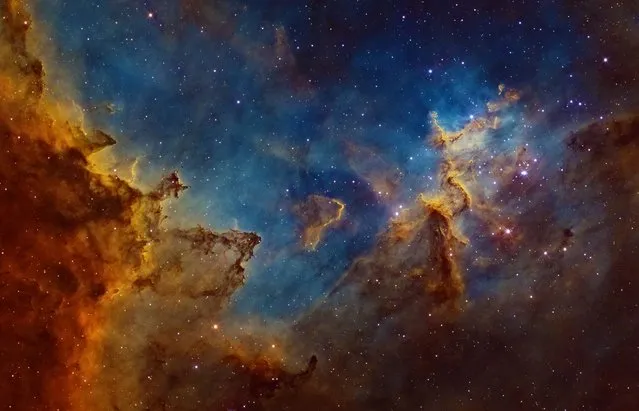
Centre of the Heart Nebula by Ivan Eder (Hungary). Situated 7500 light years away in the ‘W’-shaped constellation of Cassiopeia, the Heart Nebula is a vast region of glowing gas, energized by a cluster of young stars at its centre. The image depicts the central region, where dust clouds are being eroded and moulded into rugged shapes by the searing cosmic radiation. (Photo by Ivan Eder)

The competition, which is run by the Royal Observatory Greenwich in association with BBC Sky at Night Magazine, is now in its sixth year and has received over 2,500 entries. Photo: Centre of the Heart Nebula by Ivan Eder (Hungary). Situated 7500 light years away in the “W”-shaped constellation of Cassiopeia, the Heart Nebula is a vast region of glowing gas, energized by a cluster of young stars at its centre. The image depicts the central region, where dust clouds are being eroded and moulded into rugged shapes by the searing cosmic radiation. (Photo by Ivan Eder)
Details
03 Jul 2014 11:59:00
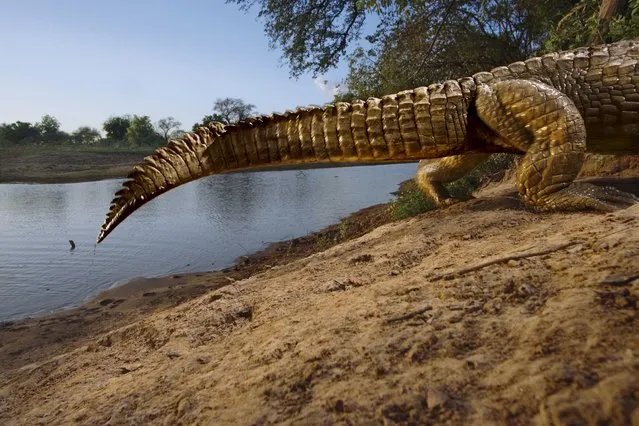
CT4 Crocodile cave on the Salamat river. Set up with Nathan Williamson last chip rain came while we were with the nomads. (Photo by Michael Nichols/National Geographic)

National Geographic has created “Air, Land & Sea: the 50 greatest wildlife photographs” exhibition. Here: CT4 Crocodile cave on the Salamat river. Set up with Nathan Williamson last chip rain came while we were with the nomads. (Photo by Michael Nichols/National Geographic)
Details
13 Sep 2018 00:03:00
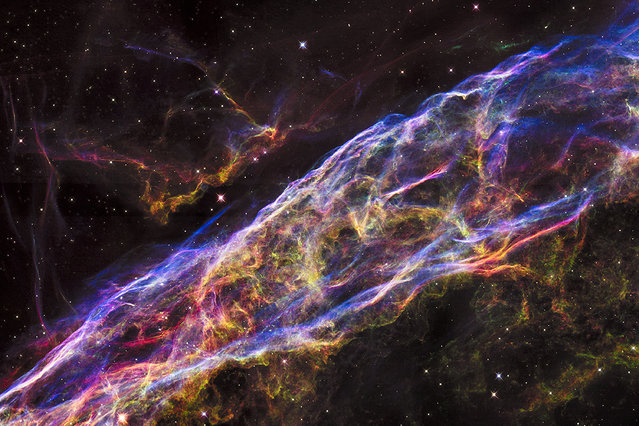
A small section of the expanding remains of the Veil Nebula, a massive star that exploded about 8,000 years ago. The entire nebula is 110 light-years across, covering six full moons on the sky as seen from Earth, and resides about 2,100 light-years away in the constellation Cygnus, the Swan. Image taken by NASA's Hubble Space Telescope. Released September 24, 2015. (Photo by Reuters/NASA/ESA/Hubble Heritage Team)

A small section of the expanding remains of the Veil Nebula, a massive star that exploded about 8,000 years ago. The entire nebula is 110 light-years across, covering six full moons on the sky as seen from Earth, and resides about 2,100 light-years away in the constellation Cygnus, the Swan. Image taken by NASA's Hubble Space Telescope. Released September 24, 2015. (Photo by Reuters/NASA/ESA/Hubble Heritage Team)
Details
10 Dec 2015 08:01:00