Loading...
Done
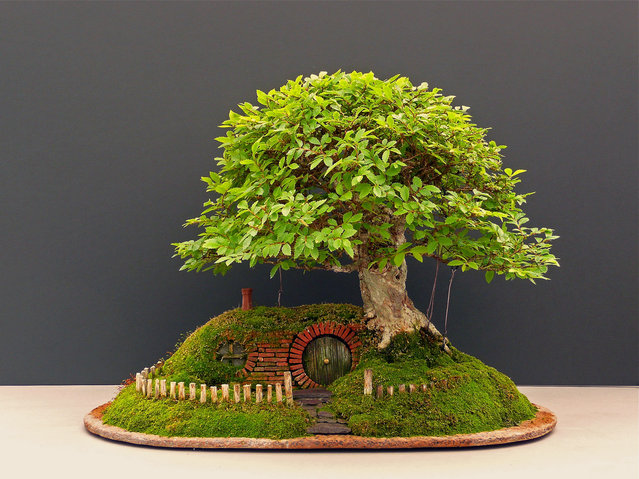
A Bonsai Baggins Hobbit Home By Chris Guise

Chris Guise is an artist, mechanical engineer and bonsai enthusiast from Maidenhead, England; and is interested in bonsai, Stirling engines, cathedrals, trees etc.
‘Bag End Bonsai Trayscape’: A Bonsai Baggins Hobbit Home is an amazing and creative creation by Artist Chris Guise. See the images below for extensive detailed work.
Details
14 May 2013 09:15:00
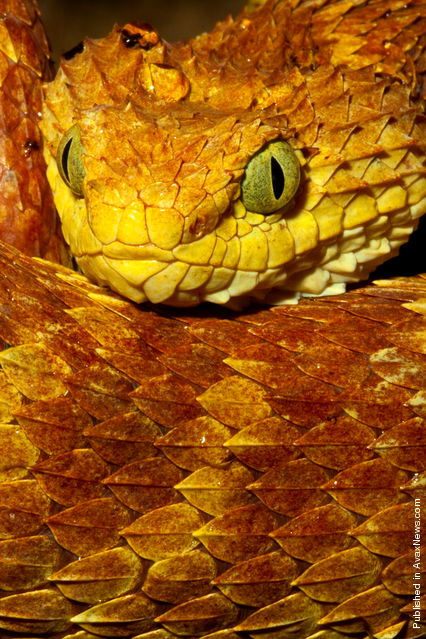
Atheris squamigera

“Atheris is a genus of venomous vipers found only in tropical subsaharan Africa, excluding southern Africa. Confined to rain forest areas, many members have isolated and fragmented distributions. In an interesting example of convergent evolution, they show many similarities to the arboreal pit vipers of Asia and South America”. – Wikipedia

Photo: Atheris squamigera. (Photo by David Williams)
Details
21 Apr 2012 13:14:00
A woman looks at traditional Ukrainian Easter eggs “Pysanka”, installed as part of the upcoming celebrations of Easter, in central Kiev, Ukraine, April 29, 2016. A pysanka is a Ukrainian Easter egg, decorated with traditional Ukrainian folk designs using a wax-resist (batik) method. The word pysanka comes from the verb pysaty, “to write”, as the designs are not painted on, but written with beeswax. Many other eastern European ethnic groups decorate eggs using wax resist for Easter. These include the Belarusians, Bulgarians, Croats, Czechs, Hungarians, Lithuanians, Poles, Romanians, Serbs, Slovaks, Slovenes and Sorbs. (Photo by Valentyn Ogirenko/Reuters)

A woman looks at traditional Ukrainian Easter eggs “Pysanka”, installed as part of the upcoming celebrations of Easter, in central Kiev, Ukraine, April 29, 2016. A pysanka is a Ukrainian Easter egg, decorated with traditional Ukrainian folk designs using a wax-resist (batik) method. The word pysanka comes from the verb pysaty, “to write”, as the designs are not painted on, but written with beeswax. Many other eastern European ethnic groups decorate eggs using wax resist for Easter. These include the Belarusians, Bulgarians, Croats, Czechs, Hungarians, Lithuanians, Poles, Romanians, Serbs, Slovaks, Slovenes and Sorbs. (Photo by Valentyn Ogirenko/Reuters)
Details
30 Apr 2016 09:00:00
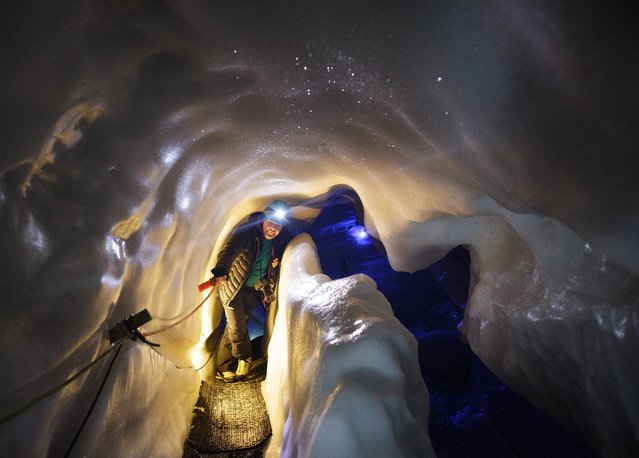
A tourist walks inside the Ice Palace glacier hollow at Hintertux glacier, located at around 3250 meters above sea level, in Zillertal, Austria, 02 March, 2016. The hollow's temperature remains constant at 0 degrees Celsius, in summer and winter alike, and is also used by the University of Innsbruck for scientific research projects. (Photo by Lisi Niesner/EPA)

A tourist walks inside the Ice Palace glacier hollow at Hintertux glacier, located at around 3250 meters above sea level, in Zillertal, Austria, 02 March, 2016. The hollow's temperature remains constant at 0 degrees Celsius, in summer and winter alike, and is also used by the University of Innsbruck for scientific research projects. (Photo by Lisi Niesner/EPA)
Details
03 Mar 2016 11:44:00
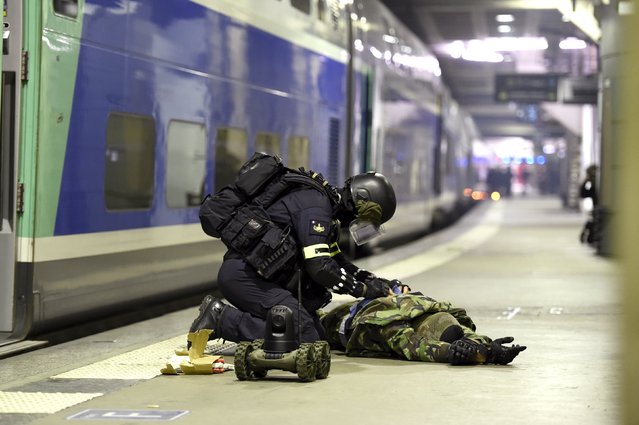
A member of the National Gendarmerie Intervention Group (GIGN) deactivates a bomb from a supposed terrorist during a training exercise in the event of a terrorist attack in collaboration with Recherche Assistance Intervention Dissuasion (RAID) and Research and Intervention Brigades (BRI) in presence of the French Interior minister Bernard Cazeneuve at la Gare Montparnasse, in central Paris on April 20, 2016. (Photo by Miguel Medina/Reuters)

A member of the National Gendarmerie Intervention Group (GIGN) deactivates a bomb from a supposed terrorist during a training exercise in the event of a terrorist attack in collaboration with Recherche Assistance Intervention Dissuasion (RAID) and Research and Intervention Brigades (BRI) in presence of the French Interior minister Bernard Cazeneuve at la Gare Montparnasse, in central Paris on April 20, 2016. (Photo by Miguel Medina/Reuters)
Details
21 Apr 2016 11:54:00
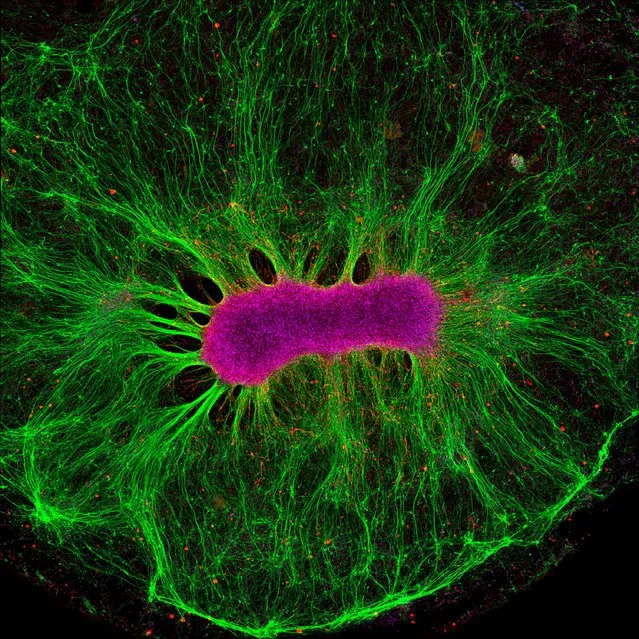
Brain-on-a-chip. Dazzling in green and magenta this image shows the nerve fibres (in green) produced by neural stem cells (in magenta) as they grow on a synthetic gel. Captured by a technique known as confocal microscopy, the image is part of research shedding light on how tinkering with the environment can affect the way in which nerve fibres grow. (Photo by Collin Edington and Iris Lee/Massachusetts Institute of Technology/Wellcome Images)

Brain-on-a-chip. Dazzling in green and magenta this image shows the nerve fibres (in green) produced by neural stem cells (in magenta) as they grow on a synthetic gel. Captured by a technique known as confocal microscopy, the image is part of research shedding light on how tinkering with the environment can affect the way in which nerve fibres grow. (Photo by Collin Edington and Iris Lee/Massachusetts Institute of Technology/Wellcome Images)
Details
17 Mar 2017 00:01:00
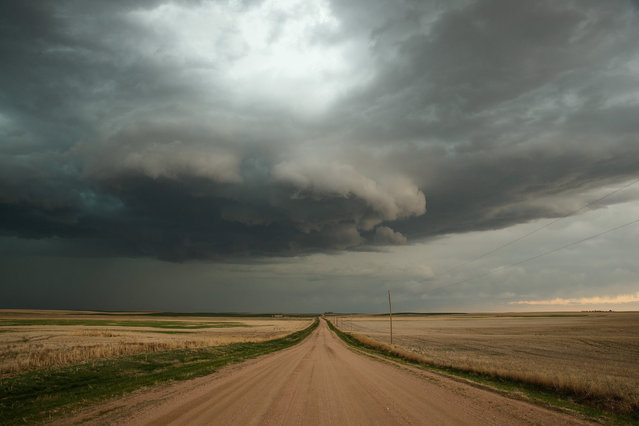
A supercell thunderstorm develops, May 8, 2017 in Elbert County outside of Limon, Colorado. With funding from the National Science Foundation and other government grants, scientists and meteorologists from the Center for Severe Weather Research try to get close to supercell storms and tornadoes trying to better understand tornado structure and strength, how low-level winds affect and damage buildings, and to learn more about tornado formation and prediction. (Photo by Drew Angerer/Getty Images)

A supercell thunderstorm develops, May 8, 2017 in Elbert County outside of Limon, Colorado. With funding from the National Science Foundation and other government grants, scientists and meteorologists from the Center for Severe Weather Research try to get close to supercell storms and tornadoes trying to better understand tornado structure and strength, how low-level winds affect and damage buildings, and to learn more about tornado formation and prediction. (Photo by Drew Angerer/Getty Images)
Details
16 Jun 2017 06:20:00
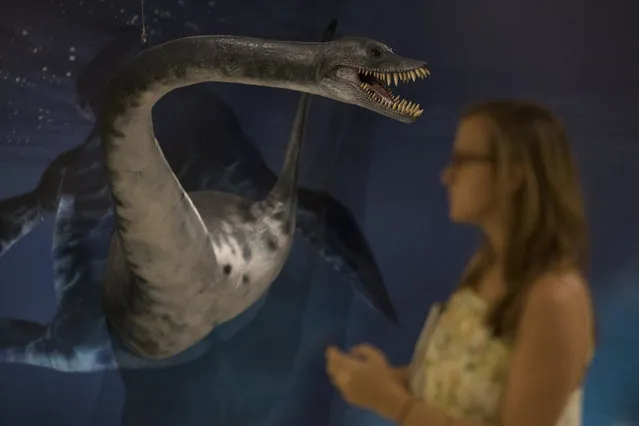
In this January 16, 2019 photo, a sculpture of a Plesiosaur is displayed at an exhibit about the studies of researchers from the National Museum made in Antartica, during a media presentation of the exhibit in Rio de Janeiro, Brazil. The National Museum will inaugurate on Jan. 17 their first exhibition after the fire, held at the building that houses the Cultural Center and Museum of Brazil's Mint. (Photo by Leo Correa/AP Photo)

In this January 16, 2019 photo, a sculpture of a Plesiosaur is displayed at an exhibit about the studies of researchers from the National Museum made in Antartica, during a media presentation of the exhibit in Rio de Janeiro, Brazil. The National Museum will inaugurate on Jan. 17 their first exhibition after the fire, held at the building that houses the Cultural Center and Museum of Brazil's Mint. (Photo by Leo Correa/AP Photo)
Details
18 Jan 2019 09:26:00