Loading...
Done
Tridacna Gigas, or Giant Clams

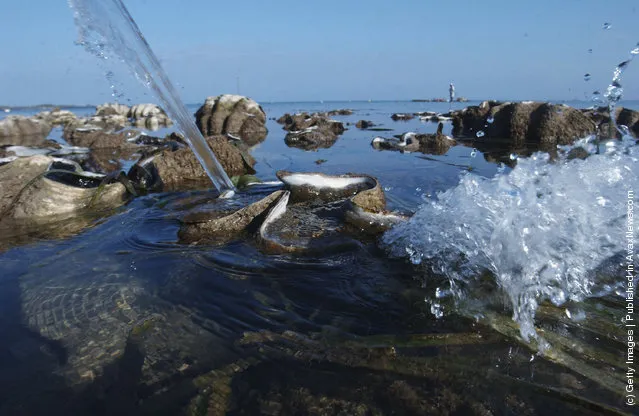
“The giant clam, Tridacna gigas (known as pā’ua in Cook Islands Māori), is the largest living bivalve mollusc. T. gigas is one of the most endangered clam species. It was mentioned as early as 1825 in scientific reports. One of a number of large clam species native to the shallow coral reefs of the South Pacific and Indian oceans, they can weigh more than 200 kilograms (440 lb) measure as much as 120 cm (47 in) across, and have an average lifespan in the wild of 100 years or more”. – Wikipedia

Photo: Tridacna Gigas, or Giant Clams spew water as a traditional fisherman passes by a small sanctuary on January 23, 2004 near Bolinao in the Northern Philippines. The clams, prime builders for coral reefs and providing shelter for spawning fish and other marine life, are exposed by low tides in the sanctuary. Overfishing and pollution throughout the country are not only threatening food security, but are also starting to choke one of the few working clam sanctuaries in the world. (Photo by David Greedy/Getty Images)
Details
01 Oct 2011 13:10:00
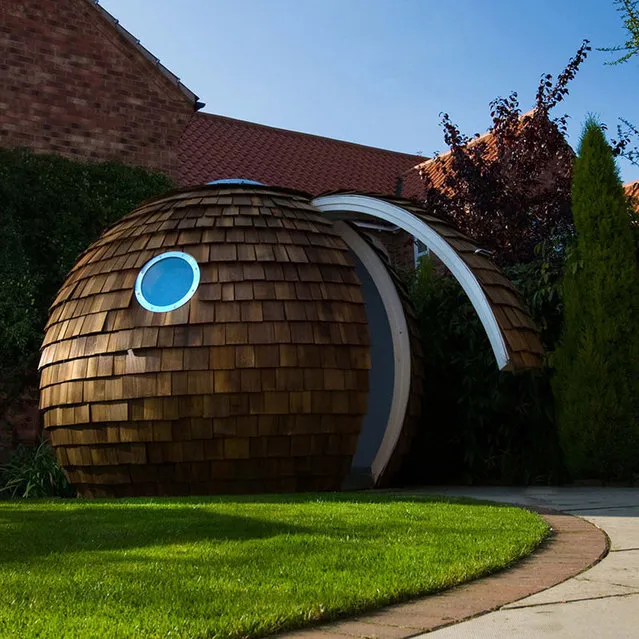
Futuristic Home Office Garden Design

Archipod futuristic home office Garden design created especially for your private office. Working from home office make you are closer to your family and nature. Home office design in your own backyard complete with telephone, electricity and water. Natural features futuristic such as coconut, brown and rough on outside, white and fluffy inside. Pod features a large skylight dometop with round windows, natural lighting into Archipod home office design. Dimmable floodlights interior, concealed lighting. Archipod futuristic home office garden design use ergonomic semi-circle office desk, with a thin white drawers unit and desktop. Gullwing doors easy open with gas struts. Archipod futuristic home office garden design made of wood panel on the outside.
Details
11 Mar 2013 10:26:00
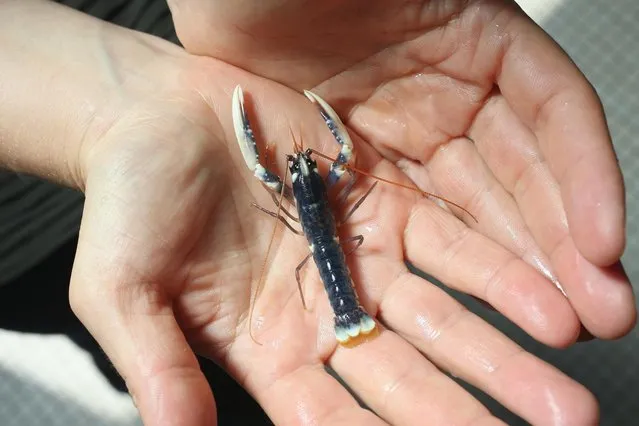
Isabel Schmalenbach, an environmental scientist with the Helgoland Biological Institute (Biologische Anstalt Helgoland), part of the Alfred Wegener Institute for Polar and Marine Research, holds a one-year old baby European lobster (Homarus gammarus) raised at the institute on August 3, 2013 on Helgoland Island, Germany. (Photo by Sean Gallup/Getty Images)

Isabel Schmalenbach, an environmental scientist with the Helgoland Biological Institute (Biologische Anstalt Helgoland), part of the Alfred Wegener Institute for Polar and Marine Research, holds a one-year old baby European lobster (Homarus gammarus) raised at the institute on August 3, 2013 on Helgoland Island, Germany. Later in the day Schmalenbach and her colleagues released a total of 415 one-year old lobsters into the North Sea as part of an effort to repopulate the lobster population around Helgoland (also called Heligoland). In the 19th century local fishermen caught up to 80,000 lobsters a year in the surrounding waters, combined with the heavy allied bombing of the island during and after World War II, as well as other environmental factors, decimated the lobster population. (Photo by Sean Gallup)
Details
05 Aug 2013 08:39:00
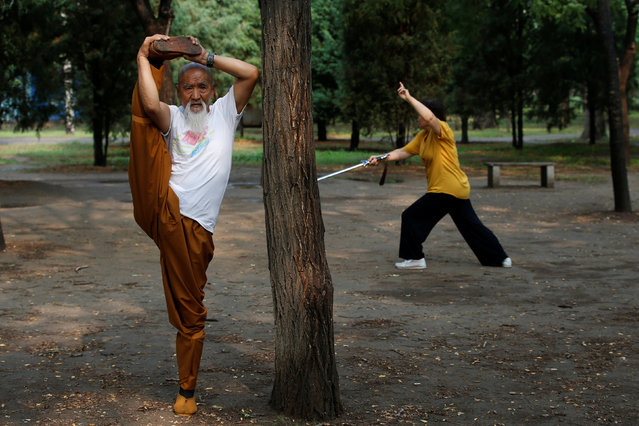
Kung Fu master Li Liangui practices 'Suogugong' Kung Fu and his wife Liang Xiaoyan (R) practices Qigong at a park in Beijing, China, June 30, 2016. (Photo by Kim Kyung-Hoon/Reuters)

Kung Fu master Li Liangui practices “Suogugong” Kung Fu and his wife Liang Xiaoyan (R) practices Qigong at a park in Beijing, China, June 30, 2016. For 50 years, kung fu master Li Liangui has been contorting his body into eye-watering positions while practising one of the more unusual and less popular Chinese martial art forms. The 70-year-old is an expert in suogugong, or body shrinking kung fu, where practitioners dislocate their bones to help them achieve unlikely positions and feats. (Photo by Kim Kyung-Hoon/Reuters)
Details
17 Sep 2016 10:27:00
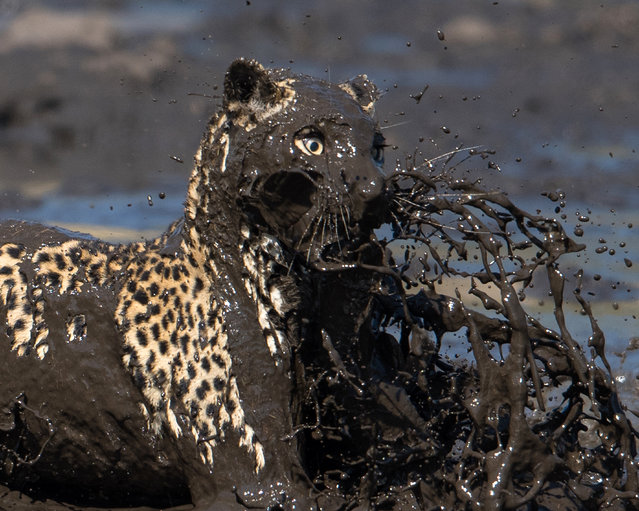
A leopard leaps into a muddy waterhole to catch a fish on August 13, 2015, in the Savuti Channel in Botswana. A leopard leaps into a muddy waterhole to catch a fish in the Savuti Channel in Botswana. The spotted predator stood poised waiting for a fish to appear – before leaping in ferociously with lightening reflexes. (Photo by Greatstock/Barcroft Media)

A leopard leaps into a muddy waterhole to catch a fish on August 13, 2015, in the Savuti Channel in Botswana. A leopard leaps into a muddy waterhole to catch a fish in the Savuti Channel in Botswana. The spotted predator stood poised waiting for a fish to appear – before leaping in ferociously with lightening reflexes. Coated in a layer of thick dark mud the big cat emerged from the water clutching the fish in its jaws. The fishing leopards of Savuti are known for their unique skills in catching fish – but have rarely been photographed. (Photo by Greatstock/Barcroft Media)
Details
06 Sep 2015 13:00:00
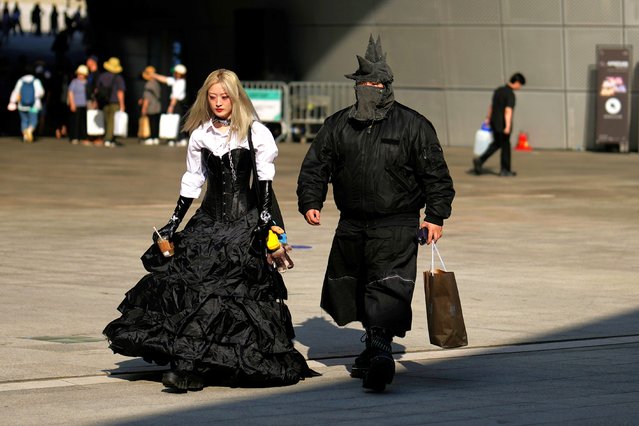
Visitors outside the venue for Seoul fashion week in Seoul, South Korea on September 3, 2024. (Photo by Lee Jin-man/AP Photo)

Visitors outside the venue for Seoul fashion week in Seoul, South Korea on September 3, 2024. (Photo by Lee Jin-man/AP Photo)
Details
28 Sep 2024 02:20:00


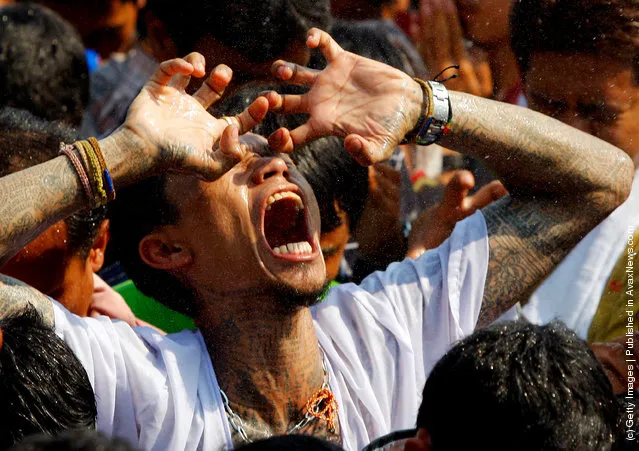
A Thai devotee in a state of trance screams while holy water is sprayed as thousands race towards the edifice of the founder monk during the annual Tattoo fesitval at Wat Bang Phra on March 7, 2009 in Nakhom Pathom, Thailand. Some men take on the characteristics of sacred animals that have been carved onto their skin. Thousands of believers from all over Thailand come to take part in one of the country's most bizarre festivals about 50 miles outside Bangkok to pay respect to the temple's monks who are master tattooist. In Thai culture the tattoo or Thai word sak yant is worn as a symbol of spiritual and physical protection, many believe that the tattoo have mystical powers. Many tattoo fanatics choose to have monkeys and tigers as well as the Khmer/Cambodia ancient script on their bodies. (Photo Paula Bronstein/Getty Images)
Details
27 Jun 2011 10:43:00
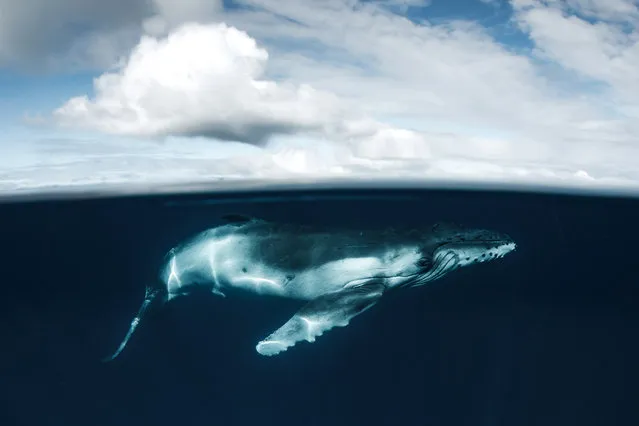
The images were taken off the coast of Tonga in the South Pacific. Photographer Grant Thomas said: “Through my images I aim to show off the amazing life we have on our planet in hope of inspiring more people to experience it for themselves and, most importantly, care for it. There is nothing to be afraid of with the humpback whales, as these animals are some of the most majestic and peaceful creatures in the sea. They will often be very curious of people in the water and will even seek out interactions with us”. (Photo by Grant Thomas/Caters News Agency)

The images were taken off the coast of Tonga in the South Pacific. Photographer Grant Thomas said: “Through my images I aim to show off the amazing life we have on our planet in hope of inspiring more people to experience it for themselves and, most importantly, care for it”. (Photo by Grant Thomas/Caters News Agency)
Details
28 Nov 2019 00:03:00