Loading...
Done
An image of a Fennec fox painted on a tree hole by Wang Yue is seen in Shijiazhuang, on March 13, 2013. Wang Yue, a senior at Dalian Industry University, uses her paintbrush to turn ugly tree holes into lovely views in Shijiazhuang, capital city of Hebei Province, China. Wang and her companions call the tree-hole paintings “meitu”, which means “beautiful journey”. The paintings on the trees have brightened the city during the dull, grey winter. (Photo by Pillar Lee/Reuters)

An image of a Fennec fox painted on a tree hole by Wang Yue is seen in Shijiazhuang, on March 13, 2013. Wang Yue, a senior at Dalian Industry University, uses her paintbrush to turn ugly tree holes into lovely views in Shijiazhuang, capital city of Hebei Province, China. Wang and her companions call the tree-hole paintings “meitu”, which means “beautiful journey”. The paintings on the trees have brightened the city during the dull, grey winter. (Photo by Pillar Lee/Reuters)

P.S. All pictures are presented in high resolution. To see Hi-Res images – just TWICE click on any picture. In other words, click small picture – opens the BIG picture. Click BIG picture – opens VERY BIG picture (if available; this principle works anywhere on the site AvaxNews).
Details
16 Mar 2013 11:27:00
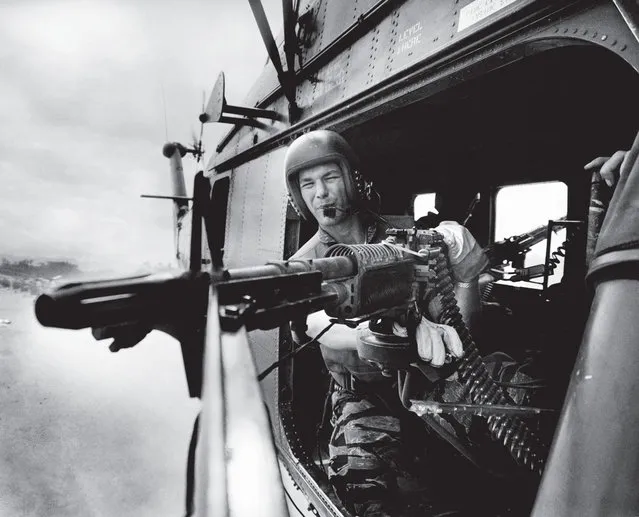
Man your battle stations: The crew chief of helicopter Yankee Papa 13, lance corporal James C. Farley, mans an M-60 machine gun during a mission near Da Nang, Vietnam on March 31, 1965. (Photo by Larry Burrows/Time & Life Pictures)

In the spring of 1965, within weeks of 3,500 American Marines arriving in Vietnam, a 39-year-old Briton named Larry Burrows began work on a feature for LIFE magazine, chronicling the day-to-day experience of U.S. troops on the ground – and in the air – in the midst of the rapidly widening war. The photographs in this gallery focus on a calamitous March 31, 1965, helicopter mission; Burrows’ “report from Da Nang”, featuring his pictures and his personal account of the harrowing operation, was published two weeks later as a now-famous cover story in the April 16, 1965, issue of LIFE.

Photo: Man your battle stations: The crew chief of helicopter Yankee Papa 13, lance corporal James C. Farley, mans an M-60 machine gun during a mission near Da Nang, Vietnam on March 31, 1965. (Photo by Larry Burrows/Time & Life Pictures)
Details
07 Apr 2013 07:08:00
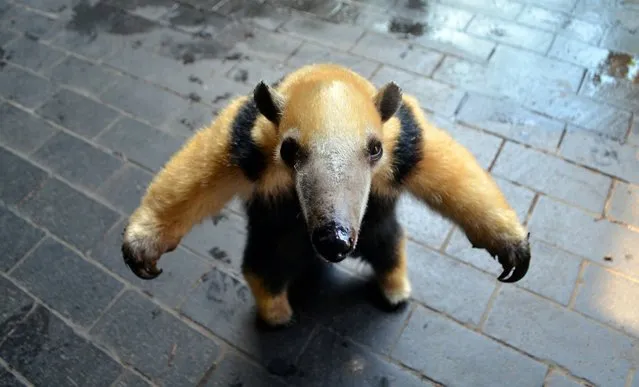
London Zoo photo of Tammy the tree-climbing anteater who is to be given her own minder during a series of late night events at ZSL London Zoo this summer. The twelve-year-old tree-climbing anteater is famed for her friendly disposition, but with naturally poor eyesight zookeepers will be giving Tammy help to steer her past any errant feet in the free-roaming exhibit. (Photo by ZSL London Zoo/PA Wire)

London Zoo photo of Tammy the tree-climbing anteater who is to be given her own minder during a series of late night events at ZSL London Zoo this summer. The twelve-year-old tree-climbing anteater is famed for her friendly disposition, but with naturally poor eyesight zookeepers will be giving Tammy help to steer her past any errant feet in the free-roaming exhibit. (Photo by ZSL London Zoo/PA Wire)

P.S. All pictures are presented in high resolution. To see Hi-Res images – just TWICE click on any picture. In other words, click small picture – opens the BIG picture. Click BIG picture – opens VERY BIG picture (if available; this principle works anywhere on the site AvaxNews)
Details
08 Jun 2013 11:16:00
The Borges' family pet dog, Little, is placed on the back of Tom, their tiger, for a photo to be taken, in Maringa, Brazil, Friday, September 27, 2013. The Brazilian family is now locked in a legal dispute for the big cats, they have eight tigers and two lions, with federal wildlife officials working to take them away. While Borges does have a license to raise the animals, Brazilian wildlife officials say he illegally bred the cats, creating a public danger. (Photo by Renata Brito/AP Photo)

“Ary Borges and his family live in southern Brazil like most families the Borges' love animals and have an array of cats living in their home. The only difference between the cats owned by the Borges family and the cat that is cuddled up on your lap as you read this is the Borges' cats weigh over 700 pounds and could kill you just as soon as look at you. The Borges family shares their home with nine tigers, two lionesses, a chimp and a Chihuahua”. – Amanda Schiavo via Latin Times. Photo: The Borges' family pet dog, Little, is placed on the back of Tom, their tiger, for a photo to be taken, in Maringa, Brazil, Friday, September 27, 2013. (Photo by Renata Brito/AP Photo)
Details
04 Oct 2013 11:51:00
New Yorkers Celebrate At West Indian Day Parade

“The Labor Day Parade (or West Indian Carnival), is an annual celebration held on American Labor Day (the first Monday in September), in Crown Heights, Brooklyn, New York. Ms. Jessie Waddell and some of her West Indian friends started the Carnival in Harlem in the 1920s by staging costume parties in large enclosed places like the Savoy, Renaissance and Audubon Ballrooms due to the cold wintry weather of February. This is the usual time for the pre-Lenten celebrations held in most countries around the world. However, because of the very nature of Carnival, and the need to parade in costume to music, indoor confinement did not work well. The earliest known Carnival street parade was held on September 1, 1947. The Trinidad Carnival Pageant Committee was the founding force behind the parade, which was held in Harlem. The parade route was along Seventh Avenue, starting at 110th St.” – Wikipedia

Photo: A reveler looks on during the West Indian-American Day Parade September 5, 2011 in the Brooklyn borough of New York City. More than 2 million spectators were expected to attend the celebration of Caribbean culture. (Photo by Mario Tama/Getty Images)
Details
06 Sep 2011 11:18:00
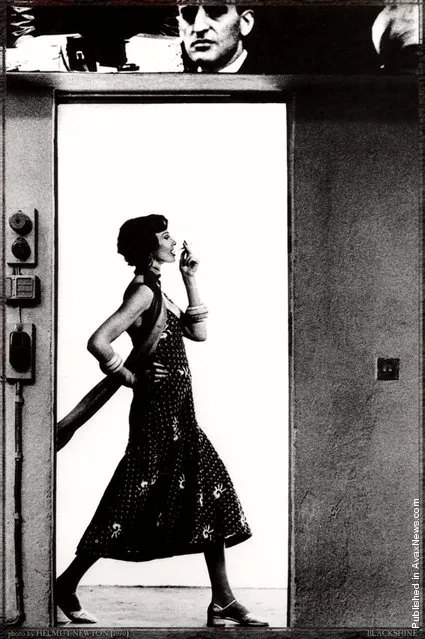
Photographers: Helmut Newton

“Newton was born in Berlin, the son of Klara “Claire” (Marquis) and Max Neustädter, a button factory owner. His family was Jewish. Newton attended the Heinrich-von-Treitschke-Realgymnasium and the American School in Berlin. Interested in photography from the age of 12 when he purchased his first camera, he worked for the German photographer Yva (Elsie Neulander Simon) from 1936. The increasingly oppressive restrictions placed on Jews by the Nuremberg laws meant that his father lost control of the factory in which he manufactured buttons and buckles; he was briefly interned in a concentration camp on “Kristallnacht”, November 9, 1938, which finally compelled the family to leave Germany. Newton's parents fled to South America. He was issued with a passport just after turning 18, and left Germany on December 5, 1938. At Trieste he boarded the “Conte Rosso” (along with about 200 others escaping the Nazis) intending to journey to China. After arriving in Singapore he found he was able to remain there, first and briefly as a photographer for the Straits Times and then as a portrait photographer”. – Wikipedia

Photo: Sigourney Weaver by Helmut Newton, 1995.
Details
08 Apr 2012 13:49:00
A pro-Russian armed man secures crash site wreckage of the Malaysia Airlines Boeing 777 plane (flight MH17) at the site of the plane crash near the settlement of Grabovo in the Donetsk region November 16, 2014. Local emergency services have begun collecting parts of the wreckage from its crash site in the middle of the conflict zone, Dutch air accident investigators said on Sunday. (Photo by Antonio Bronic/Reuters)

A pro-Russian armed man secures crash site wreckage of the Malaysia Airlines Boeing 777 plane (flight MH17) at the site of the plane crash near the settlement of Grabovo in the Donetsk region November 16, 2014. Local emergency services have begun collecting parts of the wreckage from its crash site in the middle of the conflict zone, Dutch air accident investigators said on Sunday. Dutch inspectors had hoped to collect the parts themselves, following the downing of the flight on July 17 that killed 298 people, two thirds of them Dutch citizens. But they remain concerned about the safety of their staff in the rebel-held conflict zone, and so have decided to work with local services following an initial focus on finding human remains and belongings. (Photo by Antonio Bronic/Reuters)
Details
17 Nov 2014 12:47:00
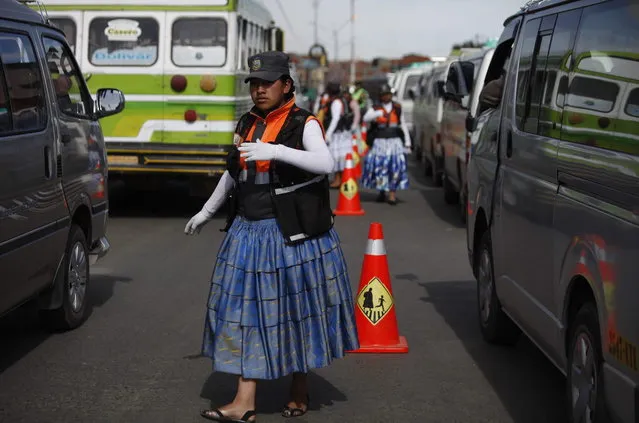
In this December 3, 2013 photo, an Aymara woman cops directs traffic on the streets of El Alto, Bolivia. The women wear the bright petticoats and shawls of indigenous women in the Andes, called cholitas in Bolivian slang, the main difference being that instead of bowler hats they wear khaki green police-style caps. Some don fluorescent traffic vests. (Photo by Juan Karita/AP Photo)

“This city in Bolivia's highlands has hired Aymara women dressed in traditional multilayered Andean skirts and brightly embroidered vests to work as traffic cops and bring order to its road chaos. About 20 of the “traffic cholitas” have been trained to direct cars and buses in El Alto, a teeming, impoverished sister city of La Paz in Bolivia's Andes mountains”. – El Alto via Associated Press. Photo: In this December 3, 2013 photo, an Aymara woman cops directs traffic on the streets of El Alto, Bolivia. The women wear the bright petticoats and shawls of indigenous women in the Andes, called cholitas in Bolivian slang, the main difference being that instead of bowler hats they wear khaki green police-style caps. Some don fluorescent traffic vests. (Photo by Juan Karita/AP Photo)
Details
25 Dec 2013 10:48:00