Loading...
Done
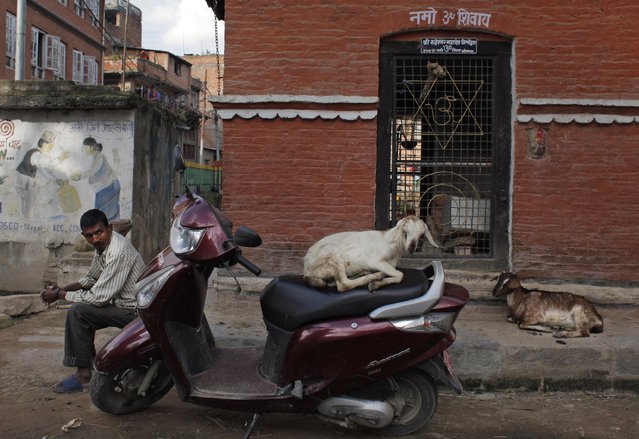
A Nepalese man sits outside a Hindu temple as a goat rests on a parked scooter in Khokana, Lalitpur District, Nepal, Monday, Sept. 26, 2016. Writing on the wall offers prayers to Hindu god Shiva. (Photo by Niranjan Shrestha/AP Photo)

A Nepalese man sits outside a Hindu temple as a goat rests on a parked scooter in Khokana, Lalitpur District, Nepal, Monday, September 26, 2016. Writing on the wall offers prayers to Hindu god Shiva. (Photo by Niranjan Shrestha/AP Photo)
Details
27 Sep 2016 09:27:00
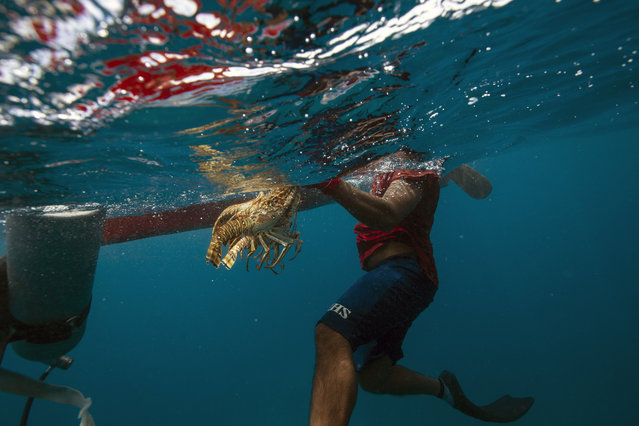
In this September 9, 2018 photo, a diver holds onto his catch of lobsters during a fishing journey in the Miskito coast near Cay Savannah, Honduras. A diver makes 75 lempiras ($3) per pound of lobster. An average 10-pound daily haul of lobster is a windfall for people in one of the most impoverished regions of the Americas, so many take the risk, and many suffer for it. (Photo by Rodrigo Abd/AP Photo)

In this September 9, 2018 photo, a diver holds onto his catch of lobsters during a fishing journey in the Miskito coast near Cay Savannah, Honduras. A diver makes 75 lempiras ($3) per pound of lobster. An average 10-pound daily haul of lobster is a windfall for people in one of the most impoverished regions of the Americas, so many take the risk, and many suffer for it. (Photo by Rodrigo Abd/AP Photo)
Details
23 Jan 2019 00:01:00
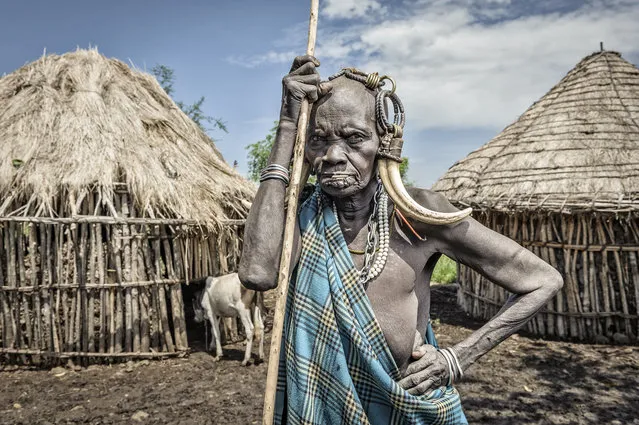
“Old Mursi woman”. Old woman by the huts of her village. Location: Marenke, Omo valley, Ethiopia. (Photo and caption by Jorge Fernandez/National Geographic Traveler Photo Contest)

“Old Mursi woman”. Old woman by the huts of her village. Location: Marenke, Omo valley, Ethiopia. (Photo and caption by Jorge Fernandez/National Geographic Traveler Photo Contest)

ATTENTION! All pictures are presented in high resolution. To see Hi-Res images – just TWICE click on any picture. In other words, click small picture – opens the BIG picture. Click BIG picture – opens VERY BIG picture.
Details
24 Jun 2013 09:55:00
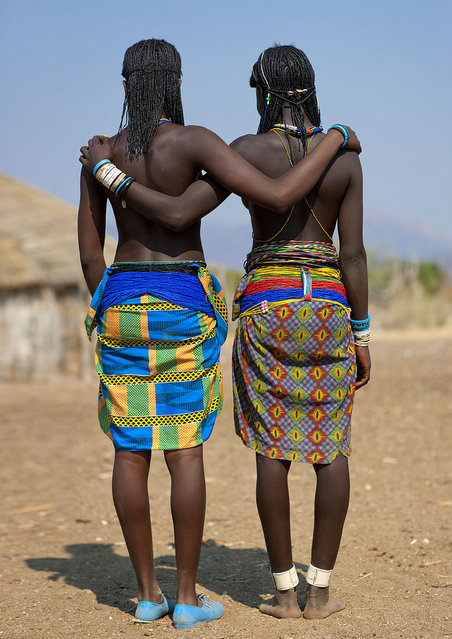
“Show us our butts! Mucawana tribe – Angola. In Soba village, the Muhacaona (Mucawana) tribe, perhaps the best place i have visited. They use cow dung and fat to make this so nice haircut, and love the beads. They asked me to make pictures of their backs... and butts to see on the camera screen if everything was perfect!”. (Eric Lafforgue)

“Show us our butts! Mucawana tribe – Angola. In Soba village, the Muhacaona (Mucawana) tribe, perhaps the best place i have visited. They use cow dung and fat to make this so nice haircut, and love the beads. They asked me to make pictures of their backs... and butts to see on the camera screen if everything was perfect!”. (Photo and comments by Eric Lafforgue)
Details
09 Nov 2012 15:04:00
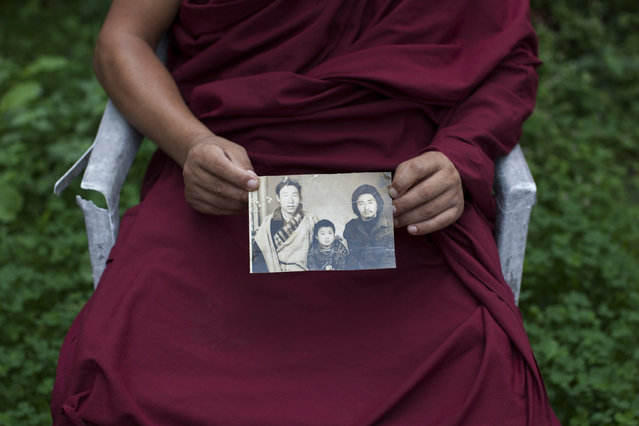
In this Saturday, September 27, 2014 photo, Tibetan monk Dorjee, 38, displays a photograph of his father, left, and himself, center, taken in Tibet, in Dharamsala, India. Dorjee said he held back his tears when he spoke with his parents on the phone after a separation period of 27 years. He exchanged a few words with his father but said his mother fainted on hearing his voice. (Photo by Tsering Topgyal/AP Photo)

“When I was 8 years old, my parents paid a smuggler to take me across the Himalayas, a weekslong walk over the mountains from Tibet to India. It was a trek that tens of thousands of other Tibetans have taken since the Dalai Lama fled a failed 1959 uprising against Chinese rule. My parents must have had their reasons to send me here; they must have had the best of intentions. But 18 years later, I still don't know why they did it. They are not political people. They are small farmers who raise barley and a few yak in a rural area not far from Lhasa, the Tibetan capital. I have not seen them since I left...”. – Tsering Topgyal via The Associated Press. (Photo by Tsering Topgyal/AP Photo)
Details
05 Nov 2014 12:27:00
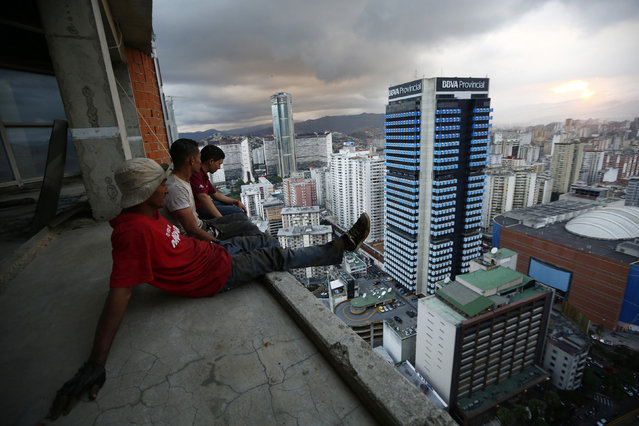
Men rest after salvaging metal on the 30th floor of the “Tower of David” skyscraper in Caracas February 3, 2014. A 45-storey skyscraper in the center of Venezuela's capital Caracas is a slum, probably the highest in the world. Dubbed the “Tower of David”, the building was intended to be a shining new financial center but was abandoned around 1994 after the death of its developer – banker and horse-breeder David Brillembourg – and the collapse of the financial sector. (Photo by Jorge Silva/Reuters)

Men rest after salvaging metal on the 30th floor of the “Tower of David” skyscraper in Caracas February 3, 2014. A 45-storey skyscraper in the center of Venezuela's capital Caracas is a slum, probably the highest in the world. Dubbed the “Tower of David”, the building was intended to be a shining new financial center but was abandoned around 1994 after the death of its developer – banker and horse-breeder David Brillembourg – and the collapse of the financial sector. (Photo by Jorge Silva/Reuters)
Details
03 Apr 2014 12:05:00
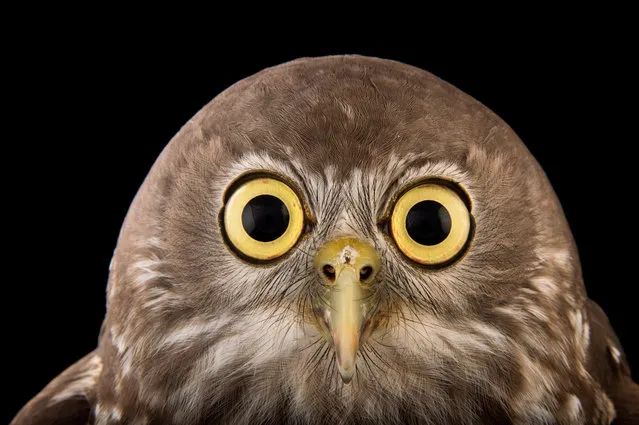
The National Geographic Photo Ark is a travelling exhibition of photographer Joel Sartore’s quest to create a photo archive of biodiversity around the world. So far, Sartore has captured studio portraits of more than 6,000 species – a number that he hopes to double. On 1 July, the ark will open at Melbourne zoo – the first time it has been exhibited in the southern hemisphere. More than 50 portraits will be on display, including many of Australian endangered animals being protected by programs at the zoo itself. These captions have been edited from text supplied by Melbourne zoo. Here: Barking owl. So-named because its call sounds like a barking dog, these birds are native to Australia, Indonesia and Papua New Guinea. In Victoria they are listed as an endangered species, and in 2003 there were estimated to be fewer than 50 breeding pairs. The main threat to the species in Victoria is loss of habitat, especially large trees with hollows in which they can nest and on which many of their prey depend. Apart from a bark, they may utter a chilling scream when they feel threatened. (Photo by Joel Sartore/National Geographic Photo Ark/The Guardian)

The National Geographic Photo Ark is a travelling exhibition of photographer Joel Sartore’s quest to create a photo archive of biodiversity around the world. So far, Sartore has captured studio portraits of more than 6,000 species – a number that he hopes to double. On 1 July, the ark will open at Melbourne zoo – the first time it has been exhibited in the southern hemisphere. More than 50 portraits will be on display, including many of Australian endangered animals being protected by programs at the zoo itself. These captions have been edited from text supplied by Melbourne zoo. Here: Barking owl. (Photo by Joel Sartore/National Geographic Photo Ark/The Guardian)
Details
01 Jul 2017 07:45:00
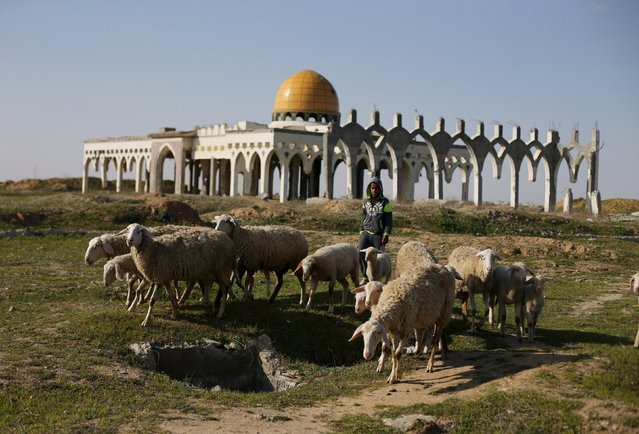
A Palestinian boy herds sheep in front of the ruins of Yasser Arafat International Airport, which was bombed by Israel in the past, in Rafah in the southern Gaza Strip February 5, 2016. Nabil Shurafa's travel agency in Gaza was once packed with clients booking flights to London, Paris, New York or cities across the Arab world. These days, he's lucky if anyone comes in, as so few people can get out. (Photo by Ibraheem Abu Mustafa/Reuters)

A Palestinian boy herds sheep in front of the ruins of Yasser Arafat International Airport, which was bombed by Israel in the past, in Rafah in the southern Gaza Strip February 5, 2016. Nabil Shurafa's travel agency in Gaza was once packed with clients booking flights to London, Paris, New York or cities across the Arab world. These days, he's lucky if anyone comes in, as so few people can get out. (Photo by Ibraheem Abu Mustafa/Reuters)
Details
18 Feb 2016 13:27:00