Loading...
Done
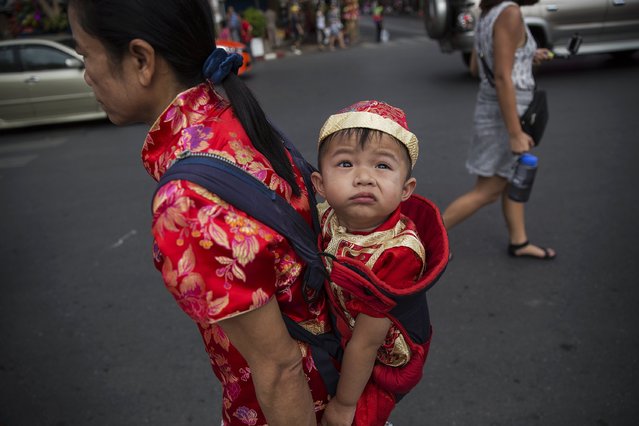
A woman carries her child, both wearing traditional red clothes celebrating the Chinese Lunar New Year in Bangkok February 19, 2015. (Photo by Damir Sagolj/Reuters)

A woman carries her child, both wearing traditional red clothes celebrating the Chinese Lunar New Year in Bangkok February 19, 2015. (Photo by Damir Sagolj/Reuters)
Details
20 Feb 2015 12:07:00
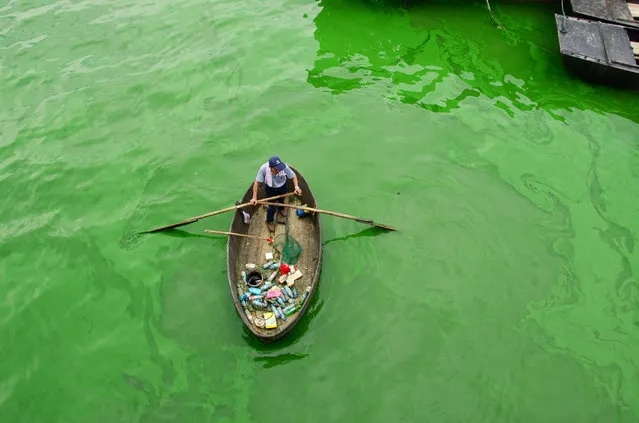
A fisherman boats in Chao Lake where thick cyanobacteria gather on the surface on August 5, 2015 in Chaohu, Anhui Province of China. As high temperature came in summar, part of water in Anhui Province's Chao Lake breeds large tracts of cyanobacteria which not only brought pollution to sense of smell, but also affected people's life. (Photo by ChinaFotoPress/ChinaFotoPress via Getty Images)

A fisherman boats in Chao Lake where thick cyanobacteria gather on the surface on August 5, 2015 in Chaohu, Anhui Province of China. As high temperature came in summar, part of water in Anhui Province's Chao Lake breeds large tracts of cyanobacteria which not only brought pollution to sense of smell, but also affected people's life. (Photo by ChinaFotoPress/ChinaFotoPress via Getty Images)
Details
06 Aug 2015 11:36:00
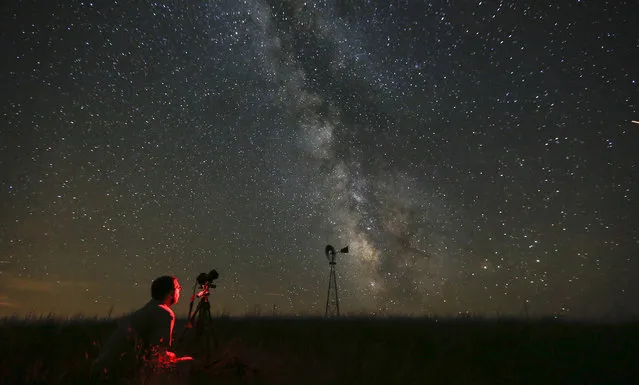
In this Wednesday, July 23, 2014 file photo, Omaha photographer Lane Hickenbottom photographs the night sky in a pasture near Callaway, Neb. With no moon in the sky, the Milky Way was visible to the naked eye. More than one-third of the world’s population can no longer see the Milky Way because of man-made lights, according to a scientific paper by Light Pollution Science and Technology Institute's Fabio Falchi and his team members, published on Friday, June 10, 2016. (Photo by Travis Heying/The Wichita Eagle via AP Photo)

In this Wednesday, July 23, 2014 file photo, Omaha photographer Lane Hickenbottom photographs the night sky in a pasture near Callaway, Neb. With no moon in the sky, the Milky Way was visible to the naked eye. More than one-third of the world’s population can no longer see the Milky Way because of man-made lights, according to a scientific paper by Light Pollution Science and Technology Institute's Fabio Falchi and his team members, published on Friday, June 10, 2016. (Photo by Travis Heying/The Wichita Eagle via AP Photo)
Details
11 Jun 2016 12:37:00


A nurse consoles herself with a box of chocolates as she reads a paper-back thriller. (Photo by Hulton Archive/Getty Images). Circa 1955
Details
30 Mar 2011 09:49:00
A supporter of “Si” vote cries after the nation voted  “NO” in a referendum on a peace deal between the government and Revolutionary Armed Forces of Colombia (FARC) rebels, at Bolivar Square in Bogota, Colombia, October 2, 2016. (Photo by John Vizcaino/Reuters)

A supporter of “Si” vote cries after the nation voted “NO” in a referendum on a peace deal between the government and Revolutionary Armed Forces of Colombia (FARC) rebels, at Bolivar Square in Bogota, Colombia, October 2, 2016. (Photo by John Vizcaino/Reuters)
Details
04 Oct 2016 10:30:00
A participant in the Borodino Battle re-enactment before the show at the Borodino Field in the Moscow Region on September 4, 2016. (Photo by Kirill Kallinikov/Sputnik)

A participant in the Borodino Battle re-enactment before the show at the Borodino Field in the Moscow Region on September 4, 2016. The Battle of Borodino, fought on September 7, 1812, was a battle fought in the Napoleonic Wars during the French invasion of Russia. The fighting involved around 250,000 troops and left at least 70,000 casualties, making Borodino the deadliest day of the Napoleonic Wars. (Photo by Kirill Kallinikov/Sputnik)
Details
07 Sep 2016 09:58:00
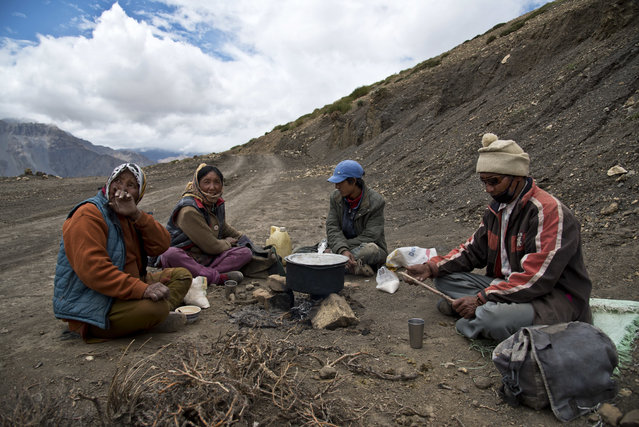
In this August 17, 2016, photo, from left to right, Chhering Chodom, 60, Tashi Yangzom, 50, Lobsang Chhering, 27, and Dorje Tandup, 58, drink milk tea on the side of the road. For centuries, the sleepy valley nestled in the Indian Himalayas remained a hidden Buddhist enclave forbidden to outsiders. Enduring the harsh year-round conditions of the high mountain desert, the people of Spiti Valley lived by a simple communal code – share the Earth's bounty, be hospitable to neighbors, and eschew greed and temptation at all turns. That's all starting to change, for better or worse. Since India began allowing its own citizens as well as outsiders to visit the valley in the early 1990s, tourism and trade have boomed. And the marks of modernization, such as solar panels, asphalt roads and concrete buildings, have begun to appear around some of the villages that dot the remote landscape at altitudes above 4,000 meters (13,000 feet). (Photo by Thomas Cytrynowicz/AP Photo)

In this August 17, 2016, photo, from left to right, Chhering Chodom, 60, Tashi Yangzom, 50, Lobsang Chhering, 27, and Dorje Tandup, 58, drink milk tea on the side of the road. For centuries, the sleepy valley nestled in the Indian Himalayas remained a hidden Buddhist enclave forbidden to outsiders. Enduring the harsh year-round conditions of the high mountain desert, the people of Spiti Valley lived by a simple communal code – share the Earth's bounty, be hospitable to neighbors, and eschew greed and temptation at all turns. That's all starting to change, for better or worse. (Photo by Thomas Cytrynowicz/AP Photo)
Details
15 Sep 2016 09:22:00
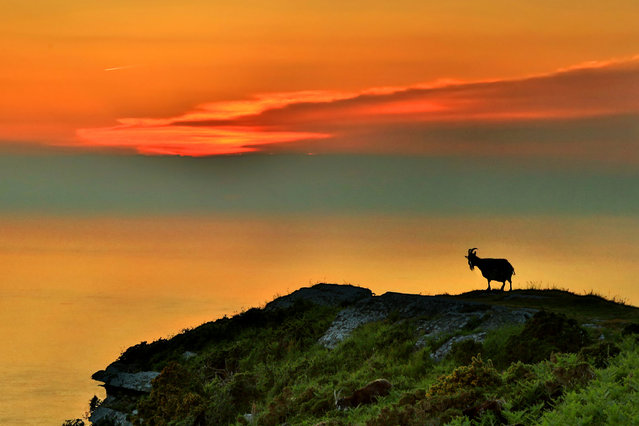
An Exmoor wild goat silhouetted in the sky over the Bristol Channel at the valley of the Rocks, North Devon, as the UK's heat wave continues on July 19, 2018. (Photo by Paul Silver/South West News Service)

An Exmoor wild goat silhouetted in the sky over the Bristol Channel at the valley of the Rocks, North Devon, as the UK's heat wave continues on July 19, 2018. (Photo by Paul Silver/South West News Service)
Details
15 Oct 2018 00:03:00