Loading...
Done
Vinyl Clock By Pavel Sidorenko Part 2

Pavel Sidorenko is an award winning Estonian designer who was born in 1980 in Tallinn and studied product design at Estonian Academy of Arts and Graduated in 2006. Not only does he incorporate pragmatic necessity, but also transmits an emotional qualities within the everyday environment. His fantastic collection of Re Vinyl designs are a result of upcycling a product fashioned from old vinyl records. Beautifully crafted and working with a range of themes from scenography to animal creatures, there is sure to be something for everyone with these stylish selection of recycled vinyl clocks!


See also: Part 1
Details
01 Mar 2014 11:09:00
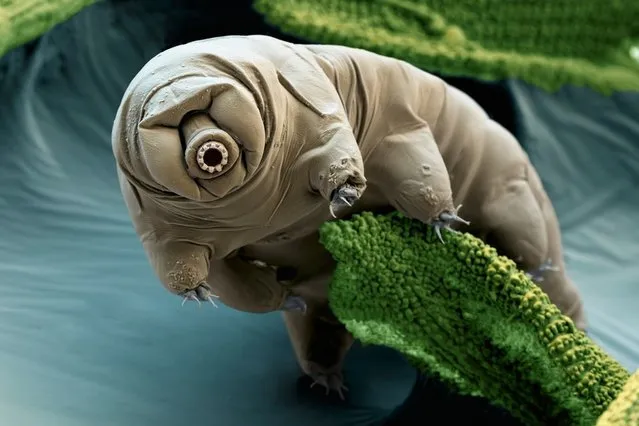
Tardigrades (commonly known as waterbears or moss piglets). (Photo by SPL/East News)

“Tardigrades (commonly known as waterbears or moss piglets) are small, water-dwelling, segmented animals with eight legs. Tardigrades were first discovered in 1773 by Johann August Ephraim Goeze, who called them kleiner Wasserbär, meaning “little water bear” in German. The name Tardigrada means “slow walker” and was given by Lazzaro Spallanzani in 1777. The name water bear comes from the way they walk, reminiscent of a bear's gait. The biggest adults may reach a body length of 1.5 millimetres (0.059 in), the smallest below 0.1 mm. Freshly hatched tardigrades may be smaller than 0.05 mm”. – Wikipedia. Photo: Tardigrades. (Photo by SPL/East News)
Details
26 Sep 2012 09:55:00
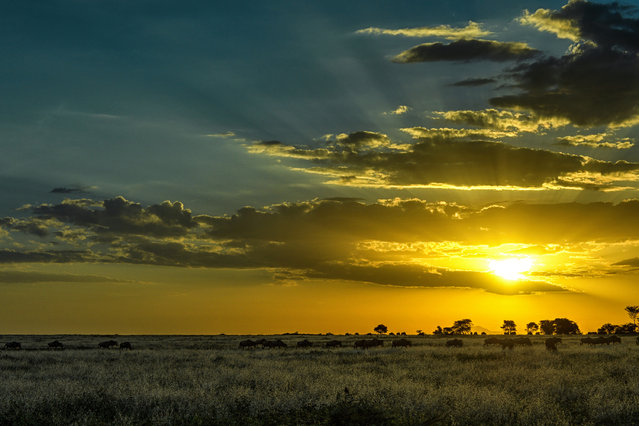
Using his camera skills, Marc meters the background sky in order to achieve the beautiful black silhouettes of the wildlife, Africa, 2010-2016. A photographer has travelled around Africa for six years to capture striking silhouettes of lions, giraffes and birds. Australian wildlife photographer, Marc Mol took the series of pictures in various areas of Africa; including Botswana and Kenya to Tanzania and Zambia. Whether grazing, hunting or resting, the animals' daily activities are transformed into something majestic when cast against golden evenings and pink dawns. (Photo by Marc Mol/Barcroft Images)

Using his camera skills, Marc meters the background sky in order to achieve the beautiful black silhouettes of the wildlife, Africa, 2010-2016. (Photo by Marc Mol/Barcroft Images)
Details
10 Jan 2017 13:36:00
In this Wednesday, January 27, 2016 photo, Jung Myoung Sook, 61, holds her puppies she rescued at a shelter in Asan, South Korea. In the country, where dogs are considered a traditional delicacy and have only recently become popular as pets, Jung's love for her canine friends is viewed by some as odd. (Photo by Lee Jin-man/AP Photo)

In this Wednesday, January 27, 2016 photo, Jung Myoung Sook, 61, holds her puppies she rescued at a shelter in Asan, South Korea. In the country, where dogs are considered a traditional delicacy and have only recently become popular as pets, Jung's love for her canine friends is viewed by some as odd. But others see her as a champion of animal rights. (Photo by Lee Jin-man/AP Photo)
Details
03 Feb 2016 13:28:00
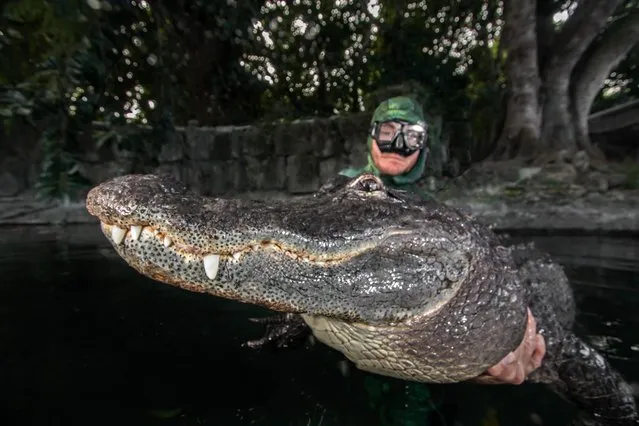
He brings the beast up close and personal to the camera. (Photo by Chris Gillette and Michael Dornellas/Mediadrumworld.com)

The incredible photographs show the three alligators crowding around the man’s head as they look directly at the camera and one even appears to sit on his lap whilst another reptile places a claw on his arm as it swims towards the surface. Photographs taken from above the surface show animal handler, Chris Gillette (29) from Fort Lauderdale, Florida, USA holding an alligator out of the water. The images of Chris were taken by Michael Dornellas at the Everglades Outpost Wildlife Rescue, Florida USA. Here: Mich­ael Dornellas brings the beast up close and personal to the camera. (Photo by Chris Gillette and Michael Dornellas/Mediadrumworld.com)
Details
20 Jan 2017 08:03:00
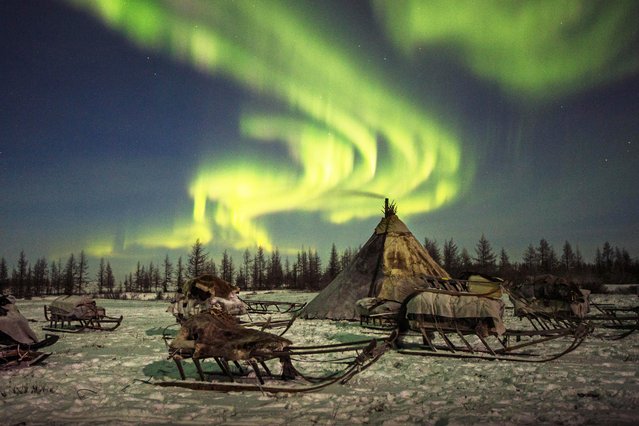
An empty camp is shown beneath a colourful sky in Siberia, December 2016. (Photo by Timothy Allen/Barcroft Productions)

A British photographer has captured life at the “edge of the world”. Timothy Allen, best known for his work on BBC's Human Planet, trekked through the freezing Siberian wilderness for 16 days as he joined part of an 800km migration of reindeer in the Yamal-Nenets region – a name that roughly translates to “edge of the world”. The stunning pictures feature the nomadic Nenets tribe, who drink blood to survive in -45°C temperatures. Timothy's epic journey, which will be revealed in an eight-minute documentary on Animal Planet USA, saw him travel across the bleak terrain of the frozen Ob River with the Nenets people in December last year. Here: An empty camp is shown beneath a colourful sky in Siberia, December 2016. (Photo by Timothy Allen/Barcroft Productions)
Details
19 Sep 2017 07:48:00
A reef shell lies on a beach as the sun sets on Lady Elliot Island located north-east of the town of Bundaberg in Queensland, Australia, June 10, 2015. (Photo by David Gray/Reuters)

A reef shell lies on a beach as the sun sets on Lady Elliot Island located north-east of the town of Bundaberg in Queensland, Australia, June 10, 2015. UNESCO World Heritage delegates recently snorkelled on Australia’s Great Barrier Reef, thousands of coral reefs, which stretch over 2,000 km off the northeast coast. Surrounded by manta rays, dolphins and reef sharks, their mission was to check the health of the world's largest living ecosystem, which brings in billions of dollars a year in tourism. Some coral has been badly damaged and animal species, including dugong and large green turtles, are threatened. UNESCO will say on Wednesday whether it will place the reef on a list of endangered World Heritage sites, a move the Australian government wants to avoid at all costs, having lobbied hard overseas. Earlier this year, UNESCO said the reef's outlook was “poor”. (Photo by David Gray/Reuters)
Details
30 Jun 2015 12:21:00
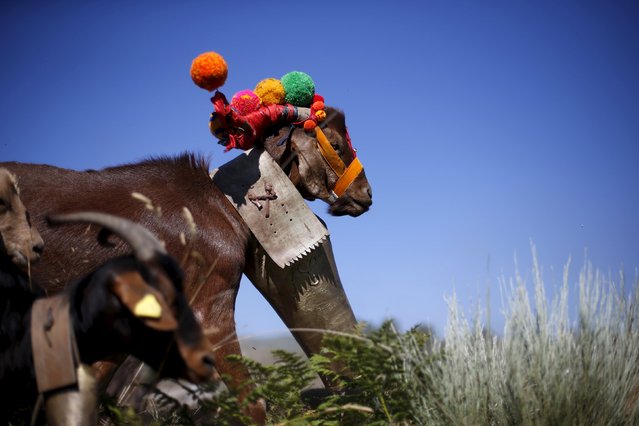
Sheep walk as they are herded to summer pastures in Serra da Estrela, near Seia, Portugal June 27, 2015. (Photo by Rafael Marchante/Reuters)

Sheep walk as they are herded to summer pastures in Serra da Estrela, near Seia, Portugal June 27, 2015. In late June, shepherds young and old in the Seia region of central Portugal start guiding sheep, goats and cattle to the Serra da Estrela, the country’s highest mountains, in search of better pastures. There they stay until the end of September. Modern-day shepherds may have mobile phones to keep in touch with family and friends, but their lifestyle has changed little for centuries. The sound of cowbells and the bark of longhaired mastiffs starts early in the morning as the animals – often decorated with traditional woollen balls on their horns – are herded up steep, narrow paths. (Photo by Rafael Marchante/Reuters)
Details
14 Jul 2015 13:48:00