Anicka Newell, of Canada, does a handstand ahead of the final of the women's pole vault at the 2020 Summer Olympics, Thursday, August 5, 2021, in Tokyo. (Photo by Matthias Schrader/AP Photo)
Frankie the Dinosaur, mascot of the United Nations Development Program “Don't Choose Extinction” visits Times Square spreading his climate-related message in New York on September 21, 2022. (Photo by Alex Kent/AFP Photo)
Britain's Queen Elizabeth boards a train at Kings Cross station in London, in this December 17, 2009 file photo. Queen Elizabeth celebrates her 90th birthday on April 21, 2016. (Photo by Stefan Rousseau/Reuters)
Protestors break through the barriers of the DNC in Park #578 during the March on the DNC 2024 in Chicago, IL on Monday, August 19, 2024. (Photo by Laura Thompson/Rex Features/Shutterstock)
An employee feeds a one-week-old coati cub with a bottle of milk at the Royev Ruchey zoo in the suburbs of Krasnoyarsk, Siberia, October 10, 2014. The mother of three cubs refused to nurse them, according to zoo employees. (Photo by Ilya Naymushin/Reuters)
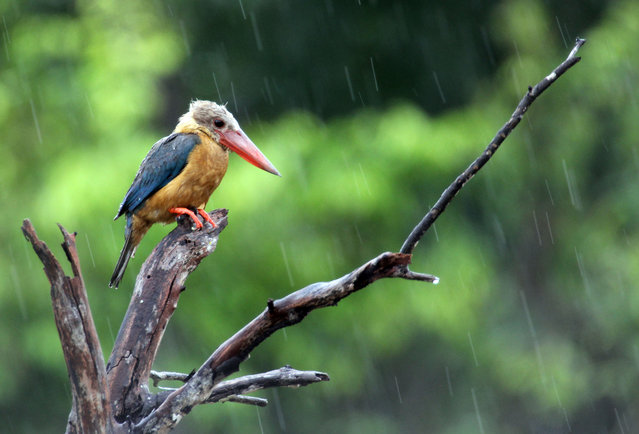
A stork-billed kingfisher (Pelargopsis capensis) is seen perched on a tree during monsoon rain on July 25, 2016 in Bintan, Indonesia. The stork-billed kingfisher is a tree species which is widely but sparsely distributed in the tropical Indian subcontinent and Southeast Asia, from India to Indonesia. This kingfisher is resident throughout its range. It is very large, measuring 35 to 38 cm (14 to 15 in) in length. The adult has a green back, blue wings and tail, and grey head. (Photo by Sijori Images/Barcroft Images)
2016 Rio Olympics, Rhythmic Gymnastics, Final, Individual All-Around Final, Rotation 1, Rio Olympic Arena, Rio de Janeiro, Brazil on August 20, 2016. Melitina Staniouta (BLR) of Belarus competes using the hoop. (Photo by Ruben Sprich/Reuters)
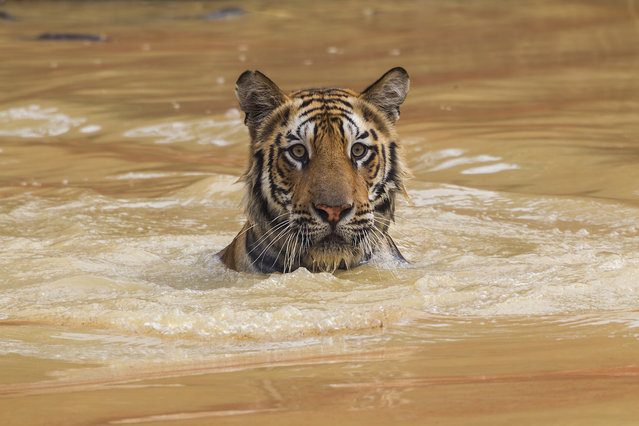
National Geographic photographer Steve Winter has spent most of his adult life shooting wild cats. Photo: A 14-month-old cub, cooling off in a pond, is riveted by a deer that appeared near the shore. Tigers are powerful swimmers; they can easily cross rivers four to five miles wide and have been known to swim distances of up to 18 miles. (Photo by Steve Winter/National Geographic)