Loading...
Done
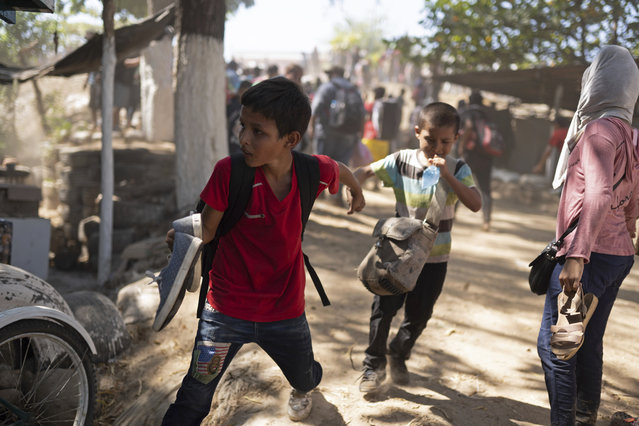
Migrant children run away from clashes with Mexican National Guards after their group crossed the Suchiate River on foot from Guatemala to Mexico, on the riverbank near Ciudad Hidalgo, Mexico, Monday, January 20, 2020. More than a thousand Central American migrants hoping to reach the United States marooned in Guatemala are walking en masse across a river leading to Mexico in an attempt to convince authorities there to allow them passage through the country. (Photo by Santiago Billy/AP Photo)

Migrant children run away from clashes with Mexican National Guards after their group crossed the Suchiate River on foot from Guatemala to Mexico, on the riverbank near Ciudad Hidalgo, Mexico, Monday, January 20, 2020. More than a thousand Central American migrants hoping to reach the United States marooned in Guatemala are walking en masse across a river leading to Mexico in an attempt to convince authorities there to allow them passage through the country. (Photo by Santiago Billy/AP Photo)
Details
30 Jan 2020 00:01:00
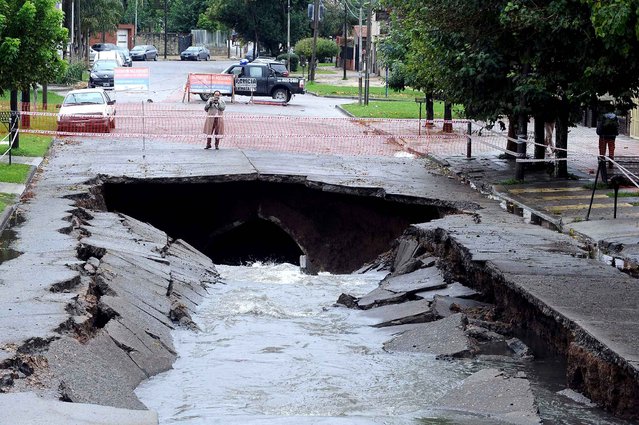
Handout picture released by Telam showing the tarmac of the Pedro Palacios Avenue in Ramos Mejia, province of Buenos Aires, Argentina, under which the channeled waters of the Maldonado stream flow, after it collapsed on April 8, 2014 leaving a 40-metre-long, 1.4-metre-deep hole. About 3000 people had to be evacuated in the Argentine provinces of Neuquen (soutwest), Catamarca (northwest), Santiago del estero (center) and Cordoba (center)due to the foods caused by heavy rain, official sources said. (Photo by Daniel Dabove/AFP Photo)

Handout picture released by Telam showing the tarmac of the Pedro Palacios Avenue in Ramos Mejia, province of Buenos Aires, Argentina, under which the channeled waters of the Maldonado stream flow, after it collapsed on April 8, 2014 leaving a 40-metre-long, 1.4-metre-deep hole. About 3000 people had to be evacuated in the Argentine provinces of Neuquen (soutwest), Catamarca (northwest), Santiago del estero (center) and Cordoba (center)due to the foods caused by heavy rain, official sources said. (Photo by Daniel Dabove/AFP Photo)
Details
12 Apr 2014 12:40:00
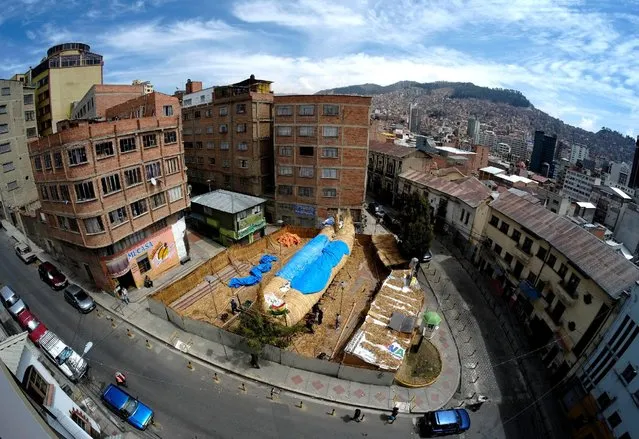
Aerial view of the “Viracocha III”, a boat made only from the totora reed, as it is being prepared to cross the Pacific from Chile to Australia on an expected six-month journey, La Paz, Bolivia, October 19, 2016. An expedition in a boat made only of reeds crafted by indigenous Bolivians is getting ready to cross the Pacific from South America to Australia, in a fresh attempt to prove that ancient mariners were capable of making the journey. Phil Buck, a 51-year-old explorer from the United States, already has led two similar expeditions and will captain the “Viracocha III” set to depart from northern Chile in February on an expected six-month journey. (Photo by David Mercado/Reuters)

Aerial view of the “Viracocha III”, a boat made only from the totora reed, as it is being prepared to cross the Pacific from Chile to Australia on an expected six-month journey, La Paz, Bolivia, October 19, 2016. An expedition in a boat made only of reeds crafted by indigenous Bolivians is getting ready to cross the Pacific from South America to Australia, in a fresh attempt to prove that ancient mariners were capable of making the journey. (Photo by David Mercado/Reuters)
Details
20 Oct 2016 10:53:00
Four pillars of light from the 4 Laser Guide Star Facility on ESO's Very Large Telescope (VLT) are shown reaching into the Chilean night sky in this image from ESO Photo Ambassador Fred Kamphues, on September 2, 2016. The lasers are a key part of the adaptive optics system on the VLT. Adaptive optics allows astronomers to drastically reduce the atmospheric distortion present at even the best sites in the world for astronomy, including Paranal in Chile, the home of the VLT. (Photo by F. Kamphues/ESO)

Four pillars of light from the 4 Laser Guide Star Facility on ESO's Very Large Telescope (VLT) are shown reaching into the Chilean night sky in this image from ESO Photo Ambassador Fred Kamphues, on September 2, 2016. The lasers are a key part of the adaptive optics system on the VLT. Adaptive optics allows astronomers to drastically reduce the atmospheric distortion present at even the best sites in the world for astronomy, including Paranal in Chile, the home of the VLT. (Photo by F. Kamphues/ESO)
Details
23 Feb 2017 00:06:00
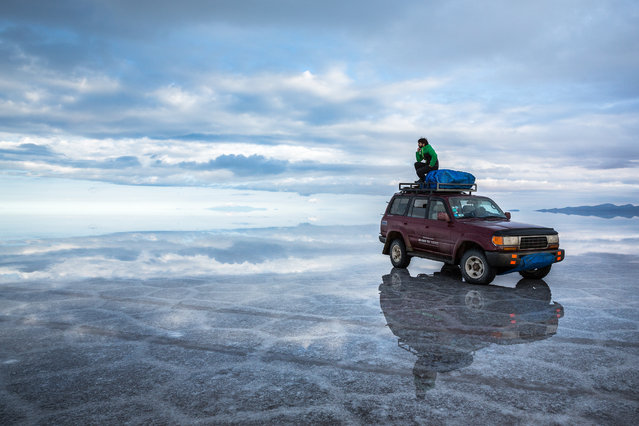
At 10,582 square kilometres, the Bolivian salt flats – otherwise known as Salar de Uyuni – are the largest on the planet and contain between 50 and 70% of the world’s lithium reserves. After exploring Chile and Argentina, photographer Joel Santos decided to travel to Bolivia in January 2017 to check the salt flats off his bucket list. With an electrical storm rolling in, Joel and his two travelling companions were the only souls left on the vast flats and captured the eerie flats without a person in sight. (Photo by Joel Santos/Barcroft Images)

At 10,582 square kilometres, the Bolivian salt flats – otherwise known as Salar de Uyuni – are the largest on the planet and contain between 50 and 70% of the world’s lithium reserves. After exploring Chile and Argentina, photographer Joel Santos decided to travel to Bolivia in January 2017 to check the salt flats off his bucket list. With an electrical storm rolling in, Joel and his two travelling companions were the only souls left on the vast flats and captured the eerie flats without a person in sight. (Photo by Joel Santos/Barcroft Images)
Details
12 Aug 2019 00:03:00
Beard Bird Inca Tern

The Inca Tern is a seabird in the family Sternidae. It is the only member of the genus Larosterna. This uniquely plumaged bird breeds on the coasts of Peru and Chile, and is restricted to the Humboldt current. It can be identified by its dark grey body, white moustache on the both sides of its head, and red-orange beak and feet.
Details
21 Apr 2013 17:02:00
Hair stylist Marcelo Avatte (R) prepares to fit Isidora Serrano, a 14-year-old who lost her hair due to chemotherapy to treat her bone cancer, with a natural hair wig in the cancer ward of the Luis Calvo Mackenna Hospital in Santiago, October 23, 2014. (Photo by Rodrigo Garrido/Reuters)

Hair stylist Marcelo Avatte (R) prepares to fit Isidora Serrano, a 14-year-old who lost her hair due to chemotherapy to treat her bone cancer, with a natural hair wig in the cancer ward of the Luis Calvo Mackenna Hospital in Santiago, October 23, 2014. The wigs, handmade by Italian-Chilean hair stylist Marcelo Avatte and his team, have helped the children regain their self-esteem and confidence during cancer treatment. Renowned for making customised wigs, Avatte has donated more than 300 wigs since 2009 and says he was motivated to begin the project by the pain he felt when his own son lost his hair during chemotherapy. (Photo by Rodrigo Garrido/Reuters)
Details
18 Nov 2014 11:33:00
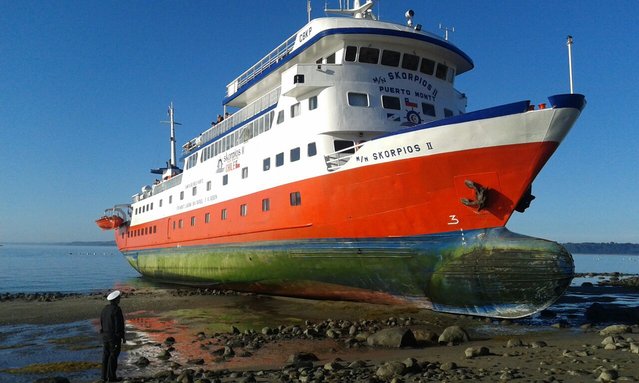
The Chilean ship “Skorpios II” is seen after it ran aground in “Maillen” island, near Puerto Montt, south of Santiago, in this handout picture from the Chilean Navy, February 5, 2015. According to the Chilean Navy, the ship's 89 passengers and 31 crew members were all evacuated and no oil spills or casualties were reported. (Photo by Reuters/Chilean Navy)

The Chilean ship “Skorpios II” is seen after it ran aground in “Maillen” island, near Puerto Montt, south of Santiago, in this handout picture from the Chilean Navy, February 5, 2015. According to the Chilean Navy, the ship's 89 passengers and 31 crew members were all evacuated and no oil spills or casualties were reported. (Photo by Reuters/Chilean Navy)
Details
07 Feb 2015 14:22:00