Loading...
Done
The sun sets behind the Giant Swing, also known as Sao Chingcha, in Bangkok, Thailand, on March 6, 2025. (Photo by Athit Perawongmetha/Reuters)

The sun sets behind the Giant Swing, also known as Sao Chingcha, in Bangkok, Thailand, on March 6, 2025. (Photo by Athit Perawongmetha/Reuters)
Details
12 Mar 2025 03:55:00
Tardigrades (commonly known as waterbears or moss piglets). (Photo by SPL/East News)

“Tardigrades (commonly known as waterbears or moss piglets) are small, water-dwelling, segmented animals with eight legs. Tardigrades were first discovered in 1773 by Johann August Ephraim Goeze, who called them kleiner Wasserbär, meaning “little water bear” in German. The name Tardigrada means “slow walker” and was given by Lazzaro Spallanzani in 1777. The name water bear comes from the way they walk, reminiscent of a bear's gait. The biggest adults may reach a body length of 1.5 millimetres (0.059 in), the smallest below 0.1 mm. Freshly hatched tardigrades may be smaller than 0.05 mm”. – Wikipedia. Photo: Tardigrades. (Photo by SPL/East News)
Details
26 Sep 2012 09:55:00
Rescued brown and black bears feed at The Wild Animal Sanctuary

“The Wild Animal Sanctuary is a U.S. organization that specializes in rescuing and caring for large predators which are being ill-treated, for which their owners can no longer care, or which might otherwise be euthanized. Created in 1980, The Wild Animal Sanctuary is situated on 720 acres (291 ha) of grassland near Keenesburg, Colorado North of Denver, and has helped over 1,000 animals since it first opened. As of 2010, it was home to over 290 animals”. – Wikipedia

Photo: Rescued brown and black bears feed at The Wild Animal Sanctuary on October 20, 2011 in Keenesburg, Colorado. (Photo by John Moore/Getty Images)
Details
27 Feb 2012 11:59:00
In late summer and early autumn polar bears flock to the native village of Kaktovik in the Alaskan Arctic to eat at “the boneyard” – the remains of whales annually hunted by the community. (Photo by Katie Orlinsky/Getty Images)

A selection of work by four photojournalists who have won grants of $10,000 and editorial support from the agency. Here: “Chasing Winter” by Katie Orlinksy. In late summer and early autumn polar bears flock to the native village of Kaktovik in the Alaskan Arctic to eat at “the boneyard” – the remains of whales annually hunted by the community. (Photo by Katie Orlinsky/Getty Images)
Details
02 Sep 2016 13:55:00
Female Iraqi Kurdish peshmerga fighters watch on as they release a bear into the wild in the Gara Mountains near the northern Iraqi city of Dohuk on March 4, 2018, after Iraqi Kurdish Animal rights activists from a local NGO rescued it from a private home. (Photo by Safin Hamed/AFP Photo)

Female Iraqi Kurdish peshmerga fighters watch on as they release a bear into the wild in the Gara Mountains near the northern Iraqi city of Dohuk on March 4, 2018, after Iraqi Kurdish Animal rights activists from a local NGO rescued it from a private home. (Photo by Safin Hamed/AFP Photo)
Details
06 Mar 2018 09:27:00
A woman walks past posters bearing the letter “Z” in the colours of the ribbon of Saint George, which has become a symbol of support for Russian military action in Ukraine, and reading “We are proud of Russia! We are not ashamed!” at a bus stop on Nevsky Prospekt in central Saint Petersburg on March 15, 2022. (Photo by AFP Photo/Stringer)

A woman walks past posters bearing the letter “Z” in the colours of the ribbon of Saint George, which has become a symbol of support for Russian military action in Ukraine, and reading “We are proud of Russia! We are not ashamed!” at a bus stop on Nevsky Prospekt in central Saint Petersburg on March 15, 2022. (Photo by AFP Photo/Stringer)
Details
17 Mar 2022 05:42:00
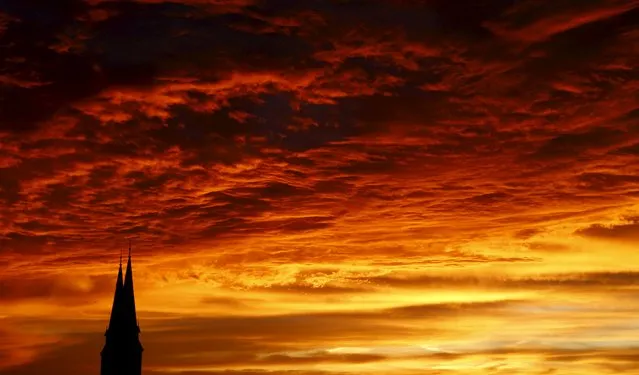
The rising sun illuminates the sky above the spires of a church in Vienna, Austria, November 17, 2015. (Photo by Heinz-Peter Bader/Reuters)

The rising sun illuminates the sky above the spires of a church in Vienna, Austria, November 17, 2015. (Photo by Heinz-Peter Bader/Reuters)
Details
19 Nov 2015 08:05:00
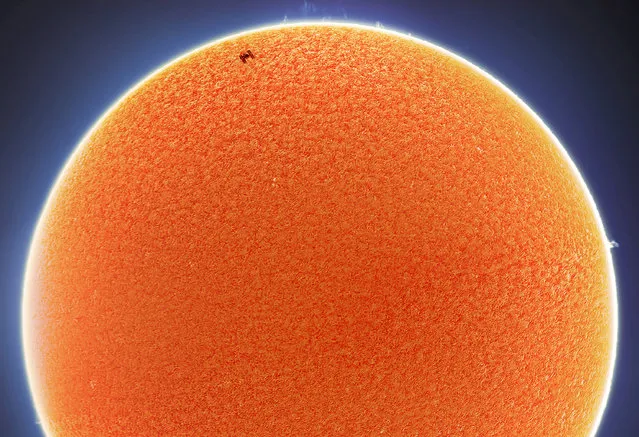
The International Space Station (ISS) moving in front of the sun in November 2020 by astrophotographer Andrew McCarthy. These incredible photos capture the clearest images ever taken of the International Space Station (ISS) moving in front of both the moon and the sun. The photos, taken within days of one another, were captured in the space of less than a second, as the space station could be clearly seen zooming across against the bright backdrops of both moon and sun. Photographer Andrew McCarthy, from California, USA, said the photo of the ISS in front of the sun, in broad daylight, was “one of my trickiest shots ever”. (Photo by Andrew McCarthy/South West News Service)

The International Space Station (ISS) moving in front of the sun in November 2020 by astrophotographer Andrew McCarthy. These incredible photos capture the clearest images ever taken of the International Space Station (ISS) moving in front of both the moon and the sun. The photos, taken within days of one another, were captured in the space of less than a second, as the space station could be clearly seen zooming across against the bright backdrops of both moon and sun. Photographer Andrew McCarthy, from California, USA, said the photo of the ISS in front of the sun, in broad daylight, was “one of my trickiest shots ever”. (Photo by Andrew McCarthy/South West News Service)
Details
28 Nov 2020 00:05:00