Loading...
Done
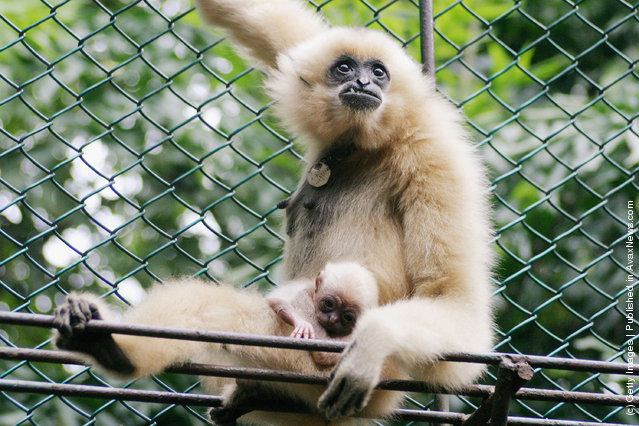
Newborn White-Cheeked Gibbon Nomascus

“Nomascus is the second most speciose genus of gibbons (family Hylobatidae). Originally this genus was a subgenus of Hylobates, and all individuals were considered one species, Hylobates concolor. Species within Nomascus are characterized by 52 chromosomes. Some species are all black, some light with a distinct black tuft of crown fur, and some by distinct, light-colored cheek patches. Nomascus is found from southern China (Yunnan) to southern Vietnam, and also on Hainan Island. One of the genus' species, Nomascus nasutus, has been deemed “the most critically endangered ape species in the world”. All of the species in this genus are endangered or critically endangered”. – Wikipedia

Photo: A newborn White-Cheeked Gibbon clings to its mother in the Nanning Zoo on April 12, 2004 in Nanning, Guangxi province, China. The White-Cheeked Gibbon's natural habitat is Southern China as well as Vietnam and Laos. They are classified as highly endangered and are on the brink of extinction due to poaching and reduction of natural rainforests. (Photo by Getty Images)
Details
12 Aug 2011 11:51:00
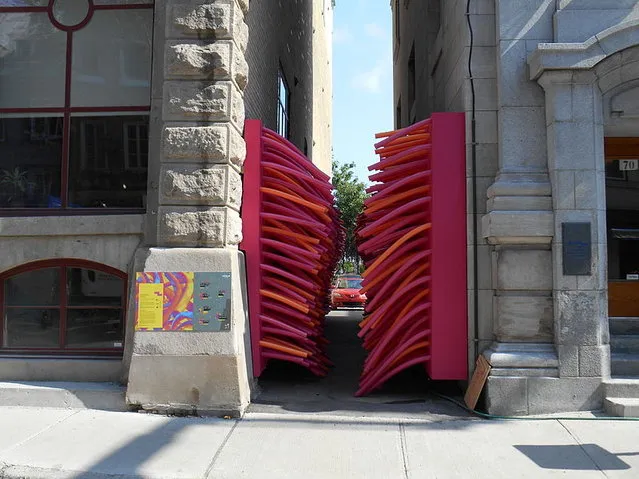
Delirious Frites Installation By Les Astronautes

The creator of this architectural installation, placed in a deserted alley in the city of Quebec, probably got his inspiration after looking at French fries while being on acid. This might be the reason why Les Astronautes called his creation Delirious Frites (frites is another name for French fries). This colorful installation attracts passersby like a magnet, making everyone want to enter the narrow passage between hundreds of foam noodles. Though it may look peculiar during the day, this installation looks even better during the night. The light, shining from above, creates a lot of shadows as it encounters all the “tendrils” that seemingly grow from the very walls of the buildings. This will leave even the sanest person wondering if he isn’t having a delusion.
Details
11 Nov 2014 11:45:00
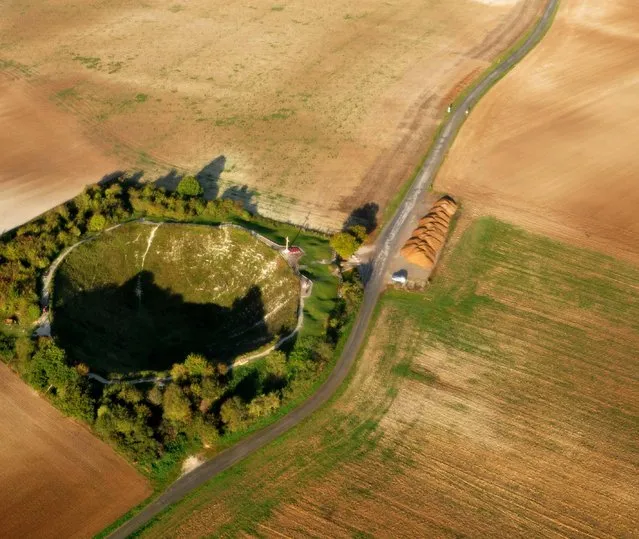
Lochnagar Crater Somme In France

It is amazing how much the humanity can change the face of the earth. Not only can it create huge craters, which look a lot like craters from meteors, they leave a big enough impact that it can be seen from space. Though this crater, caused by a massive explosion on 1 July 1916, looks large, being 90 feet deep and 300 feet across; it is nowhere big enough to be viewed for space. A common misconception is that the Great Wall of China can be seen from space. In reality, however, it is impossible. Not only is it of the same color as the earth near it, it is also not that wide. Deforestation, on the other hand, can be clearly seen from space. Also, at night, all the lights that the large cities produce are also very visible.
Details
17 Nov 2014 12:48:00
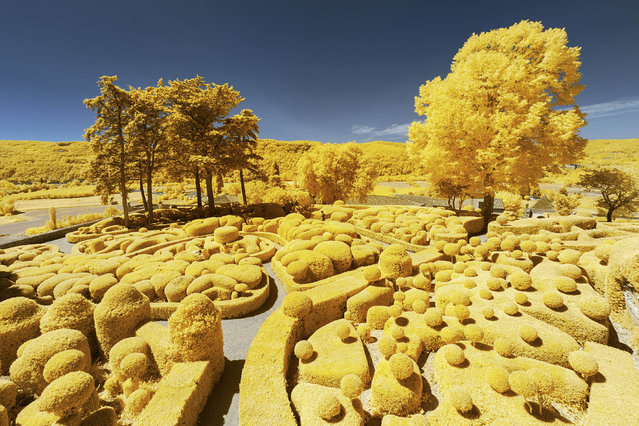
While this has meant creating large collection of shots, Ferrer said that he only selected about 50 works for the public’s eyes so far. (Photo by Pierre-Louis Ferrer/Caters News Agency)

Photographer Pierre-Louis Ferrer shows viewers the beauty of France in a whole new light, shooting the country in beautiful infrared. Ferrer’s images are as enchanting as they are intriguing, displaying a whole new variation of color in shrubs, grass and trees, as well as famous landmarks. In some of Ferrer’s works, the foliage is an eye-catching canary yellow – a stark contrast to the more normal shades in the remainder of the images. In other works, whole forests glow red, giving the French countryside an otherworldly look. (Photo by Pierre-Louis Ferrer/Caters News Agency)
Details
04 Oct 2018 00:05:00
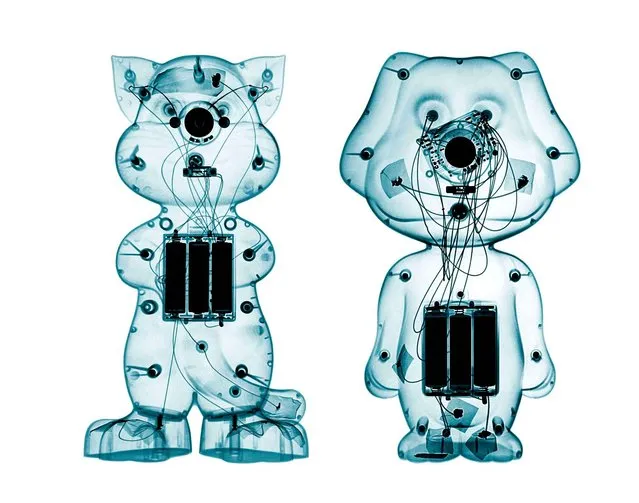
Australian photographer Brendan Fitzpatrick’s X-ray photographs expose the inner workings of toys. Fitzpatrick’s photographs are both whimsical and mechanical, evoking the curiosity of childhood and the desire to discover how things look and work from other perspectives. (Photo by Brendan Fitzpatrick)

Australian photographer Brendan Fitzpatrick’s X-ray photographs expose the inner workings of toys. Fitzpatrick’s photographs are both whimsical and mechanical, evoking the curiosity of childhood and the desire to discover how things look and work from other perspectives. The strategic placement of wires, batteries, and screws are revealed, the complexity of the inside contrasting with the seemingly simplistic design of the outside. Fitzpatrick uses chest X-ray and mammogram machines to photograph flowers, toys, and creatures, then enhances the color in the images in order to more effectively distinguish the various parts that have been exposed. This photographs are part of series he calls “Invisible Light”. (Photo by Brendan Fitzpatrick)
Details
08 Aug 2014 10:59:00
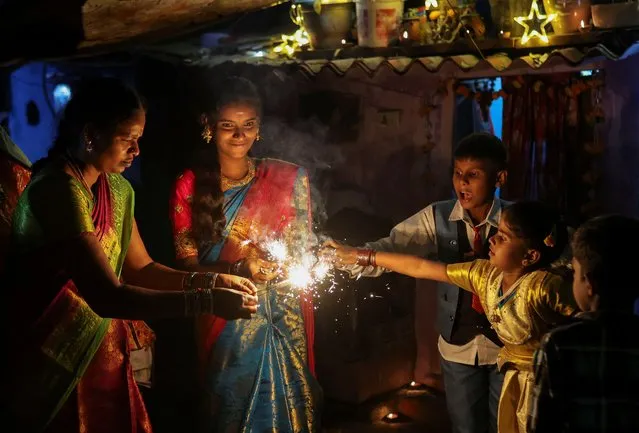
People light fireworks to celebrate Diwali, the Hindu festival of lights, in New Delhi, India on November 12, 2023. (Photo by Anushree Fadnavis/Reuters)

People light fireworks to celebrate Diwali, the Hindu festival of lights, in New Delhi, India on November 12, 2023. (Photo by Anushree Fadnavis/Reuters)
Details
18 Nov 2023 04:57:00
A participant holds his dog as colored powder is thrown into the air during the Color Run in Lausanne, Switzerland, 12 September 2015. The international 5km running event is inspired by the Hindu Holi spring festival of colors. (Photo by Valentin Flauraud/EPA)

A participant holds his dog as colored powder is thrown into the air during the Color Run in Lausanne, Switzerland, 12 September 2015. The international 5km running event is inspired by the Hindu Holi spring festival of colors. (Photo by Valentin Flauraud/EPA)
Details
13 Sep 2015 14:15:00
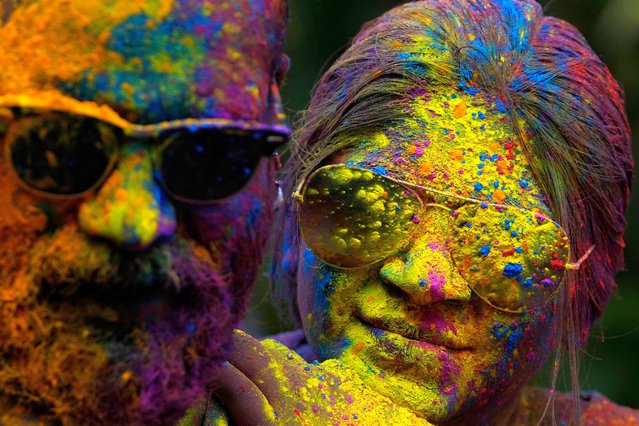
Faces of a couple are smeared with colored powder as they celebrate Holi, the Hindu festival of colors, in Mumbai, India, Monday, March 25, 2024. (Photo by Rafiq Maqbool/AP Photo)

Faces of a couple are smeared with colored powder as they celebrate Holi, the Hindu festival of colors, in Mumbai, India, Monday, March 25, 2024. (Photo by Rafiq Maqbool/AP Photo)
Details
14 Jun 2025 04:19:00