Loading...
Done
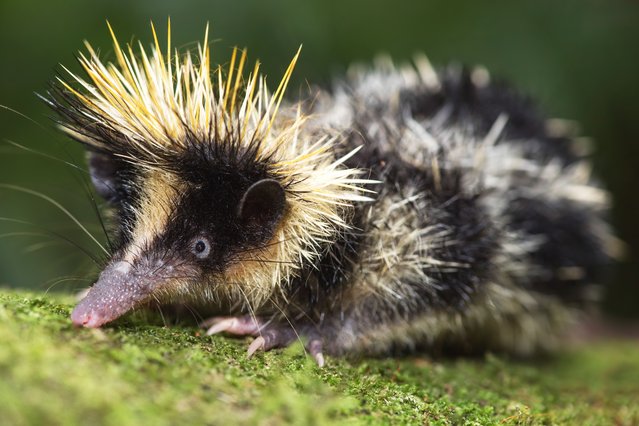
This spiky tenrec was spotted in Madagascar’s Mantadia National Park in the last decade of September 2025. Mostly nocturnal and rarely seen, it puffs out its spines when threatened. Spiky tenrecs are excellent swimmers — unlike most spiny mammals, some species of tenrec can forage in streams and rivers, using their spines for protection while hunting aquatic insects and small prey. (Photo by Dale Morris/Solent News & Photo Agency)

This spiky tenrec was spotted in Madagascar’s Mantadia National Park in the last decade of September 2025. Mostly nocturnal and rarely seen, it puffs out its spines when threatened. Spiky tenrecs are excellent swimmers — unlike most spiny mammals, some species of tenrec can forage in streams and rivers, using their spines for protection while hunting aquatic insects and small prey. (Photo by Dale Morris/Solent News & Photo Agency)
Details
05 Oct 2025 04:02:00
Snow Leopard

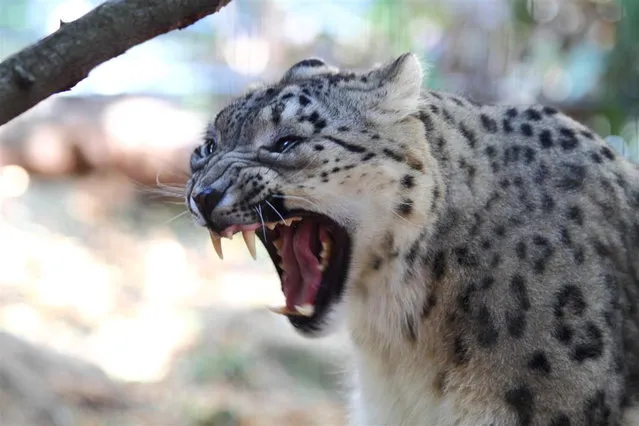
The snow leopard (Panthera uncia syn. Uncia uncia) is a large cat native to the mountain ranges of Central and South Asia. It is listed as endangered on the IUCN Red List of Threatened Species because as of 2003, the size of the global population was estimated at 4,080-6,590 adults, of which fewer than 2,500 individuals may reproduce in the wild.
Details
12 May 2014 10:14:00
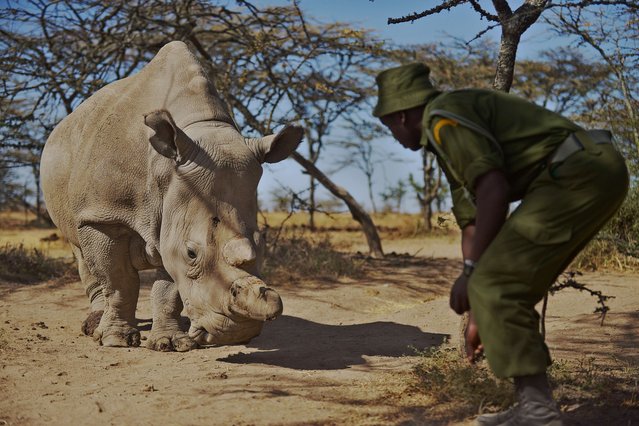
A park ranger stands next to a nothern white female rhinoceros named Najin at Ol Pejeta Conservancy, some 290 kms north of the Kenyan capital, Nairobi, on January 27, 2015. Najin is one of only five members of the sub-species left on the planet, three of which reside at Ol Pejeta Conservancy. (Photo by Tony Karumba/AFP Photo)

A park ranger stands next to a nothern white female rhinoceros named Najin at Ol Pejeta Conservancy, some 290 kms north of the Kenyan capital, Nairobi, on January 27, 2015. Najin is one of only five members of the sub-species left on the planet, three of which reside at Ol Pejeta Conservancy. Conservationists and scientists met in Kenya this week to come up with a last ditch plan to save the northern white rhinoceros from extinction. (Photo by Tony Karumba/AFP Photo)
Details
31 Jan 2015 14:07:00
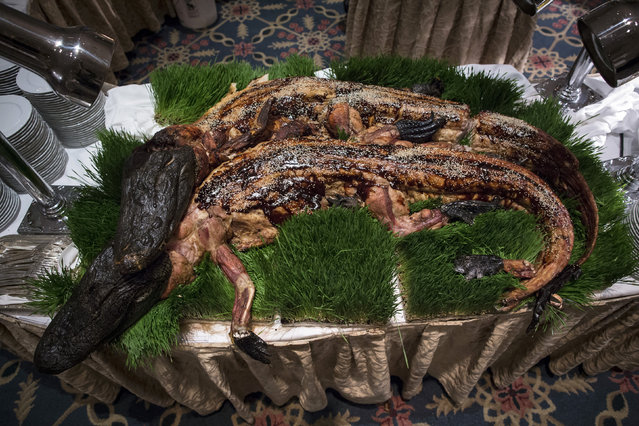
Whole cooked alligators are displayed before being served at the 110th Explorers Club Annual Dinner at the Waldorf Astoria in New York March 15, 2014. The club, which promotes the scientific exploration of land, sea, air and space featured catering by chef and exotic creator Gene Rurka. Chef Rurka prepared a variety of dishes featuring an array of insects, wildlife, animal body parts and invasive species. (Photo by Andrew Kelly/Reuters)

Whole cooked alligators are displayed before being served at the 110th Explorers Club Annual Dinner at the Waldorf Astoria in New York March 15, 2014. The club, which promotes the scientific exploration of land, sea, air and space featured catering by chef and exotic creator Gene Rurka. Chef Rurka prepared a variety of dishes featuring an array of insects, wildlife, animal body parts and invasive species. (Photo by Andrew Kelly/Reuters)
Details
20 Mar 2014 10:03:00
These surfing penguins are making waves as they glide gracefully across the ocean.They are showcasing their talent as they arrive on the East Coast beach of New Island in the Falklands.The penguins are of the gentoo species, characterised by their bright orange bills and the distinctive white stripes on their heads. Here: a lone penguin balancing cooly on a single foot as it catches a wave. (Photo by Shanu Subra/Solent News/SIPA Press)

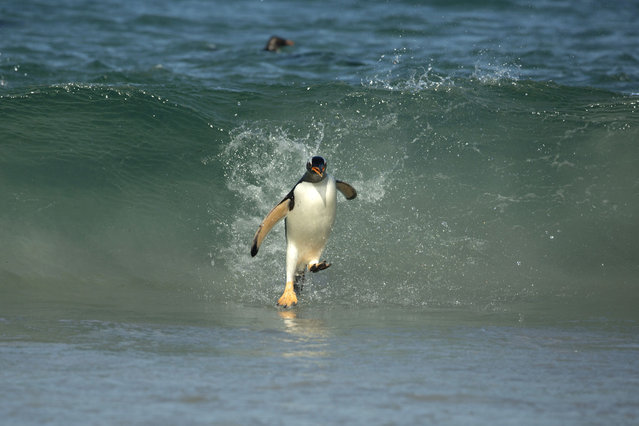
These surfing penguins are making waves as they glide gracefully across the ocean.They are showcasing their talent as they arrive on the East Coast beach of New Island in the Falklands.The penguins are of the gentoo species, characterised by their bright orange bills and the distinctive white stripes on their heads. The dazzling images were captured by amateur photographer Shanu Subra, during a 26 day ecology expedition. Here: a lone penguin balancing cooly on a single foot as it catches a wave. (Photo by Shanu Subra/Solent News/SIPA Press)
Details
25 Nov 2014 10:55:00


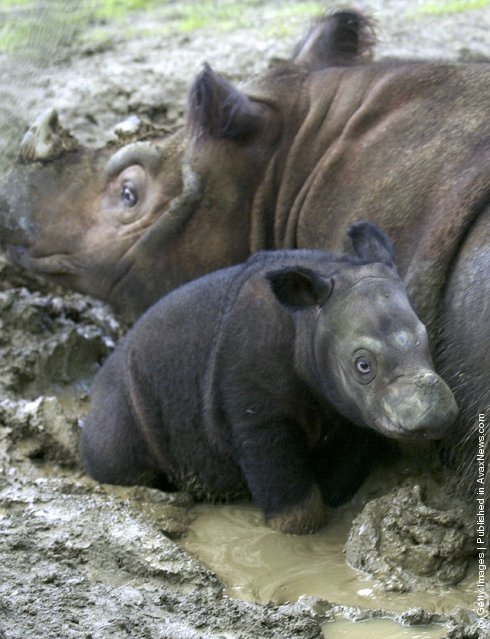
“The Sumatran Rhinoceros (Dicerorhinus sumatrensis) is a member of the family Rhinocerotidae and one of five extant rhinoceroses. It is the only extant species of the genus Dicerorhinus. It is the smallest rhinoceros, standing about 120–145 centimetres (3.9–4.76 ft) high at the shoulder, with a body length of 250 centimetres (8.2 ft) and weight of 500–800 kilograms (1,100–1,800 lb). Like the African species, it has two horns; the larger is the nasal horn, typically 15–25 centimetres (5.9–9.8 in), while the other horn is typically a stub. A coat of reddish-brown hair covers most of the Sumatran Rhino's body”. – Wikipedia

Photo: Emi, a Sumatran rhinoceros lies in the mud with her three-week-old female calf at the Cincinnati Zoo and Botanical Garden August 19, 2004 in Cincinnati, Ohio. Emi made history by becoming the first Sumatran rhino to produce two calves in captivity. (Photo by Mike Simons/Getty Images)
Details
22 Jun 2011 12:37:00
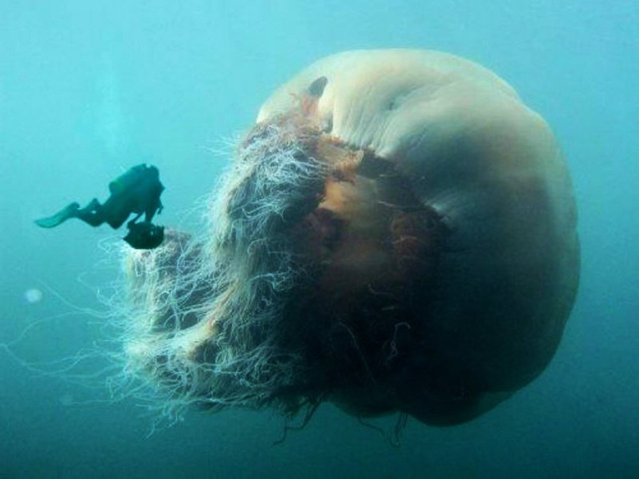
Giant Jellyfish Cyanea capillata

Cyanea capillata is the largest known species of jellyfish. Its range is confined to cold, boreal waters of the Arctic, northern Atlantic, and northern Pacific Oceans, seldom found farther south than 42°N latitude. Similar jellyfish, which may be the same species, are known to inhabit seas near Australia and New Zealand. The largest recorded specimen found, washed up on the shore of Massachusetts Bay in 1870, had a bell (body) with a diameter of 7 feet 6 inches (2.29 m) and tentacles 120 feet (37 m) long.Lion's mane jellyfish have been observed below 42°N latitude for some time—specifically in the larger bays of the east coast of the United States.
Details
24 Jul 2012 12:00:00
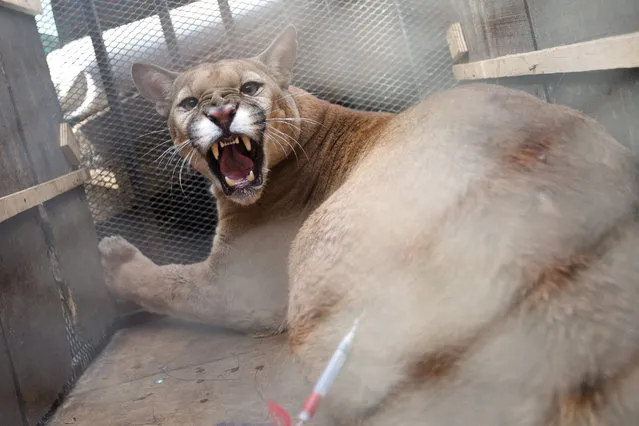
A male puma, named Bordo arrives for an examination and tests at a veterinary in Brasilia, Brazil, 31 October 2017 (issued 01 November 2017). Bordo, a young male puma, captured when he was a cub, will become the first animal of his species to be released in a sanctuary in the Brazilian savannah in Goias State close to Brasilia. The sanctuary, a preserve for wild cats,  is in the first phase and is located on private lands but state funded. (Photo by Joedson Alves/EPA/EFE)

A male puma, named Bordo arrives for an examination and tests at a veterinary in Brasilia, Brazil, 31 October 2017 (issued 01 November 2017). Bordo, a young male puma, captured when he was a cub, will become the first animal of his species to be released in a sanctuary in the Brazilian savannah in Goias State close to Brasilia. The sanctuary, a preserve for wild cats, is in the first phase and is located on private lands but state funded. (Photo by Joedson Alves/EPA/EFE)
Details
05 Nov 2017 08:13:00