Loading...
Done
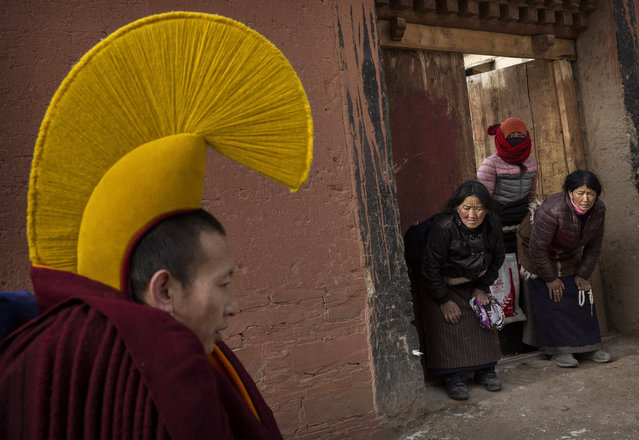
Devotees bow to a passingTibetan Buddhist monk on his way to take part in a special prayer during Monlam or the Great Prayer rituals on March 5, 2015 at the Labrang Monastery, Xiahe County, Amdo, Tibetan Autonomous Prefecture, Gansu Province, China. (Photo by Kevin Frayer/Getty Images)

Devotees bow to a passingTibetan Buddhist monk on his way to take part in a special prayer during Monlam or the Great Prayer rituals on March 5, 2015 at the Labrang Monastery, Xiahe County, Amdo, Tibetan Autonomous Prefecture, Gansu Province, China. Labrang Monastery is one of the six great monasteries of the Gelug school of Tibetan Buddhism and one of the largest outside of the Tibetan Autonomous Region. Monlam, the most important prayer event for many Tibetans was banned during the Cultural Revolution in China but once again in recent years it is celebrated in many areas. (Photo by Kevin Frayer/Getty Images)
Details
14 Mar 2015 14:37:00
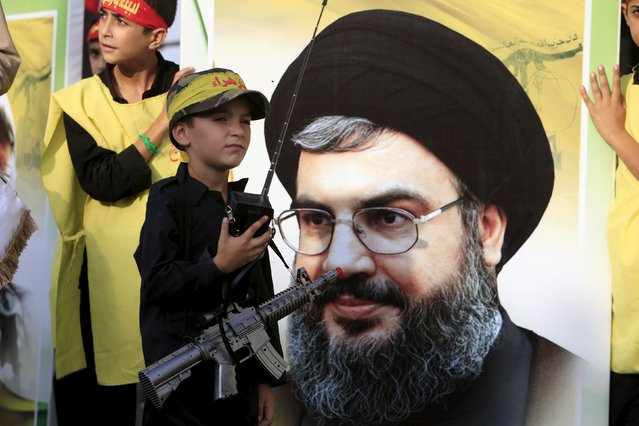
A Muslim Shi'ite boy carries a toy gun while standing next to a picture of Hezbollah leader Sayyed Hassan Nasrallah as he takes part in a march organised by Hezbollah during a re-enactment of the battle of Kerbala during a mourning process, ahead of the day of Ashura, in Saksakieh village, southern Lebanon, October 18, 2015. (Photo by Ali Hashisho/Reuters)

A Muslim Shi'ite boy carries a toy gun while standing next to a picture of Hezbollah leader Sayyed Hassan Nasrallah as he takes part in a march organised by Hezbollah during a re-enactment of the battle of Kerbala during a mourning process, ahead of the day of Ashura, in Saksakieh village, southern Lebanon, October 18, 2015. Ashoura, the most important day in the Shi'ite calendar, commemorates the death of Imam Hussein, grandson of the Prophet Mohammad, in the 7th century battle of Kerbala. (Photo by Ali Hashisho/Reuters)
Details
21 Oct 2015 08:00:00
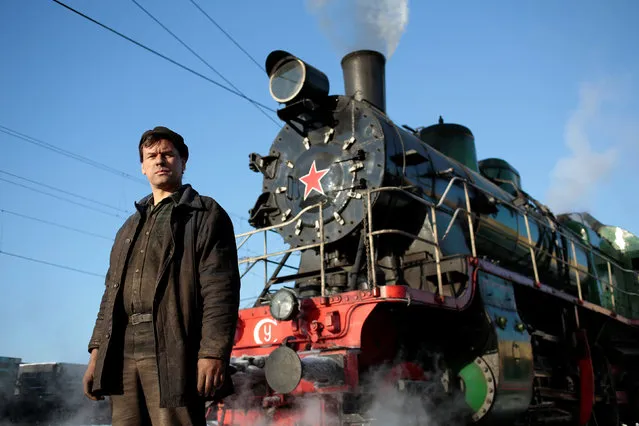
Alexei Gruk, 45, mechanic and supporter of presidential candidate Pavel Grudinin, poses for a picture in St. Petersburg, Russia, January 31, 2018. “The most important thing for me is that our foreign policy stays the same”, said Gruk. “To hell with the sanctions… So what if they don’t bring foreign stuff here anymore? As if that means we have to give up. I don't care”. (Photo by Anton Vaganov/Reuters)

Most Russians intending to vote for Vladimir Putin in Sunday's election say stability is at the root of their faith in their candidate – though many young voters believe it's time for a change of leader. Putin, 65, is expected to win a fourth term in office with 69 percent of the vote, according to the latest survey by a state-run pollster. Reuters correspondents and photographers who travelled around the country talking to voters ahead of the March 18 election found nothing to contradict expectation of an emphatic Putin victory. (Photo by Anton Vaganov/Reuters)
Details
15 Mar 2018 00:01:00


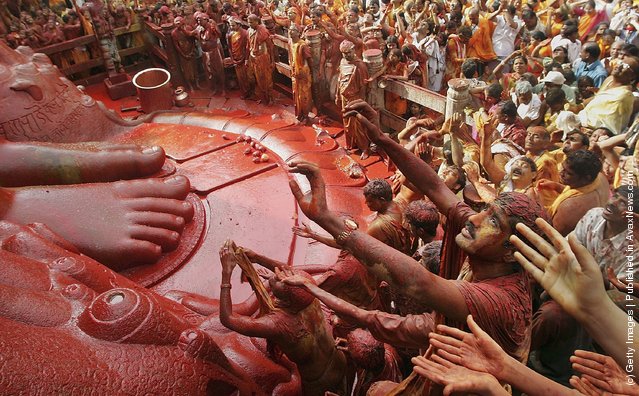
“The Mahamasthakabhisheka (or Mahamasthak Abhishek) is an important Jain festival held once every twelve years in the town of Shravanabelagola in Karnataka state, India. The festival is held in veneration of an immense 18 meter high statue of the Bhagwan (or Saint) Gomateshwara Bahubali. The anointing last took place in February 2006, and the next ceremony will occur in 2018”. – Wikipedia

Photo: A Jain Sadhu (2nd L) and devotees gather and pray at the feet of the monolithic statue of Jain sage Gomateswara during preparations for the Mahamastak Abhisheka ceremony February 7, 2006 in Shravanabelagola, India. The Mahamastak Abhisheka ceremony is held just once every twelve years where the statue will be bathed with milk, yogurt, saffron, gold coins and other religious items. The statue is said to be the world's largest monolith. The ceremony officially runs February 8-19. (Photo by Mario Tama/Getty Images)
Details
21 Jun 2011 12:27:00


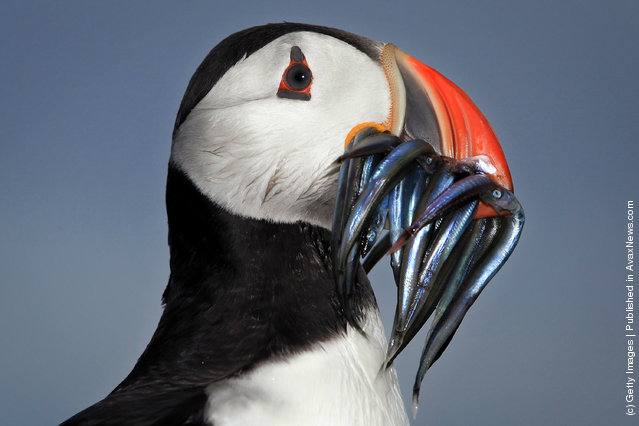
A Puffin returns to it's nest with a beak full of sand eels on June 25, 2011 on Inner Farne, England. The Farne Islands, which are run by the National Trust, are situated two to three miles off the Northumberland coastline. The archipeligo of 16-28 separate islands (depending on the tide) make the summer home to approximately 100,000 pairs of breeding seabirds including around 36,000 Puffins, 32,000 Guillemots and 2,000 pairs of Arctic Terns. The species of birds which nest in internationally important numbers include Shag, Sandwich Tern and Arctic Tern. The coastline around The Farnes are also the breeding ground to one of Europe's largest Grey Seal colonies with around 4,000 adults giving birth to 1500 pups every year. (Photo by Dan Kitwood/Getty Images)
Details
27 Jun 2011 12:58:00
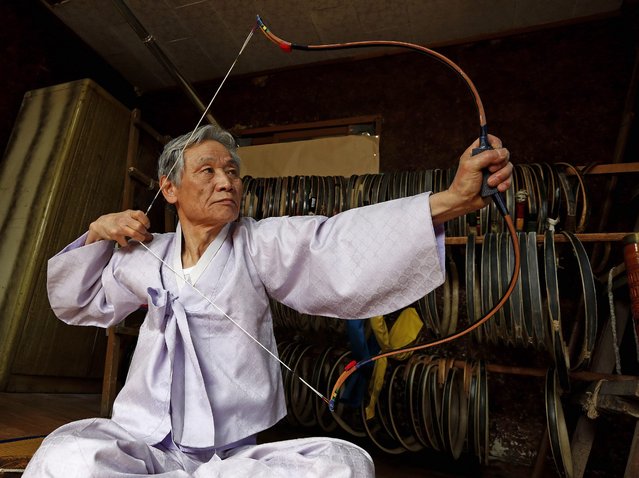
South Korean traditional bow artisan Kwon Yeong-Hak works on a bow in his workshop in Yecheon-gun, Gyeongsangbuk-do, South Korea, 26 February 2015. (Photo by Jeon Heon-Kyun/EPA)

South Korean traditional bow artisan Kwon Yeong-Hak works on a bow in his workshop in Yecheon-gun, Gyeongsangbuk-do, South Korea, 26 February 2015. Kwon Yeong-Hak still crafts his bows in the traditional way, carrying on a four-generation family business. The Gakgung bow, of which Kwon is one of the last remaining artisans, is unique to Korea, and is constructed with a variety of materials, including water buffalo horn, oak, bamboo and cattle spinal sinew. A ban on the import of water buffalo horns has put the Gakgung tradition at risk. (Photo by Jeon Heon-Kyun/EPA)
Details
24 Mar 2015 09:54:00
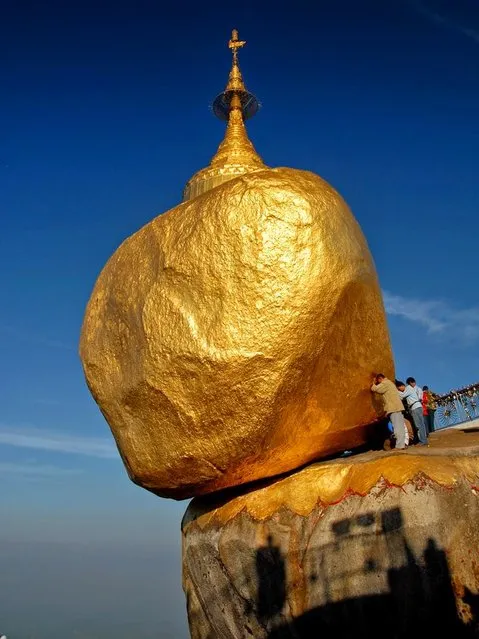
 Kyaiktiyo Pagoda AKA  Golden Rock In Burma

Kyaiktiyo Pagoda, also known as Golden Rock is a well-known Buddhist pilgrimage site in Mon State, Burma. It is a small pagoda (7.3 metres (24 ft)) built on the top of a granite boulder covered with gold leaves pasted on by devotees. According to legend, the Golden Rock itself is precariously perched on a strand of the Buddha's hair. The balancing rock seems to defy gravity, as it perpetually appears to be on the verge of rolling down the hill. The rock and the pagoda are at the top of Mt. Kyaiktiyo. It is the third most important Buddhist pilgrimage site in Burma after the Shwedagon Pagoda and the Mahamuni Pagoda. A glimpse of the "gravity defying" Golden Rock is believed to be enough of an inspiration for any person to turn to Buddhism.
Details
04 Jun 2015 11:42:00
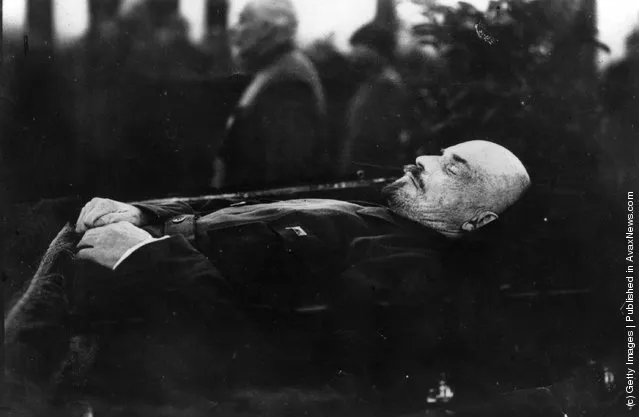
1924:  Vladimir Ilyich Lenin lying in state in the Kremlin

Photo: Vladimir Ilyich Lenin (1870 – 1924) lying in state in the Kremlin. (Photo by Hulton Archive/Getty Images). 1924

Important! For the same article in Russian language click here.

Something quite intriguing is happening within Russian-speaking internet during the last few – should you type a fully academic inquiry (at least, according to Russian academic requirements) in national search engines for "Lenin's mausoleum" – the first thing you get (even in top 10 searches) is website pages talking about black magic and occult. Website authors view this construction differently, but unconditionally agree on one thing: the mausoleum of the "leader of the world proletariat” – the essence of a magical artifact, a sort of “energy vampire”. It was built with a certain purpose: to drain the energy out of miserable Soviet citizens on one hand; and to poison the anthroposphere of one-sixth part of the earth with its vibes (the exact territory that was occupied by the former Soviet Union), depriving the Russian people of will to resist on the other hand. Complete nonsense? No doubt. Nevertheless, an intriguing one. Well, probably because some oddities do exist in mausoleum's history. These oddities are the thing we are going to discuss this time. First, let me refresh you memory on the subject.
Details
16 Oct 2011 11:27:00