Loading...
Done


“The saguaro (scientific name Carnegiea gigantea) is a large, tree-sized cactus species in the monotypic genus Carnegiea. It is native to the Sonoran Desert in the U.S. state of Arizona, the Mexican state of Sonora, a small part of Baja California in the San Felipe Desert and an extremely small area of California, U.S. The saguaro blossom is the State Wildflower of Arizona”. – Wikipedia

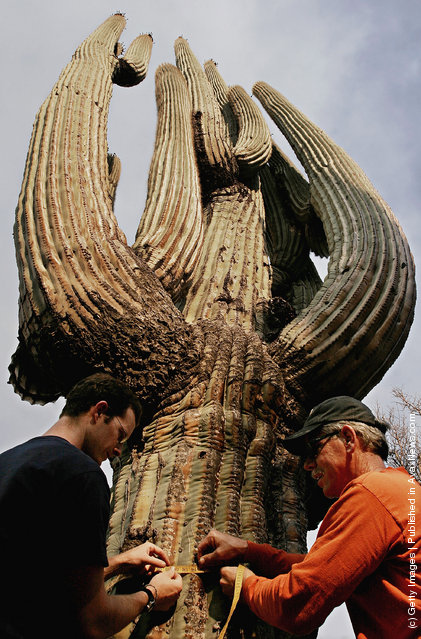
Photo: Daniel Appel (L), a firefighter with Engine 84 from the Lassen National Forest in California and Mike Hallen, (R), Arizona representative of the National Register of Big Trees, measure the circumference of this Saguaro cactus called the "Grand One," in the Tonto National Forest on July 1, 2005 35 miles north of Phoenix, near Carefree, Arizona. The cactus, estimated to be more than 200 years old, measures a circumference of 7 feet, 10 inches (2.4 meters) and stands 46 feet high (14 meters). The cactus was burned in the Cave Creek Complex fire and may not survive. It was once the largest Saguaro in the world, two others have been found recently that have tied it's measurements. The fire has burned more than 214,000 acres of the Sonoran desert. (Photo by Jeff Topping/Getty Images)
Details
26 Jul 2011 12:27:00
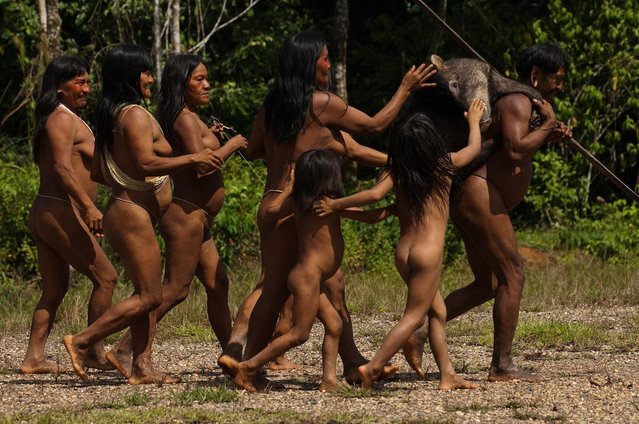
Spectacular images offering insight into the lives of the Huaorani people in the Ecuadorian Amazon have been revealed showing how they use traditional methods to hunt monkeys for food. The stunning pictures were taken by conservation photographer Pete Oxford from Torquay, Devon in the Ecuadorian Amazon. “The Huaorani Indians are a forest people highly in tune with their environment. Many are now totally acculturated since the 1950s by missionaries”, said Pete. “Today they face radical change to their culture to the proximity of oil exploration within their territory and the Yasuni National Park and Biosphere Reserve, they are vastly changed. Some still live very traditionally and for this shoot, through my Huaorani friend, a direct relative of those photographed he wanted to depict them as close to their original culture as possible. They still largely hunt with blow pipes and spears eating a lot of monkeys and peccaries”. The Huaorani are also known as the Waorani, Waodani or the Waos and are native Amerindians. Their lands are located between the Curaray and Napo rivers and speak the Huaorani language. Pete says that during his visit he was welcomed into the group and hopes that ancient cultures can be saved. Here: The tribe were seen celebrating after a hunter returned to camp with a wild pig. (Photo by Pete Oxford/Mediadrumworld.com)

Spectacular images offering insight into the lives of the Huaorani people in the Ecuadorian Amazon have been revealed showing how they use traditional methods to hunt monkeys for food. The stunning pictures were taken by conservation photographer Pete Oxford from Torquay, Devon in the Ecuadorian Amazon. Here: The tribe were seen celebrating after a hunter returned to camp with a wild pig. (Photo by Pete Oxford/Mediadrumworld.com)
Details
20 Jan 2017 07:58:00


Retired 90 year old Frank Foss of St. Petersburg, Florida, with his home made banjo, made from a frying pan, a length of wood and some strings. (Photo by Fox Photos/Getty Images). 2nd July 1972
Details
10 Jul 2011 09:45:00
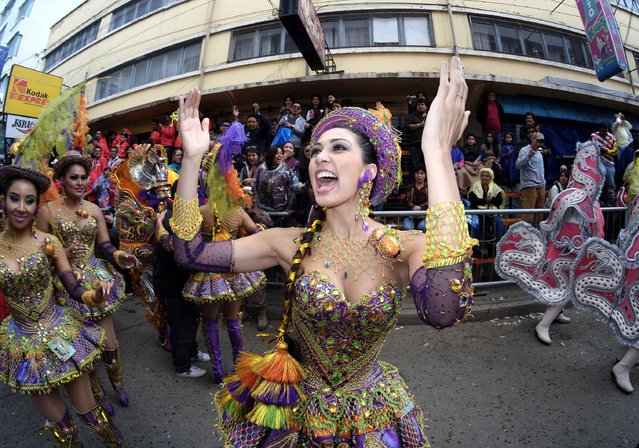
A member of the “Morenada Los Cocanis” group dances during the Carnival parade in Oruro February 14, 2015. (Photo by David Mercado/Reuters)

A member of the “Morenada Los Cocanis” group dances during the Carnival parade in Oruro February 14, 2015. Thousands of dancers and tourists attend the carnival celebrations in Oruro, south of La Paz. (Photo by David Mercado/Reuters)
Details
15 Feb 2015 14:25:00
A young man performs a wheelie on his bicycle during a stunt show in the Petare neighborhood of Caracas, Venezuela, on Sunday, October 31, 2021. (Photo by Pedro Ramses Mattey/Anadolu Agency via Getty Images)

A young man performs a wheelie on his bicycle during a stunt show in the Petare neighborhood of Caracas, Venezuela, on Sunday, October 31, 2021. (Photo by Pedro Ramses Mattey/Anadolu Agency via Getty Images)
Details
16 Nov 2021 08:14:00
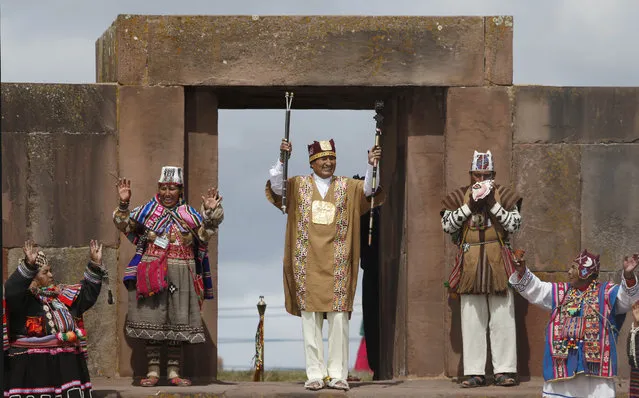
Bolivia's president Evo Morales holds his scared staffs of power during a blessing by Aymaran spiritual guides, in a traditional ceremony at the archeological site Tiwanaku, Bolivia, Wednesday, January 21, 2015. Morales is set to begin a new term Thursday, that will make him the Andean nation's longest-serving leader, riding high on a wave of unprecedented growth and stability. (Photo by Juan Karita/AP Photo)

Bolivia's president Evo Morales holds his scared staffs of power during a blessing by Aymaran spiritual guides, in a traditional ceremony at the archeological site Tiwanaku, Bolivia, Wednesday, January 21, 2015. Morales is set to begin a new term Thursday, that will make him the Andean nation's longest-serving leader, riding high on a wave of unprecedented growth and stability. (Photo by Juan Karita/AP Photo)
Details
22 Jan 2015 13:38:00
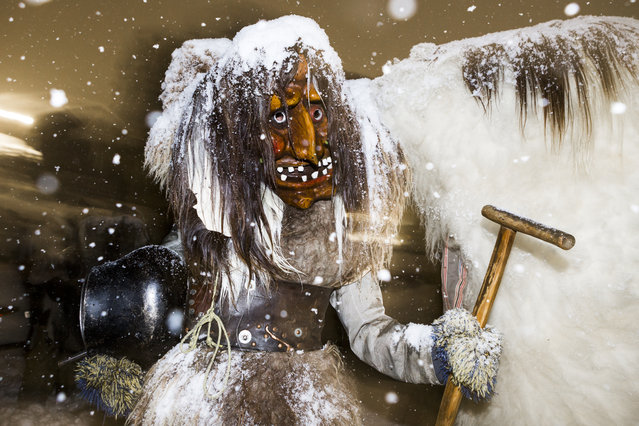
In this February 4, 2016 picture  a masked participant of the traditional carnival  parade poses in the streets of the village of Kippel in the Loetschental valley, southwestern part of Switzerland. During this sinister carnival,  participants wearing  wooden masks and animal furs,  crowd the streets of the villages to scare the people.  (Photo by Dominic Steinmann/Keystone via AP Photo)

In this February 4, 2016 picture a masked participant of the traditional carnival parade poses in the streets of the village of Kippel in the Loetschental valley, southwestern part of Switzerland. During this sinister carnival, participants wearing wooden masks and animal furs, crowd the streets of the villages to scare the people. (Photo by Dominic Steinmann/Keystone via AP Photo)
Details
06 Feb 2016 13:05:00
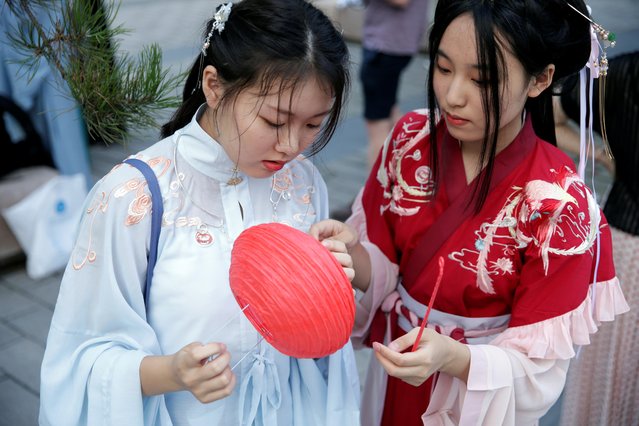
Girls dressed in “Hanfu”, or Han clothing, prepare for an event to mark the traditional Qixi festival, the Chinese equivalent of Valentine's Day, at a park in Beijing, China, August 7, 2019. Chinese for “Han clothing”, “Hanfu” is based on the idea of donning costumes worn in bygone eras by China's dominant Han ethnicity. Some of the most popular styles are from the Ming, Song and Tang dynasties. Hanfu enthusiasts doubled to two million in 2018 from a year earlier, according to a survey by Hanfu Zixun, a popular community account on the Wechat social media platform. (Photo by Jason Lee/Reuters)

Girls dressed in “Hanfu”, or Han clothing, prepare for an event to mark the traditional Qixi festival, the Chinese equivalent of Valentine's Day, at a park in Beijing, China, August 7, 2019. Chinese for “Han clothing”, “Hanfu” is based on the idea of donning costumes worn in bygone eras by China's dominant Han ethnicity. Some of the most popular styles are from the Ming, Song and Tang dynasties. Hanfu enthusiasts doubled to two million in 2018 from a year earlier, according to a survey by Hanfu Zixun, a popular community account on the Wechat social media platform. (Photo by Jason Lee/Reuters)
Details
23 Sep 2019 00:05:00