Loading...
Done
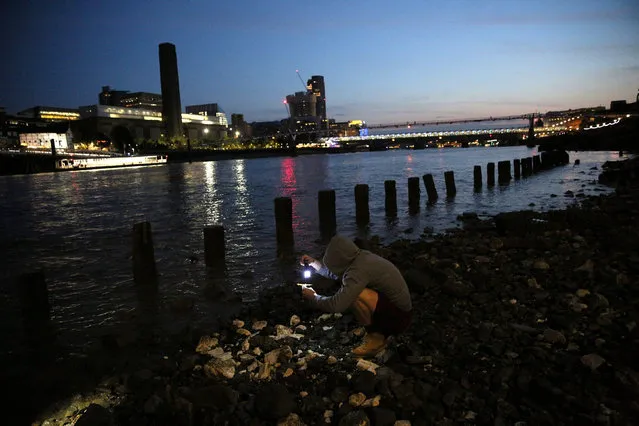
A mudlark uses a torch to look for items on the bank of the River Thames in London, Britain June 06, 2016. Mudlarking is believed to trace its origins to the 18th and 19th century, when scavengers searched the Thames' shores for items to sell. These days, history and archaeology fans are the ones hoping to find old relics such as coins, ceramics, artifacts or everyday items from across centuries. They wait for the low tide and then scour specific areas of exposed shores. "If you're in a field you could be out all day long, with the river you're restricted to about two or three hours," mudlark Nick Stevens said. While many just use the naked eye for their searches, others rely on metal detectors for which a permit from the Port of London Authority is needed. Digging also requires consent. (Photo by Neil Hall/Reuters)

A mudlark uses a torch to look for items on the bank of the River Thames in London, Britain June 06, 2016. Mudlarking is believed to trace its origins to the 18th and 19th century, when scavengers searched the Thames' shores for items to sell. These days, history and archaeology fans are the ones hoping to find old relics such as coins, ceramics, artifacts or everyday items from across centuries. their finds with the Portable Antiquities Scheme. Any item over 300 years old must be recorded. (Photo by Neil Hall/Reuters)
Details
27 Aug 2016 10:43:00
Nguyen Manh Quan (top), 26, a civil servant, carries a girl using his throat area as he performs during a showcase of the traditional Thien Mon Dao kung fu at Du Xa Thuong village, southeast of Hanoi, Vietnam May 10, 2015. (Photo by Reuters/Kham)

Nguyen Manh Quan (top), 26, a civil servant, carries a girl using his throat area as he performs during a showcase of the traditional Thien Mon Dao kung fu at Du Xa Thuong village, southeast of Hanoi, Vietnam May 10, 2015. Thien Mon Dao, a traditional Vietnamese martial art, was formed by 18th century villagers in Du Xa Thuong village, who believed the art form could help improve health as well as fight against foreign invaders. There are currently about 3,000 practitioners including farmers, industry workers and state servants. These practitioners say they are able to bend metal against their bodies and carry heavy objects using their throats, eyes or tongues, as well as run across the surface of a river, according to Thien Mon Dao kung fu master Nguyen Khac Phan. (Photo by Reuters/Kham)
Details
11 May 2015 12:27:00
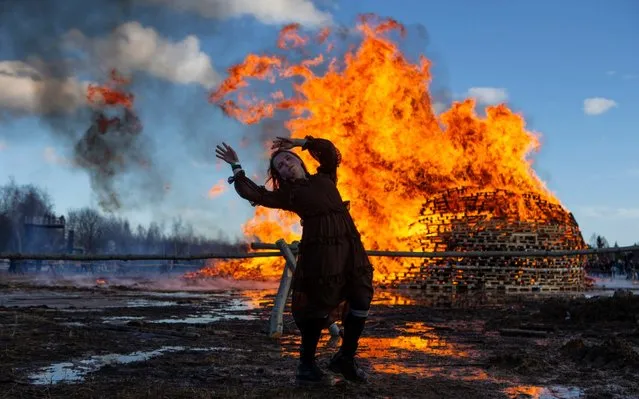
In this photo taken on Saturday, March 9, 2019, a visitor dances in front of a sculpture burning at the Maslenitsa (Shrovetide) festival at the Nikola-Lenivets art park in Nikola-Lenivets village, about 200 kilometers (125 miles) south-west of Moscow, Russia. As part of the celebrations of Maslenitsa (Shrovetide) Holiday in Russian, a folk holiday which heralds the beginning of spring, contemporary artist and park founder Nikolay Polissky built a giant sculpture made of wood and hay which was burnt to ashes during a traditional bonfire. (Photo by Alexander Zemlianichenko Jr./AP Photo)

In this photo taken on Saturday, March 9, 2019, a visitor dances in front of a sculpture burning at the Maslenitsa (Shrovetide) festival at the Nikola-Lenivets art park in Nikola-Lenivets village, about 200 kilometers (125 miles) south-west of Moscow, Russia. As part of the celebrations of Maslenitsa (Shrovetide) Holiday in Russian, a folk holiday which heralds the beginning of spring, contemporary artist and park founder Nikolay Polissky built a giant sculpture made of wood and hay which was burnt to ashes during a traditional bonfire. (Photo by Alexander Zemlianichenko Jr./AP Photo)
Details
27 Jul 2019 00:01:00
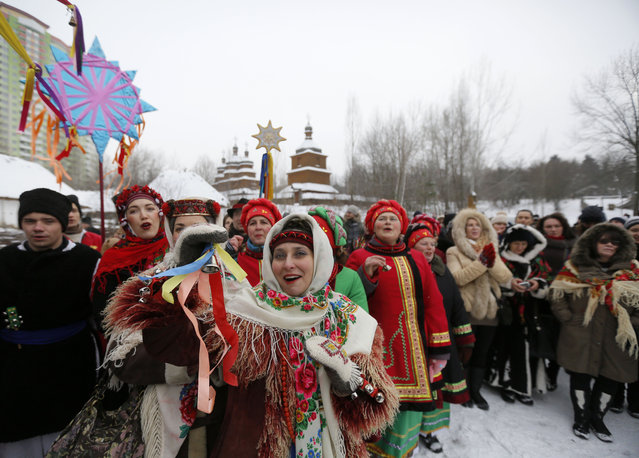
Ukrainians wearing traditional costumes sing Kolyadky or Ukrainian Christmas Carols, as a part of Orthodox Christmas in Kiev, Ukraine, Thursday, January 7 2016. Orthodox Christians mark their traditional Christmas Day Jan. 7, with many ancient symbolic events. (Photo by Sergei Chuzavkov/AP Photo)

Ukrainians wearing traditional costumes sing Kolyadky or Ukrainian Christmas Carols, as a part of Orthodox Christmas in Kiev, Ukraine, Thursday, January 7 2016. Orthodox Christians mark their traditional Christmas Day Jan. 7, with many ancient symbolic events. (Photo by Sergei Chuzavkov/AP Photo)
Details
09 Jan 2016 08:06:00
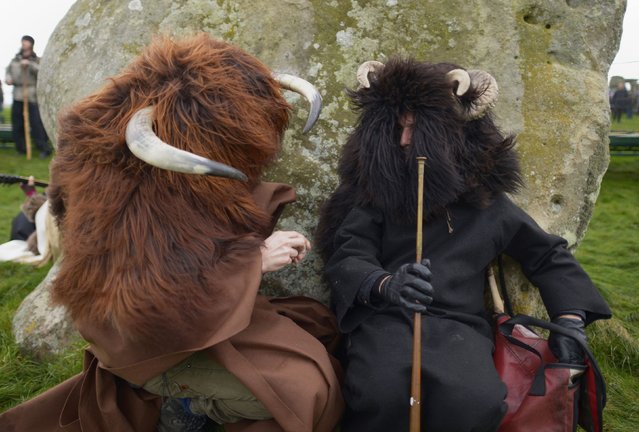
Two people wearing animal costumes  join others as people gather  to celebrate the Winter Solstice at Stonehenge in England  Tuesday December 22, 2015.  The winter solstice is celebrated by many people around the world as the beginning of the return of the sun. (Photo by Ben Birchall/PA Wire via AP Photo)

Two people wearing animal costumes join others as people gather to celebrate the Winter Solstice at Stonehenge in England Tuesday December 22, 2015. The winter solstice is celebrated by many people around the world as the beginning of the return of the sun. (Photo by Ben Birchall/PA Wire via AP Photo)
Details
24 Dec 2015 08:07:00
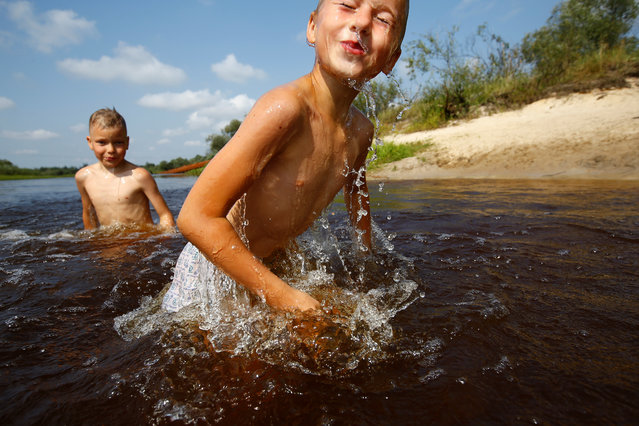
Boys play in the Stviga River on a hot summer day near the village of Pogost, Belarus, August 16, 2017. (Photo by Vasily Fedosenko/Reuters)

Just a few hours’ drive from the Belarus capital of Minsk, many villagers still live off the land. Nearly 80% of the country’s 9.5 million citizens live in urban areas, but for the rest, being close to nature can outweigh the hardships of country life. Here: Boys play in the Stviga River on a hot summer day near the village of Pogost, Belarus, August 16, 2017. (Photo by Vasily Fedosenko/Reuters)
Details
30 Nov 2017 08:28:00
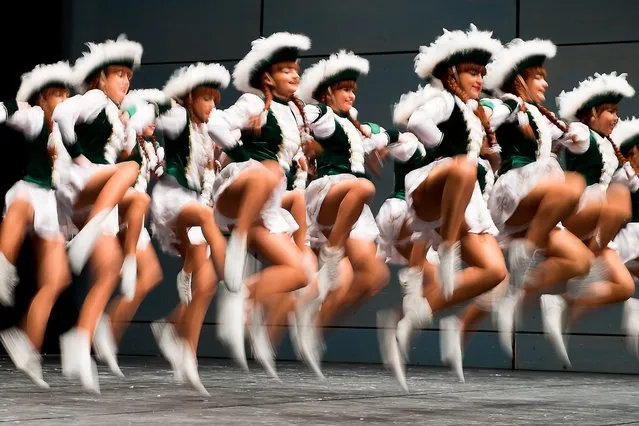
A picture taken with slow shutter speed shows members of the group “The Kattfiller” from Attendorn taking part during the Norddeutsche Championship carnivalesque dance sport in Kassel (Hessen), Germany, 28 February 2016. About 1,100 qualified dancers show in different disciplines their skills. (Photo by Swen Pfoertner/EPA)

A picture taken with slow shutter speed shows members of the group “The Kattfiller” from Attendorn taking part during the Norddeutsche Championship carnivalesque dance sport in Kassel (Hessen), Germany, 28 February 2016. About 1,100 qualified dancers show in different disciplines their skills. (Photo by Swen Pfoertner/EPA)
Details
29 Feb 2016 12:00:00
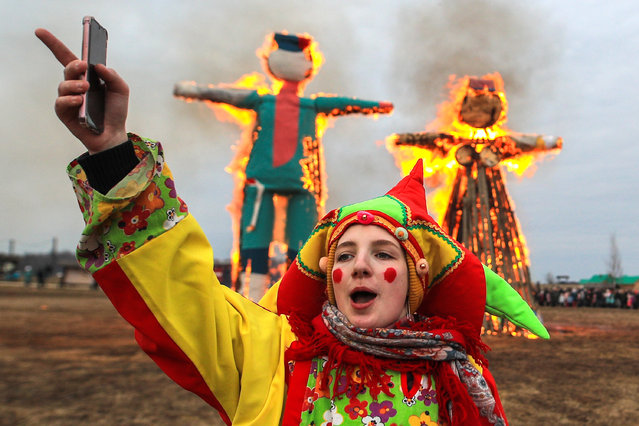
Burning effigies of winter during a celebration of Maslenitsa festival (Pancake Week) at the Etnomir (Ethnoworld) cultural and educational center in Kaluga Region, Russia on March 1, 2020. The holiday celebrates the end of winter and marks the arrival of spring. (Photo by Sergei Bobylev/TASS)

Burning effigies of winter during a celebration of Maslenitsa festival (Pancake Week) at the Etnomir (Ethnoworld) cultural and educational center in Kaluga Region, Russia on March 1, 2020. The holiday celebrates the end of winter and marks the arrival of spring. (Photo by Sergei Bobylev/TASS)
Details
04 Mar 2020 00:05:00