Loading...
Done
Brazilian singer Anitta performs during the “Ensaios de Anitta” show, an event that is part of a pre-carnival tour that makes its way through several Brazilian cities, paying tribute to a samba school in each performance at the Jockey Club of Rio de Janeiro, Brazil, 21 January 2024. Anitta only performs this time of year in her country and said that experiencing a carnival is the best way to get to know the Brazilian people because all the energy of its people is concentrated on a single topic. (Photo by Andre Coelho/EPA/EFE)

Brazilian singer Anitta performs during the “Ensaios de Anitta” show, an event that is part of a pre-carnival tour that makes its way through several Brazilian cities, paying tribute to a samba school in each performance at the Jockey Club of Rio de Janeiro, Brazil, 21 January 2024. Anitta only performs this time of year in her country and said that experiencing a carnival is the best way to get to know the Brazilian people because all the energy of its people is concentrated on a single topic. (Photo by Andre Coelho/EPA/EFE)
Details
07 Mar 2025 00:33:00
Young revelers take part in a parade called "La Calabiuza" on November 1, 2015, on the eve of the Day of the Dead in Tonacatepeque, 20 kms (13 miles) north of San Salvador. During the celebration, the residents of Tonacatepeque, originally an indigenous community, recall the characters from the mythology of Cuscatlan – pre-Columbian west and central regions of El Salvador – and their dead relatives. (Photo by Marvin Recinos/AFP Photo)

Young revelers take part in a parade called "La Calabiuza" on November 1, 2015, on the eve of the Day of the Dead in Tonacatepeque, 20 kms (13 miles) north of San Salvador. During the celebration, the residents of Tonacatepeque, originally an indigenous community, recall the characters from the mythology of Cuscatlan – pre-Columbian west and central regions of El Salvador – and their dead relatives. (Photo by Marvin Recinos/AFP Photo)
Details
04 Nov 2015 11:50:00
Revelers dance at a Jacarezinho samba school practice session ahead of Carnival celebrations on February 16, 2014 in Rio de Janeiro, Brazil. The Jacarezinho “favela” was previously controlled by drug traffickers and is now occupied by the city's Police Pacification Unit (UPP). Carnival officially begins February 28, but pre-Carnival celebrations are already underway. (Photo by Mario Tama/Getty Images)

Revelers dance at a Jacarezinho samba school practice session ahead of Carnival celebrations on February 16, 2014 in Rio de Janeiro, Brazil. The Jacarezinho “favela” was previously controlled by drug traffickers and is now occupied by the city's Police Pacification Unit (UPP). Carnival officially begins February 28, but pre-Carnival celebrations are already underway. (Photo by Mario Tama/Getty Images)
Details
19 Feb 2014 11:01:00
Adonna Khare and her Pencil

Originally hailing from a small town in Iowa, Adonna Khare was this year’s recipient of the Art Prize 2012 for her amazingly detailed large-scale pencil on paper works. All of Khare’s work evolve naturally without much pre-planning, essentially building her pieces as she continues to work.
Details
29 May 2015 15:02:00
Swiss rescue workers wheel a wounded person on a stretcher after two regional trains crashed head on near Granges-Pres-Marnand near Payerne in western Switzerland July 29, 2013. The two trains collided in the Swiss canton of Vaud on Monday evening, injuring about 40 people, four seriously, Swiss news agency ATS reported. There was no immediate report of any deaths in the crash. (Photo by Denis Balibouse/Reuters)

Swiss rescue workers wheel a wounded person on a stretcher after two regional trains crashed head on near Granges-Pres-Marnand near Payerne in western Switzerland July 29, 2013. The two trains collided in the Swiss canton of Vaud on Monday evening, injuring about 40 people, four seriously, Swiss news agency ATS reported. There was no immediate report of any deaths in the crash. (Photo by Denis Balibouse/Reuters)
Details
30 Jul 2013 11:33:00
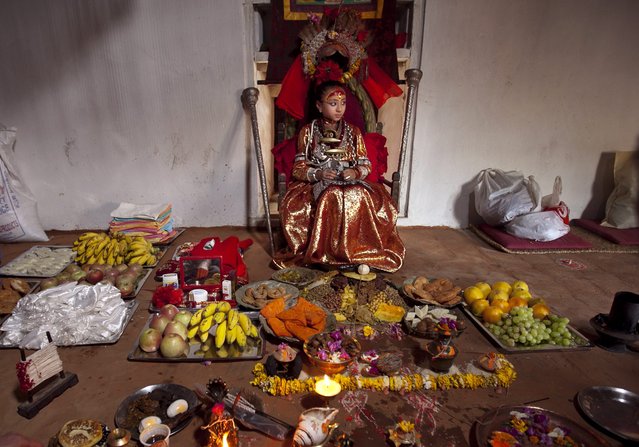
Kumari Samita Bajracharya sits in front of devotees offers during a special puja at Kumari Ghar in Patan, Nepal, 09 April 2011. It is believed that worshipping Kumari and receiving tika from her reduces illness and avoid problems. Kumari, or Kumari Devi, is a “living goddess”. The word literally means virgin in Nepali. The Living Goddesses are young pre-pubescent girls that are considered to be incarnations of the Hindu Goddess of Power, Kali. The Kumari retires when she reaches puberty. (Photo by Narendra Shrestha/EPA)

Kumari Samita Bajracharya sits in front of devotees offers during a special puja at Kumari Ghar in Patan, Nepal, 09 April 2011. It is believed that worshipping Kumari and receiving tika from her reduces illness and avoid problems. Kumari, or Kumari Devi, is a “living goddess”. The word literally means virgin in Nepali. The Living Goddesses are young pre-pubescent girls that are considered to be incarnations of the Hindu Goddess of Power, Kali. The Kumari retires when she reaches puberty. (Photo by Narendra Shrestha/EPA)
Details
18 Jun 2014 12:31:00
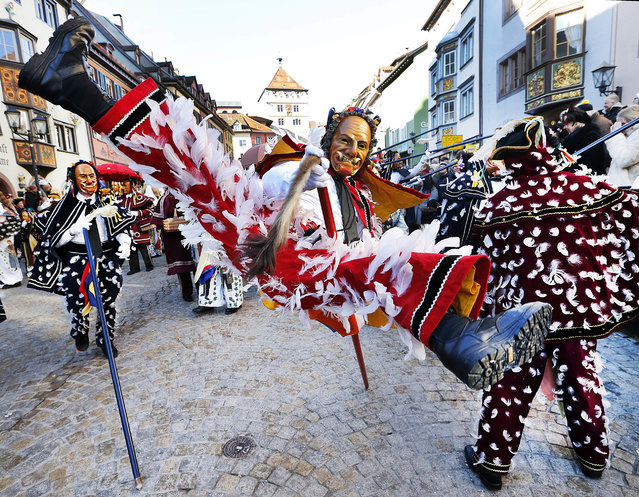
A “Federahannes”, a jester figure from Rottweil, participates in the “Narrensprung” (jester jump) parade in Rottweil, southern Germany, Monday, February 27, 2016. About 4000 jesters paraded through the city among thousands of spectators. The Rottweil Narrensprung is the highlight of the Swabian-Alemannic Fastnacht and one of the traditional pre-Lenten carnival parades in southwestern Germany. (Photo by Michael Probst/AP Photo)

A “Federahannes”, a jester figure from Rottweil, participates in the “Narrensprung” (jester jump) parade in Rottweil, southern Germany, Monday, February 27, 2016. About 4000 jesters paraded through the city among thousands of spectators. The Rottweil Narrensprung is the highlight of the Swabian-Alemannic Fastnacht and one of the traditional pre-Lenten carnival parades in southwestern Germany. (Photo by Michael Probst/AP Photo)
Details
04 Mar 2017 00:03:00
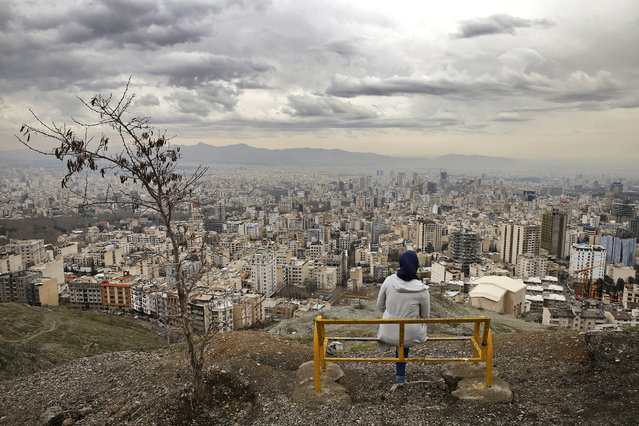
A woman spends her time outdoors to observe the ancient festival of Sizdeh Bedar, an annual public picnic day on the 13th day of the Iranian new year, at the Tochal mountainous area northern Tehran, Iran, Sunday, April, 2, 2017. Sizdeh Bedar, which comes from the Farsi words for “thirteen” and “day out”, is a legacy from Iran's pre-Islamic past that hard-liners in the Islamic Republic never managed to erase from calendars. (Photo by Ebrahim Noroozi/AP Photo)

A woman spends her time outdoors to observe the ancient festival of Sizdeh Bedar, an annual public picnic day on the 13th day of the Iranian new year, at the Tochal mountainous area northern Tehran, Iran, Sunday, April, 2, 2017. Sizdeh Bedar, which comes from the Farsi words for “thirteen” and “day out”, is a legacy from Iran's pre-Islamic past that hard-liners in the Islamic Republic never managed to erase from calendars. (Photo by Ebrahim Noroozi/AP Photo)
Details
21 Apr 2017 07:38:00