Loading...
Done
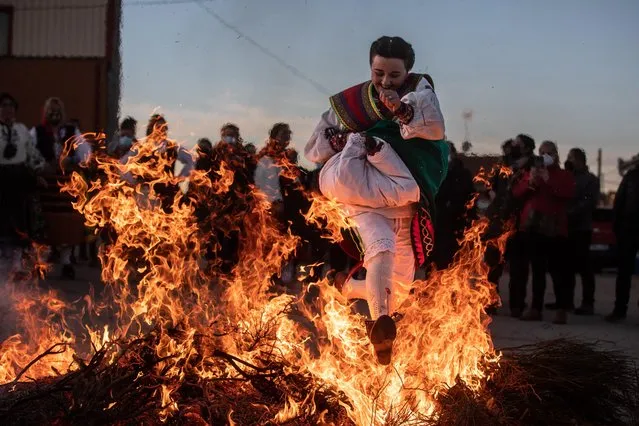
People celebrate the traditional Fiesta de las Aguedas on February 6, 2022 in Andavias, Zamora, Castilla y Leon, Spain. This celebration, also known as “El dia de las mujeres”, is a deep-rooted tradition in Castilla y Leon, especially in rural areas. The day of the Aguedas has its origin in the cult of Santa Agueda, and is celebrated every February 5. During this day, women are the protagonists and take over the city. For their part, the town councils give them the baton as a sign of authority. Around seven days of festivities are celebrated where the attendees dance, eat, sing, and even jump over a bonfire. (Photo By Emilio Fraile/Europa Press via Getty Images)

People celebrate the traditional Fiesta de las Aguedas on February 6, 2022 in Andavias, Zamora, Castilla y Leon, Spain. This celebration, also known as “El dia de las mujeres”, is a deep-rooted tradition in Castilla y Leon, especially in rural areas. The day of the Aguedas has its origin in the cult of Santa Agueda, and is celebrated every February 5. (Photo By Emilio Fraile/Europa Press via Getty Images)
Details
31 Mar 2022 06:18:00
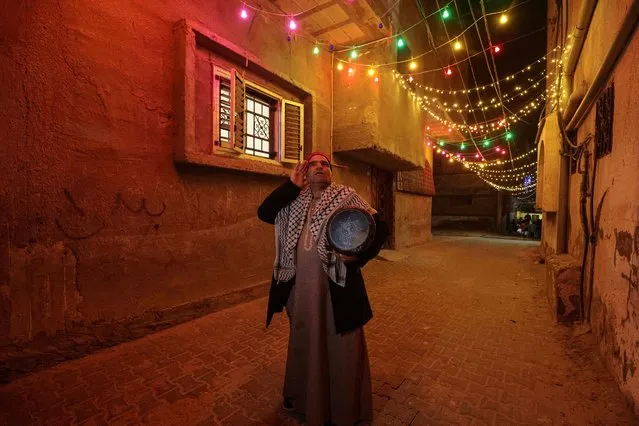
Fifty-year-old Palestinian Nizar al-Dabbas, a “Musaharati” who plays the traditional role of “Ramadan drummer”, awakens Muslims for the pre-dawn traditional “suhur” meal before the start of the following day's fast, during the holy month of Ramadan in Khan Yunis in the southern Gaza Strip early on April 5, 2022. (Photo by Said Khatib/AFP Photo)

Fifty-year-old Palestinian Nizar al-Dabbas, a “Musaharati” who plays the traditional role of “Ramadan drummer”, awakens Muslims for the pre-dawn traditional “suhur” meal before the start of the following day's fast, during the holy month of Ramadan in Khan Yunis in the southern Gaza Strip early on April 5, 2022. (Photo by Said Khatib/AFP Photo)
Details
14 Apr 2022 06:25:00
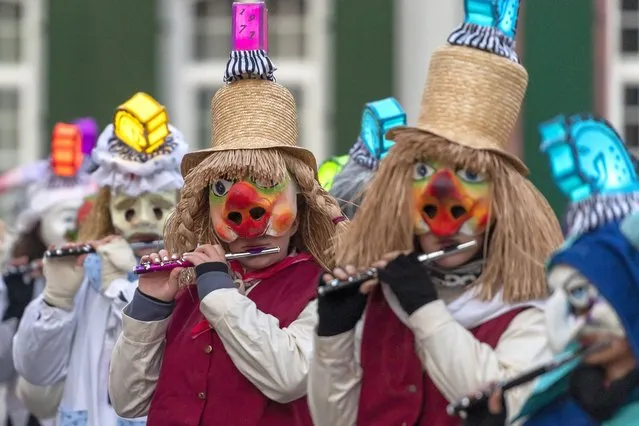
Members of carnival marching bands in costumes parade through the streets during the so-called “Morgestraich” carnival parade in Basel, Switzerland, on Monday, early 07 March 2022. The traditional “Morgenstraich” parade with colorful lanterns and revelers in traditional costumes is starting early morning at 4 a.m. and marks the kick-off for the Basel carnival. It was not held in its usual form in the past two years because of the measures against the Covid-19 pandemic. (Photo by Georgios Kefalas/EPA/EFE)

Members of carnival marching bands in costumes parade through the streets during the so-called “Morgestraich” carnival parade in Basel, Switzerland, on Monday, early 07 March 2022. The traditional “Morgenstraich” parade with colorful lanterns and revelers in traditional costumes is starting early morning at 4 a.m. and marks the kick-off for the Basel carnival. It was not held in its usual form in the past two years because of the measures against the Covid-19 pandemic. (Photo by Georgios Kefalas/EPA/EFE)
Details
23 May 2023 02:10:00
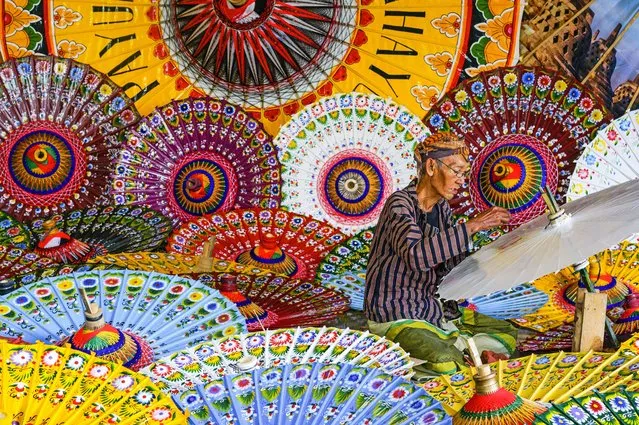
A worker is immersed in a kaleidoscope of colour while they paint traditional umbrellas in Juwiring, Klaten, Central Java, Indonesia in December 2023. The workers who spend around 8 hours a day, depending on order quantities and customer deadlines are paid around Ј200 a month. They will paint a batch over the period of two to three days until each layer of paint is dry. Extras of the traditional umbrella will be made as many tourists come to buy them. (Photo by  Lia Indriani/Solent News & Photo Agency)

A worker is immersed in a kaleidoscope of colour while they paint traditional umbrellas in Juwiring, Klaten, Central Java, Indonesia in December 2023. The workers who spend around 8 hours a day, depending on order quantities and customer deadlines are paid around Ј200 a month. They will paint a batch over the period of two to three days until each layer of paint is dry. Extras of the traditional umbrella will be made as many tourists come to buy them. (Photo by Lia Indriani/Solent News & Photo Agency)
Details
03 Jan 2024 19:39:00
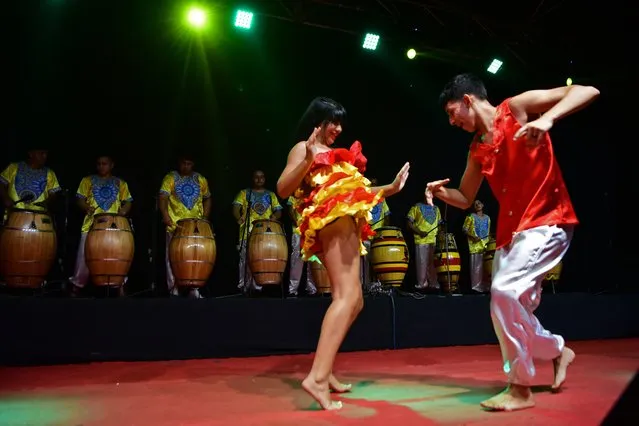
Dancers of the Saint Balthazar Kamba Kua traditional group perform in honour of Saint Balthazar, one of the Three Wise Men, during the Afro-Paraguay festival of Kamba Kua, in Fernando de la Mora, Paraguay, on January 6, 2024. The annual festival is a tradition that keeps Paraguay's Afro-descendants connected with their African roots through ancestral dance, drumming and customs. (Photo by Norberto Duarte/AFP Photo)

Dancers of the Saint Balthazar Kamba Kua traditional group perform in honour of Saint Balthazar, one of the Three Wise Men, during the Afro-Paraguay festival of Kamba Kua, in Fernando de la Mora, Paraguay, on January 6, 2024. The annual festival is a tradition that keeps Paraguay's Afro-descendants connected with their African roots through ancestral dance, drumming and customs. (Photo by Norberto Duarte/AFP Photo)
Details
28 Apr 2024 03:42:00
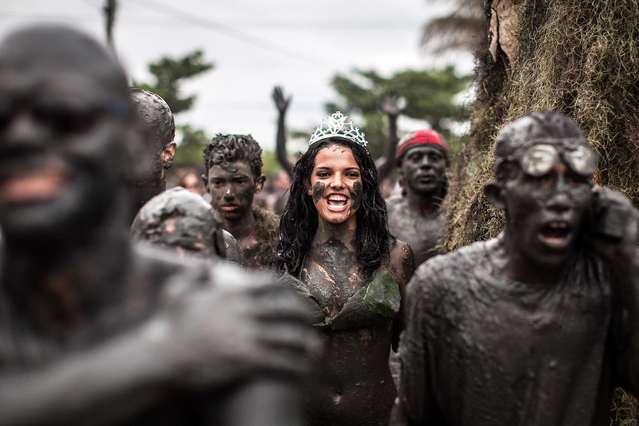
Revelers participate in the traditional Bloco da Lama (Mud block) carnival in Parati, Rio de Janeiro State, Brazil, on February 9, 2013. The event, which was begun by two men in a playful manner in 1986, has now become a traditional carnival in which participants disguised as primitives with rags, lianas or skulls and bones, dive in the mud. (Photo by Victor Moriyama/AFP Photo)

Revelers participate in the traditional Bloco da Lama (Mud block) carnival in Parati, Rio de Janeiro State, Brazil, on February 9, 2013. The event, which was begun by two men in a playful manner in 1986, has now become a traditional carnival in which participants disguised as primitives with rags, lianas or skulls and bones, dive in the mud. (Photo by Victor Moriyama/AFP Photo)
Details
12 Feb 2013 14:10:00
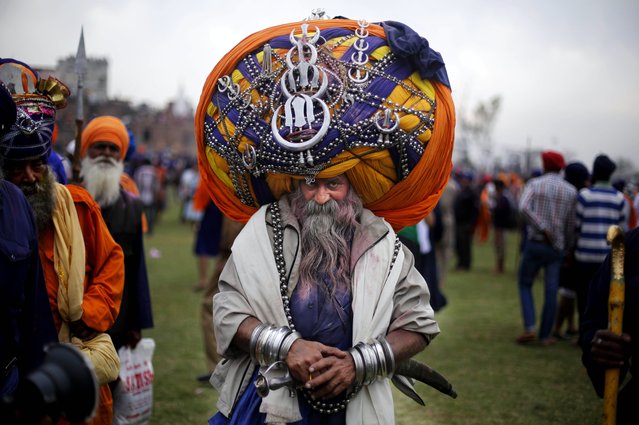
A Sikh warrior, wearing a huge turban attends the annual fair of “Hola Mohalla” in Anandpur Sahib, in the northern Indian state of Punjab, Monday, March 17, 2014. Believers from various parts of northern India collect at the religious fair to celebrate the festival of Holi in a tradition set by the tenth Sikh guru Guru Gobind Singh in the seventeenth century. Nihangs, or Sikh warriors, display their martial skills and attire during the fair, believed to be maintained in the exact tradition as set by the Guru. (Photo by Altaf Qadri/AP Photo)

A Sikh warrior, wearing a huge turban attends the annual fair of “Hola Mohalla” in Anandpur Sahib, in the northern Indian state of Punjab, Monday, March 17, 2014. Believers from various parts of northern India collect at the religious fair to celebrate the festival of Holi in a tradition set by the tenth Sikh guru Guru Gobind Singh in the seventeenth century. Nihangs, or Sikh warriors, display their martial skills and attire during the fair, believed to be maintained in the exact tradition as set by the Guru. (Photo by Altaf Qadri/AP Photo)
Details
22 Mar 2014 13:31:00
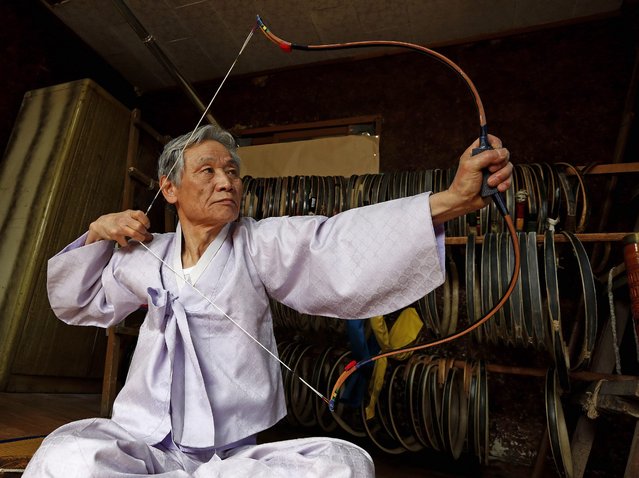
South Korean traditional bow artisan Kwon Yeong-Hak works on a bow in his workshop in Yecheon-gun, Gyeongsangbuk-do, South Korea, 26 February 2015. (Photo by Jeon Heon-Kyun/EPA)

South Korean traditional bow artisan Kwon Yeong-Hak works on a bow in his workshop in Yecheon-gun, Gyeongsangbuk-do, South Korea, 26 February 2015. Kwon Yeong-Hak still crafts his bows in the traditional way, carrying on a four-generation family business. The Gakgung bow, of which Kwon is one of the last remaining artisans, is unique to Korea, and is constructed with a variety of materials, including water buffalo horn, oak, bamboo and cattle spinal sinew. A ban on the import of water buffalo horns has put the Gakgung tradition at risk. (Photo by Jeon Heon-Kyun/EPA)
Details
24 Mar 2015 09:54:00