Loading...
Done
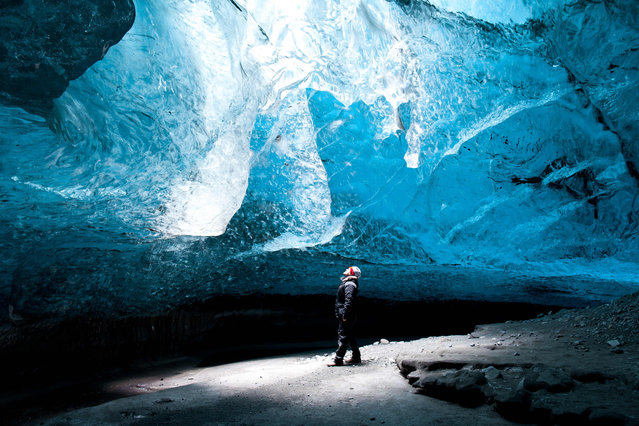
A wide view of Rob Lott  in the crystal ice cave in the Vatnajokull Glacier, Iceland. (Photo by Rob Lott/Barcroft Media)

Shimmering clearest blue and stretching as far as the eye can see, this is one of Iceland's famed crystal ice caves. The giant solid waves look frozen in time but they are slowly moving along as part of the Vatnajokull Glacier – which stretches across eight per cent of the island. The images were captured in February 2014 by British photographer Rob Lott, 49. Photo: A wide view of Rob Lott in the crystal ice cave in the Vatnajokull Glacier, Iceland. (Photo by Rob Lott/Barcroft Media)
Details
17 Mar 2014 08:26:00
Rob Switzer 34 proposed to Joli 33 whilst they were on holiday in Moscow, Russia. (Photo by Dipkiss Travels/Caters News Agency)

A loved-up couple have captured the moments they shared a dip-kiss in different locations around the world. Rob, 34, and Joli Switzer, 33, from Maryland, embark on a minimum of four international holidays per year to ensure that they get their unique dip-kiss photograph. Here: Rob Switzer 34 proposed to Joli 33 whilst they were on holiday in Moscow, Russia. (Photo by Dipkiss Travels/Caters News Agency)
Details
21 Apr 2018 00:03:00
A guest poses for photographs at the infinity pool of the newly-inaugurated Dolce Hanoi Golden Lake hotel, the world's first gold-plated hotel, in Hanoi on July 2, 2020. (Photo by Manan Vatsyayana/AFP Photo)

A guest poses for photographs at the infinity pool of the newly-inaugurated Dolce Hanoi Golden Lake hotel, the world's first gold-plated hotel, in Hanoi on July 2, 2020. It even has a gold-plated infinity pool on the roof. The 400-room, 25-storey property will operate under the American Wyndham Hotels brand. Prices start at $300 a night for rooms, or there are apartments to rent costing from $6400 per square metre. (Photo by Manan Vatsyayana/AFP Photo)
Details
04 Jul 2020 00:05:00
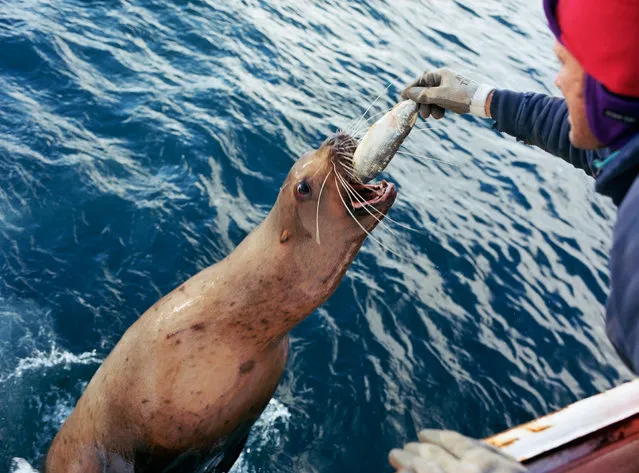
Before heading up to Alaska, the ship loads up with 3 months worth of food. Even so, it's hardly necessary. The ship's cook is constantly steaming fresh crab legs and seafood caught during the day. The hard labour of fishing requires a diet heavy in fat, protein, and omega-3s. Here, a sea lion gets a bite of the grub. (Photo by Corey Arnold)

In 2002 photographer Corey Arnold left behind a poor economy in San Francisco and headed up to Alaska to try his luck at his longtime passion of fishing. Arnold, who had worked summers during college on a salmon boat in Alaska, signed onto the f/v Rollo, a crabbing boat that fishes in the dangerous Bering Sea. While working long, strenuous hours on the Rollo, Arnold often stole away with the captain’s permission to grab his camera and photograph the crew and the ship. Arnold eventually put together “Fish Work: Bering Sea”, a documentation of his seven adventurous and dicey crab seasons aboard the Rollo. (Photo by Corey Arnold)
Details
20 Aug 2014 10:05:00
Harry Sprinkle eats a meal at St. John's Bread and Life, a free meal service in the Brooklyn borough of New York City

Harry Sprinkle eats a meal at St. John's Bread and Life, a free meal service, on December 23, 2011 in the Brooklyn borough of New York City. St. John's Bread and Life serves approximately 2,200 meals per day; the organization has existed since 1982. (Photo by Andrew Burton/Getty Images)
Details
26 Dec 2011 13:38:00
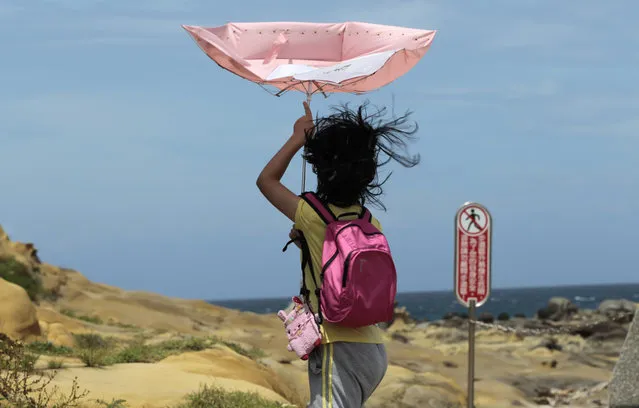
A girl struggles with winds from approaching Typhoon Matmo along the eastern coast of Keelung, northeastern Taiwan, Tuesday, July 22, 2014. The eye of Typhoon Matmo is expected to make landfall in eastern Taiwan early Wednesday bringing heavy rain and winds with gusts over 130 kilometers (85 miles) per hour. (Photo by Wally Santana/AP Photo)

A girl struggles with winds from approaching Typhoon Matmo along the eastern coast of Keelung, northeastern Taiwan, Tuesday, July 22, 2014. (Photo by Wally Santana/AP Photo)
Details
05 Aug 2014 12:46:00
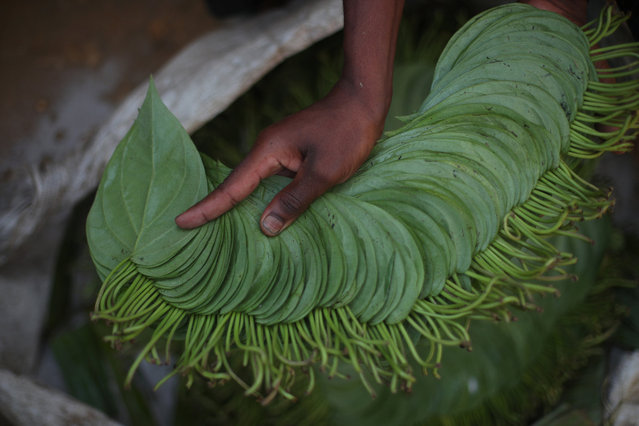
Faruk, 17, a Rohingya refugee trader holds betel leaves which are on sale at a stall in Palong Khali refugee camp near Cox's Bazar, Bangladesh, November 3, 2017. He left his village in Myanmar when the military opened fire towards the Rohingya. “I buy this betel leaf from Palong Khali market, in one bundle there are 160 pieces, I buy it for 80 taka and I sell it for 100 taka. Bangladeshi's and I sell for the same rate in the camp. Outside in the local market it is 80 taka per bundle. My problem is that I don't have money so I can't buy anything to eat, I can't buy fish to eat”, he said. (Photo by Hannah McKay/Reuters)

Faruk, 17, a Rohingya refugee trader holds betel leaves which are on sale at a stall in Palong Khali refugee camp near Cox's Bazar, Bangladesh, November 3, 2017. He left his village in Myanmar when the military opened fire towards the Rohingya. “I buy this betel leaf from Palong Khali market, in one bundle there are 160 pieces, I buy it for 80 taka and I sell it for 100 taka (1 Bangladeshi Taka = 0.012 US Dollar). Bangladeshi's and I sell for the same rate in the camp. Outside in the local market it is 80 taka per bundle. My problem is that I don't have money so I can't buy anything to eat, I can't buy fish to eat”, he said. (Photo by Hannah McKay/Reuters)
Details
27 Nov 2017 08:54:00
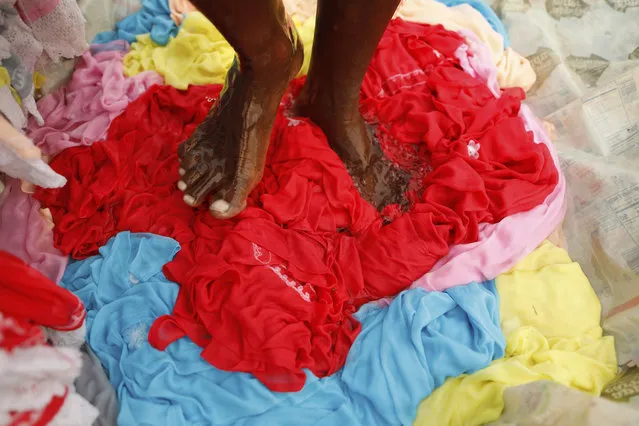
A dhobi, or a washerman washes cloths on the banks of the River Gomti in Lucknow, India, Saturday, September 12, 2020. Dhobis are traditional laundry workers who wash clothes by hand and dry them in the sun, an occupation which has been in existence for generations. Most cities in India have a Dhobi Ghat, or washermen's area, where the city's pile of clothes is laundered. This practice is still popular in India, despite of modern technology. Around 1,000 families work in Lucknow's Dhobi Ghat. However, in light of the novel coronavirus, their wages have decreased drastically. With each family earning around US$100-200 per month. (Photo by Rajesh Kumar Singh/AP Photo)

A dhobi, or a washerman washes cloths on the banks of the River Gomti in Lucknow, India, Saturday, September 12, 2020. Dhobis are traditional laundry workers who wash clothes by hand and dry them in the sun, an occupation which has been in existence for generations. Most cities in India have a Dhobi Ghat, or washermen's area, where the city's pile of clothes is laundered. This practice is still popular in India, despite of modern technology. Around 1,000 families work in Lucknow's Dhobi Ghat. However, in light of the novel coronavirus, their wages have decreased drastically. With each family earning around US$100-200 per month. (Photo by Rajesh Kumar Singh/AP Photo)
Details
25 Sep 2020 00:03:00